

This episode is a personal conversation between Michelle and Yann (a.k.a. WeCultivate’s favorite unpaid intern).
Recorded early in their journey of working together, this conversation reflects on language, learning, and lived experience through Yann’s background growing up outside major cities in France. Together, they unpack common assumptions about France, including the tendency to collapse an entire country into Paris, and what gets lost when we rely on shortcuts instead of context. The discussion explores what it means to learn and use language without constant access to technology, how formal language education often prioritizes correctness over communication, and why perfection can quietly block participation. They also reflect on how identity, confidence, and self-expression shift across languages — in work, relationships, and everyday life. Rather than offering conclusions or prescriptions, this episode creates space for nuance, dialogue, and curiosity.
Like many WeCultivate episodes, this one is a reminder that language learning doesn’t happen in a vacuum, and that understanding comes from individual lived experience, not stereotypes.
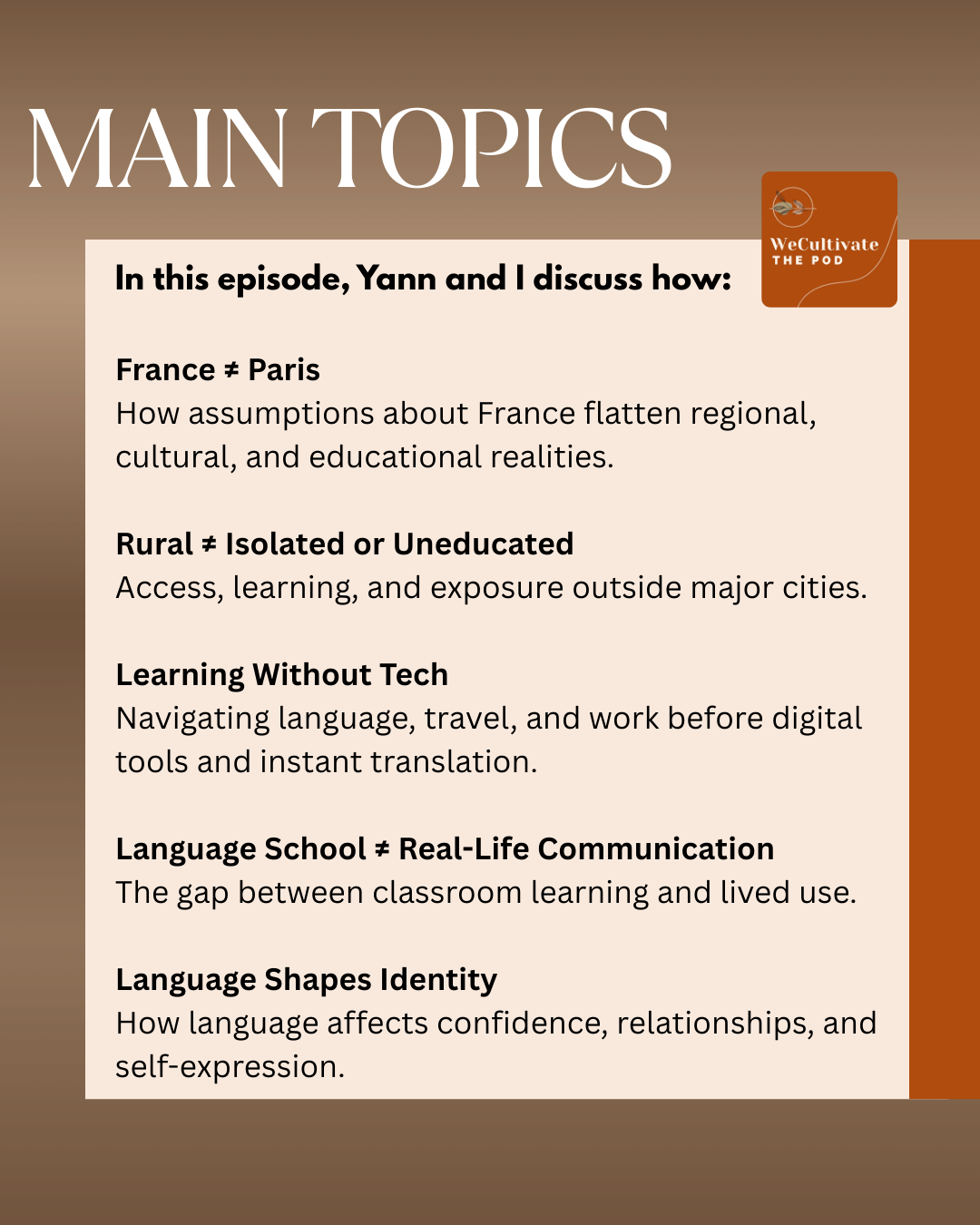
Main Topics
France ≠ Paris
How assumptions about France flatten regional, cultural, and educational realities.Rural ≠ Isolated or Uneducated
Access, learning, and exposure outside major cities.Learning Without Tech
Navigating language, travel, and work before digital tools and instant translation.Language School ≠ Real-Life Communication
The gap between classroom learning and lived use.Language Shapes Identity
How language affects confidence, relationships, and self-expression.
Recurring Themes
Gap between theory and practice
Fear of making mistakes
Cultural rigidity vs. adaptability
Language as a bridge, not a barrier
Dialogue as growth
Actionable advice (practical moves for listeners)
Audit your “country shortcut.” When you catch yourself assuming “France = Paris” (or any country = its global brand), pause and ask: What do I actually know beyond the image?
Define the purpose before you learn. Write one sentence: “I’m learning English/French to ______.” Then choose practice that matches that purpose (work meetings, neighbors, dating, travel, etc.).
Practice “middle ground” communication. Train yourself to reduce language on purpose without shame: keywords, simpler grammar, shorter sentences, confirmation checks (“Do you mean…?”).
Stop waiting to “feel ready.” Add low-stakes exposure. One conversation/week where the goal is not correctness but connection (even if it’s “push / pull” level language).
Name the hidden rule you’re following. If you freeze, ask: “Am I afraid of being wrong, or afraid of being judged?” Then choose one small risk: ask for repetition, ask for simpler wording, or say “I’m not sure I understood... can you rephrase?”
Protect conversations from “teacher mode.” If you’re in a relationship / friendship dynamic, agree on a signal:
“Correct me now” mode vs “Let me finish” mode. Correction only when meaning is at risk.
Related Resources (Many listed here only in French for space concerns. Please translate into your preferred language.)
Below, you'll find a few links tied to the topics we discuss in this episode. WeCultivate does not unequivocally endorse the material or its creators beyond a cursory review of the material presented. They have been shared here on behalf of our guest to encourage further exploration and independent learning. This is a dynamic list and subject to updates as time goes on. If any of the links become broken, or if you have a suggestion for the list, please let us know. Thanks!
Les Français sont-ils mauvais en langues étrangères ? Un état des lieux en Europe | Nord Littoral (article de presse régionale française) /// Translation: Are the French bad at foreign languages? A survey in Europe (Not the same article in spite of the name.)
Article s’appuyant sur des données européennes (souvent issues de l’Eurobaromètre) pour comparer le niveau de pratique des langues étrangères des Français avec celui des autres pays européens. Il met en évidence un retard relatif de la France, notamment en anglais, malgré un enseignement obligatoire précoce. Cet article est à mettre en relation avec les analyses plus pédagogiques proposées par Halley Language et CoursLangues, qui interrogent non pas seulement le niveau, mais les méthodes d’enseignement et les représentations culturelles liées aux langues en France.Les Français sont-ils vraiment mauvais en langues étrangères ? | Halley Language (organisme de formation linguistique) /// Translation: Are the French really bad at foreign languages? (Not the same article in spite of the name.)
Article de vulgarisation analysant les causes possibles du faible niveau perçu en langues étrangères : méthodes scolaires, peur de l’erreur, manque de pratique orale, poids culturel de la norme linguistique. Ce contenu complète bien l’article de Nord Littoral en apportant une lecture qualitative et pédagogique, centrée sur les apprenants adultes et professionnels, plutôt que sur les seuls chiffres.Les Français sont-ils nuls en langues étrangères ? | CoursLangues (plateforme de cours de langues) /// Translation: Are the French bad at foreign languages? (Not the same article in spite of the name.)
Article au ton volontairement provocateur, qui démonte certains clichés tout en soulignant les limites du système éducatif français et l’importance de la pratique immersive et contextualisée. Ce lien fait écho aux deux articles précédents mais adopte une approche plus marketing. Il reste néanmoins utile pour illustrer la perception sociale du problème et le discours des acteurs privés de la formation linguistique.Les langues vivantes étrangères et régionales dans le système éducatif français | Ministère de l’Éducation nationale (site officiel) /// Translation: Modern foreign and regional languages in the French education system
Page institutionnelle présentant les objectifs, les cadres pédagogiques et les orientations officielles de l’enseignement des langues en France, de l’école primaire au lycée, incluant les langues régionales. Cette source apporte le discours officiel et théorique, à comparer avec les constats plus critiques de la presse et des organismes de formation privés, qui soulignent un écart entre intentions institutionnelles et résultats réels.History of the French Language | YouTube – vidéo de vulgarisation linguistique
Vidéo retraçant l’évolution historique du français depuis le latin jusqu’au français moderne, en abordant les influences politiques, sociales et culturelles. Cette ressource éclaire le rapport identitaire fort des Français à leur langue, ce qui peut indirectement expliquer une certaine résistance ou insécurité face aux langues étrangères.La répartition de la population française | Assistance Scolaire (site pédagogique) /// Translation: The Distribution of the French population
Ressource éducative expliquant la distribution géographique de la population française, les zones densément peuplées et les dynamiques territoriales. Utile pour contextualiser la diversité linguistique et culturelle du territoire, en lien avec les langues régionales évoquées sur le site du Ministère de l’Éducation nationale.Discover the Hidden Gem of France: Aveyron (AKA Yann's hometown region. He's very proud and wants you to see what the landscape is like.) | YouTube – vidéo de promotion touristique
Vidéo immersive présentant l’Aveyron comme une destination encore préservée du tourisme de masse. Elle met en avant des villages médiévaux (comme Conques et Belcastel), des paysages naturels spectaculaires (gorges, campagne vallonnée), les marchés locaux, la gastronomie et un art de vivre rural axé sur la lenteur et l’authenticité. Cette vidéo complète efficacement les pages du site officiel de Tourisme Aveyron (FR et EN) en apportant une dimension visuelle et émotionnelle. Elle est particulièrement intéressante pour analyser la mise en récit touristique d’un territoire et la manière dont une région française est présentée à un public international anglophone, en insistant sur l’« off-the-beaten-path » et le slow travel.Gastronomy in Aveyron | Tourisme Aveyron (English Version)
English version of the gastronomic content, intended for an international audience. Highly relevant for analyzing cultural and linguistic translation, as well as the topic of local (culinary) identity, adapted for a non-French-speaking audience.Le Cours des Glénans – Manuel de référence de la navigation | Les Glénans (association de voile) /// Translation: The Glénans Course – Reference Manual for Navigation (Note: This is a nod to Yann's first job as a sailing instructor)
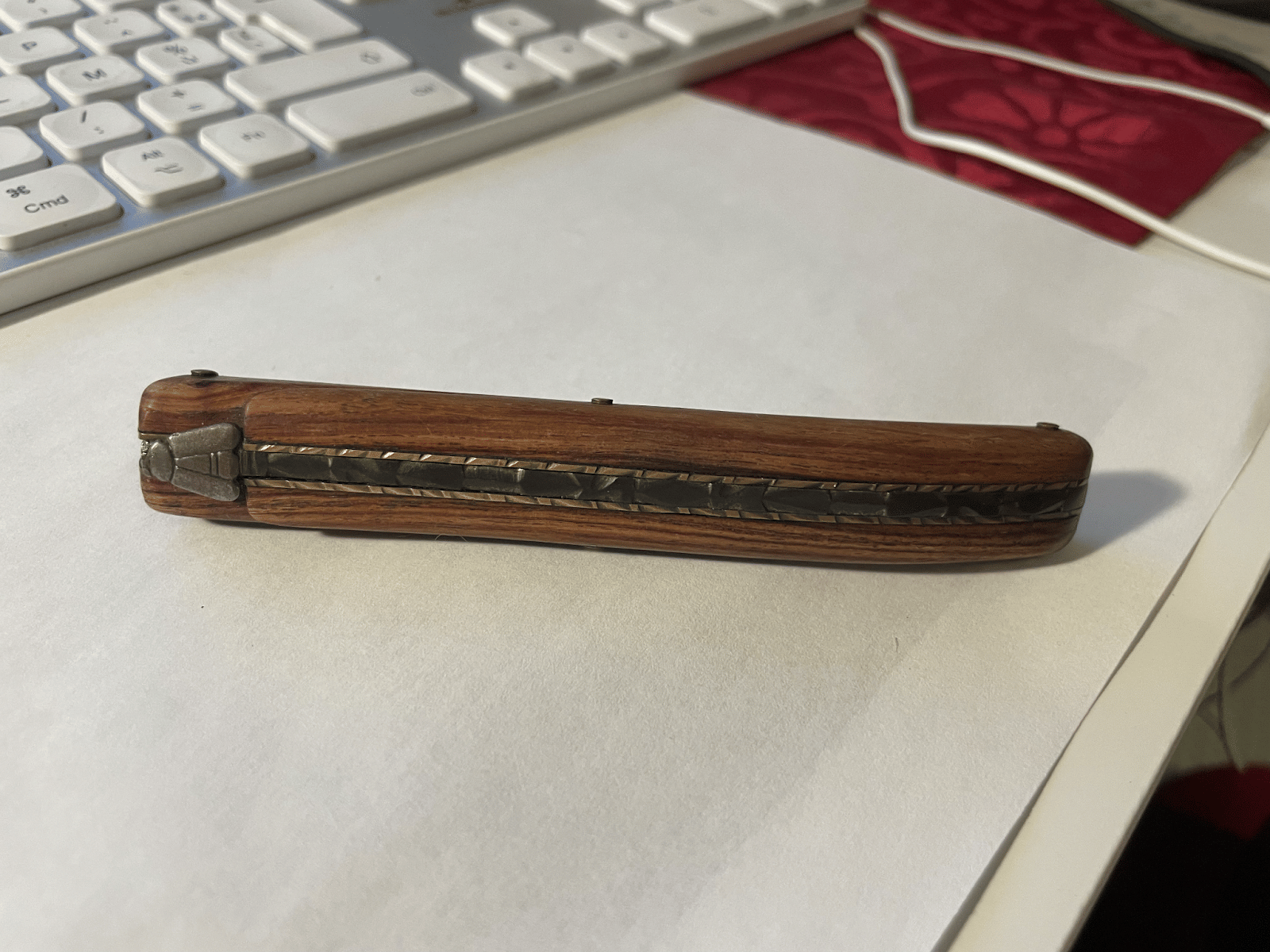
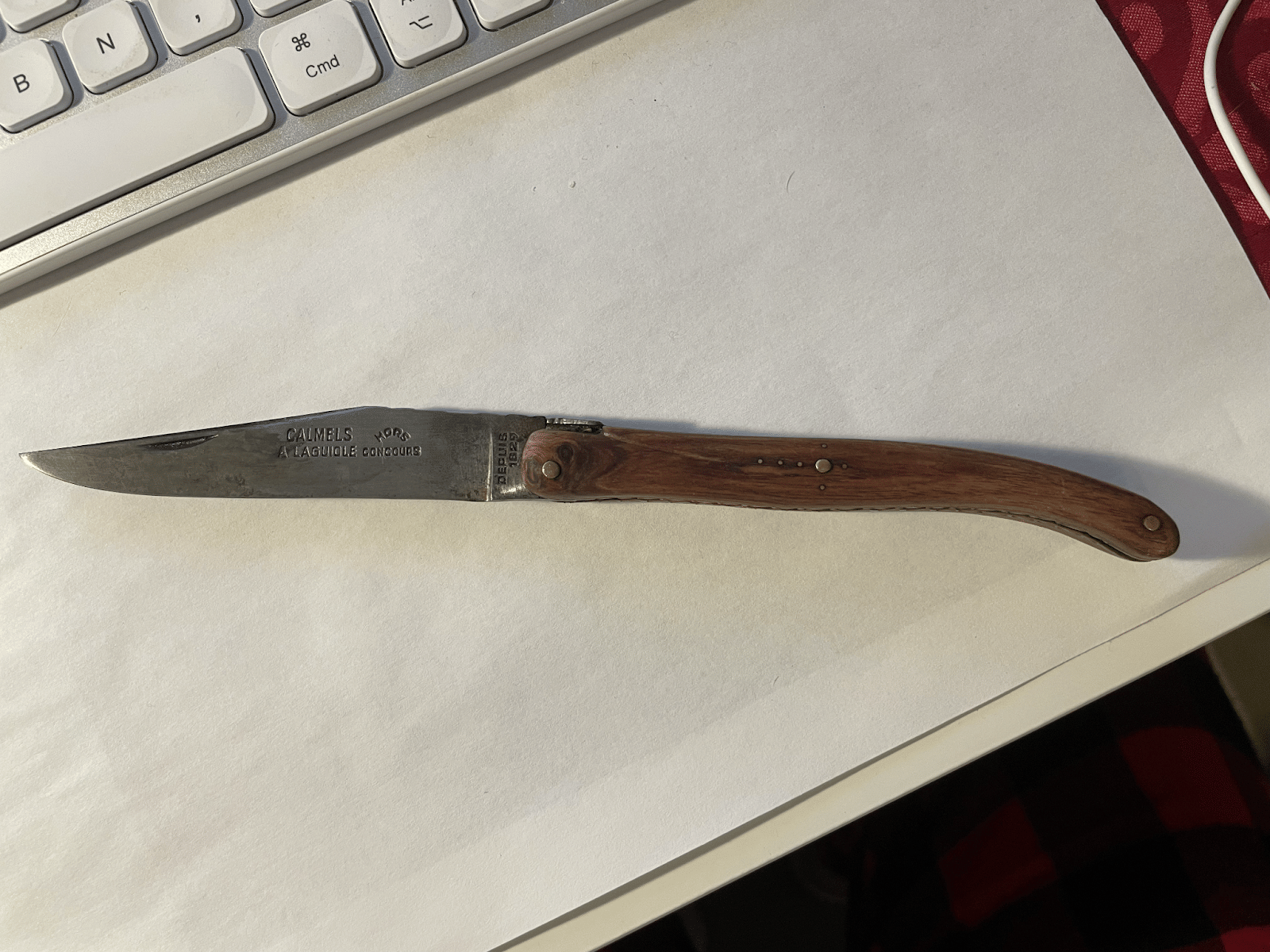
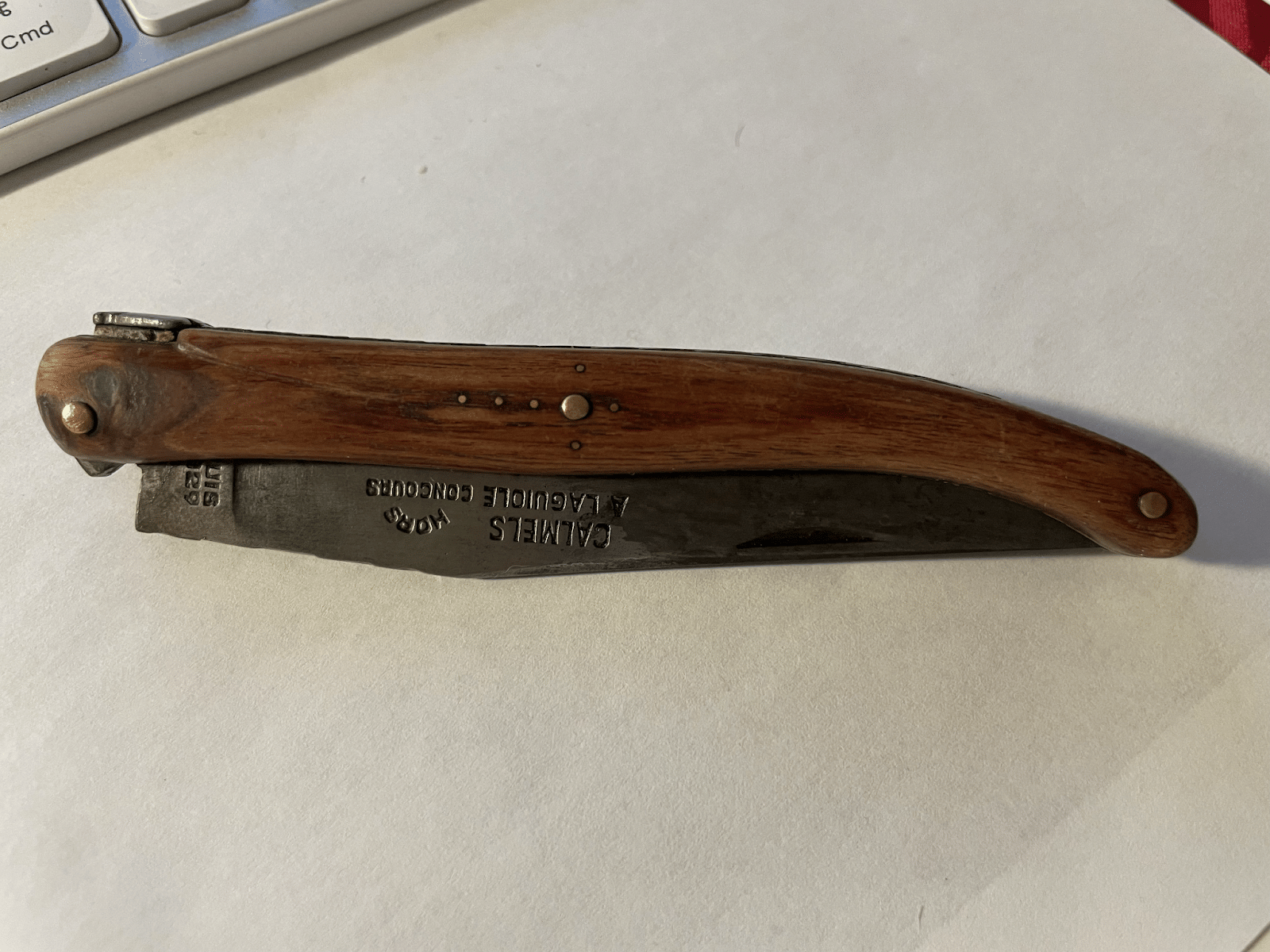
Ouvrage de référence sur la navigation à voile, mêlant technique, pédagogie et culture maritime. Ce lien s’inscrit davantage dans une logique culturelle et pédagogique, montrant une autre forme de transmission du savoir, très structurée mais aussi expérientielle.History of the Laguiole Knife (Yes, Yann's pocketknife mentioned in the episode! Pics below) | Couteau-Laguiole.com
Page présentant l’histoire du couteau Laguiole, depuis ses origines au XIXᵉ siècle jusqu’à sa reconnaissance internationale. Elle évoque l’évolution de sa fabrication entre Laguiole et Thiers, les symboles emblématiques (abeille, croix du berger) et les enjeux liés à la protection de son appellation. Cette ressource offre une synthèse claire reliant artisanat, identité régionale et questions juridiques. Elle s’inscrit dans une continuité logique avec les contenus sur l’Aveyron, en illustrant comment un objet local devient un symbole culturel et touristique.
Video version of the conversation here:
Full Transcript
This is an auto-generated transcript. There may be mistakes and typos. For the best results, please navigate to the transcripts generated alongside the episode on Spotify, Apple Podcasts or Substack.
Michelle (intro):
So this episode is very special. If you've read the title already, you know that it's going to feature Yann, our favorite unpaid intern and only one at this moment. I wanted to mention a couple things before we jump in. First, this episode was recorded about a little over a year from the time that you'll hear it, meaning it was actually at the very beginning of me bringing him into all of this. It was only a kind of couple weeks into the time that we spent trying to work together. I actually had the hardest time editing it because I feel like I was watching two people who were time capsuled a little bit. I mean, the conversation is still very relevant. It's very funny because this isn't just someone I'm interviewing. This is somebody I know and I am growing with every single day. And I guess in that way it's really, really special also to be able to see our growth in how we just have consistent dialogue on these topics, even just here at home.
In typical, WeCultivate spirit, I hope that you will allow this episode to be a place where you can examine some potentially hidden biases, assumptions. I think we often think of biases like a bad word. We all have biases. Let me be very, very clear. We all have them in ways that we didn't know. We all have unconscious leanings towards things simply because we are the product of our education, our surroundings, our environment, our own brain and values as well. I'm not sure where this mentality exactly came from, but a lot of people seem to equate France as the country with the city of Paris. And yes, Paris is the capital city. Even if we just consider the larger Paris metropolitan area that only accounts for a small minority of the country of France. And so I kind of run into some issues in my personal life when I talk to people and they just cannot break from this idea that my husband is from some tiny village, which okay, technically he'll talk about where he's from, but almost that his experience is somehow an exception to the rule or a one-off because he happened to be out in the middle of nowhere.
I don't think people do enough of their own research when they think about different countries. This is probably a pretty universal concept. While I can't say that Yann speaking for the whole country, that can't happen for anyone. His sort of background profile in terms of being from a more rural area, what he had access to language wise, and we go over all those aspects, those are all things that I have almost had to advocate for or I don't know, kind of push to provide space for. Because many people that I talk to just in my private life seem to think it's up for debate. I think that not enough people think about how countries might present themselves a certain way. They might have certain exports or a certain image they want to show to the world. That does not mean, for instance, France is known for a couple of things, including luxury items and fashion.
That does not mean that every single person is walking around with Louis Vuitton bags. And it's kind of mind blowing to me. And again, this is coming from people who I just would never have expected this from. So that's one thing. That's what I wanted to say. The second is that Yann, like all of my guests, did put together a related resource list for you all, and on that list, you will actually find pictures of a knife that he did not get to mention during our recording. So this knife is actually really important, not only in his family but in the region. It has massive historical significance, but also traditional significance because of the fact that for instance, where he's from in particular in this region and he's included many links on the region, there's a whole YouTube video also of how beautiful it is and so happy when he found it.
It's like one hour long, just let it play. Just wash the deer. But this is a pocket knife that is customized for the recipient and you get this knife when you are generally a kid. But when you've learned to read personally, I just thought it was the most adorable thing. I'm not going to lie. The first time he took out this knife and I was like, whoa, what is this? I was just like, oh my God, it's so wholesome. So I encourage you to go online during or after the episode and take a look at the pictures and the resources you'll actually see Yann, very, very soon again, because we recorded a Valentine's Day episode together, do feel free to reach out to him directly to let him know what you thought of his episode. And I really, really hope you all enjoy, not just because he's the unpaid intern and not just because of our relationship or anything. Just I hope you enjoy because I really believe that each one of us has these stories and thoughts to share. And I encourage you to this year also find your own. So here is my conversation with Yann.
Michelle:
Well, I am very pleased to welcome a very special guest today, someone who is a complete stranger in my life. Totally kidding. Of course. Welcome Yann. Thank you for being here. Thank you for doing this.
Yann:
Hi everybody. Thank you to invite me in your podcast. I'm honored.
Michelle:
You're honored. Well,I think that it makes perfect sense actually, given that so much of our life. Well first of all, because I decided to go on this whole entrepreneurial journey, so much of your daily life is filled with me talking about these topics. And since we do regularly have conversations on these different issues, I figured it would make sense to actually spotlight not just your background and story, but all your thoughts. Also because we might be married, but we are certainly different people and we live different things. So why don't we have you introduce yourself a little bit, let everyone know who you are.
Yann:
Oh, okay. What can I say? First I’m your husband, and I'm working for WeCultivate now since some weeks
Michelle:
Officially.
Yann:
But I always supported your work and I always been behind you, and so I know what's happening more or less since two years, and I know this project. About me…. What can I say? I'm from France. I think now everybody knows, but I am saying it because I think it's relevant saying I'm from France because it involves a lot of cultural things and I think we are going to talk about it a little bit later. Something more personal, but I worked with children during many years and not as a teacher, but as an educator. And so when you are talking about education or culture or whatever it is, I have some echo in my mind, in my head because yeah, of course it reminds me a lot of things that happened in my life, in my professional life before. So we are really, I think complimentary and it's really interesting because yeah, we don't see things absolutely not sometimes with the same prism. And I'm really happy now to join this journey with you.
Michelle:
I just want to clarify that using a prism, I think it's reflective. I know you, we are using different prisms to see the same topics, meaning we don't approach it the same way, but it's supposed to be that, right? Because every person, it's not about whether or not you and I agree on something, right? We have dialogue constantly because our individual prisms were shaped by our individual life experiences. That's our lens, that's our filter and how we see the world. So let's go a little bit into your education and your background with learning. So formative education, thinking academic things, and also how you've experienced languages and learning as a whole.
Yann:
Oh, okay. I have a really traditional education in France. So you are obliged to go to school in France like in a lot of country from 3 I think or something like that until the age of 15 or 16. And after you can choose to stay at school and more or less at 18 you have what we call “le baccalaureat”. It's like school grade and you choose more or less after if you go to college if you want to learn work like
Michelle:
A trade I think.
Yann:
Yeah. So it's very globally before college.
And so what I've done, it's in between college and studying real work. It's what we call technical university diploma. And so I've done that. It's two years, but also in between that and it's not in between. During that as a child I had the chance to learn sailing and I went to the same place during more than 10 years learning sailing. And after I became a trainer. And because it was a camping and there was a lot of tourists, there was a lot of people talking different languages. So most of them were German or from Netherland or from Belgium or whatever or England. And so I really saw very fast how it was interesting to at least learn some vocabulary and trying to communicate. It was funny because it was at the same time I discovered that I had a particular link with children. It was quite easy for me to communicate with children, to teach sailing with children and also different languages. So at the same time, I was around 19, 18 and I totally understood, oh, it was important for me to communicate. And it was at this age I was very shy before and it was at this age also that I opened myself to the world
And I understood that the most important is communication, whatever the type of communication, however you can do that. The most important it was to create the link and in between people and try to learn and teach from other person. And later just, yeah, I was something like 20. I had to find my way and I didn't know what to do. And so I decided to travel a little bit and I spent one year in England, in London for working in hotel or restaurants, whatever. And again, what I saw and what I understood it was whatever my level of English, my level of in English and language, the most important is find a way to communicate and to understand each other. So yeah, I think as a French people, I was confronted more than usual person to other languages.
I have to remind people that in France until recently, you don't speak at all in school. When you're learning a language, you learn more to write, to read, to not even understand. It's just really everything that is oral is really secondary. So in this different experience, I had to find the resource because I studied English at school, but I never applied it. So I had to find a way to take this thing and to apply it. And I think it's something that it's a real huge gap in between formalized education and real life. And it's something that I found really interesting in Cultivate that trying to fill this gap, and it's not trying to fill this gap, it's knowing that there is a gap, a huge gap in between traditional education and real life. And it's like you try to heal. I don't know to say, you know what I mean? I don't know all people you work with and because there is privacy and everything and you keep that. But what I understand a little bit that is people don't have a good education, better of English than me a lot, but when they are confronted in real life in specific situation like work or friends or whatever or family or whatever, they're like, okay, I have a background. I have grammar, vocabulary, everything, but I don't know how to apply it. I remember when I was teaching sailing, I just knew how to say the different parts of a boat and push and just push and pull.
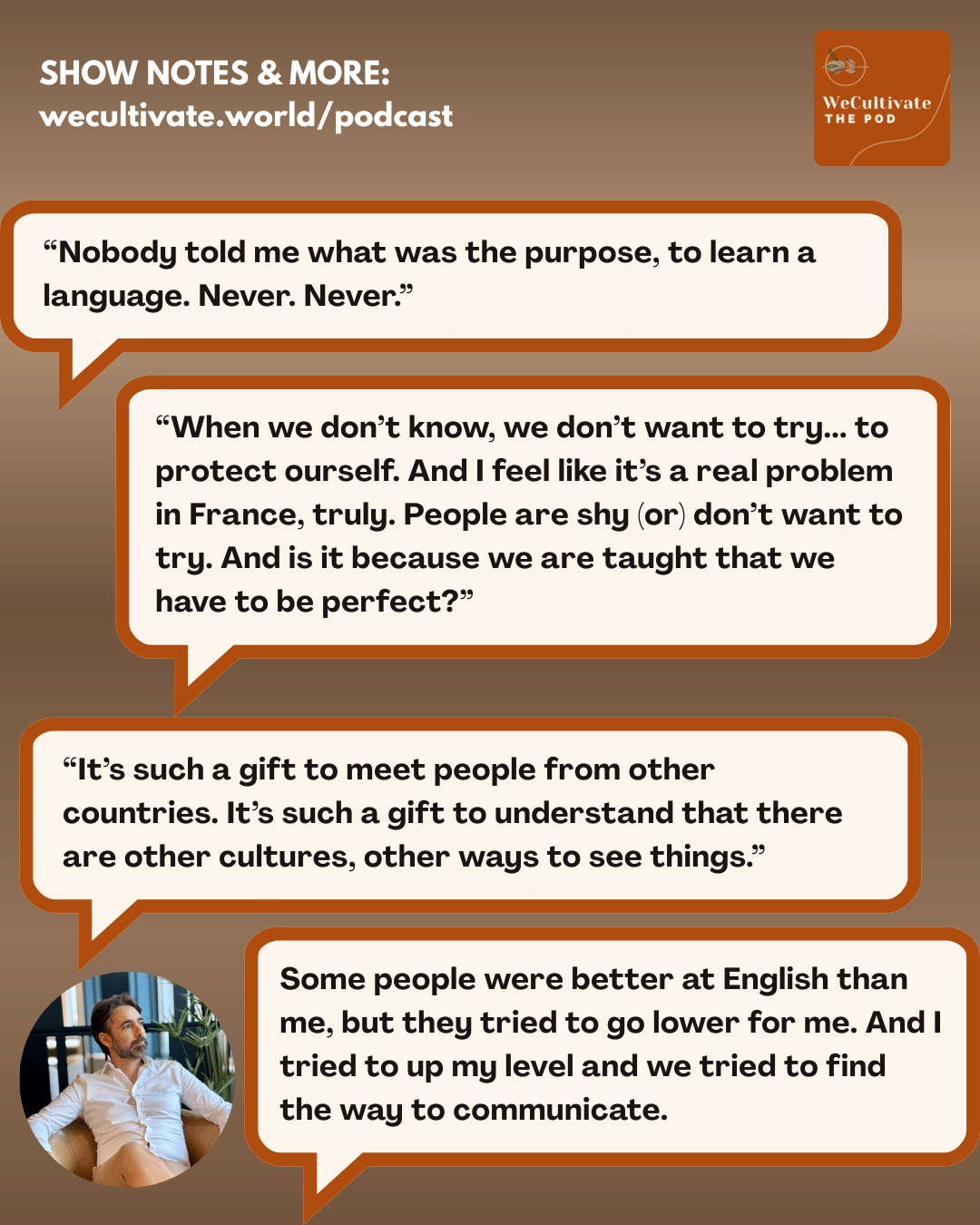
It was very, very basic, basic. I didn't make any real sentences. I was just like, oh, push, push. I don't even remember now because I don't use it anymore. And it was not even the right, nautical terms, but people understood me and it was the most important. And we didn't need to have a high level, we just needed to find the way to understand each others. So some people were better at English than me, but they tried to go lower for me. And I tried to at my level and we try to find the way to communicate
Michelle:
A middle ground,
Yann:
A middle ground. And it's really that if we're talking about languages in general and language and English, for me especially, it's that it's really what is interesting. And I think I wrote something in the newsletter recently about that. It's what amazes me is that is just finding a way to communicate and to understand each other.
Michelle:
So I want to highlight a few points just for clarity and just for context so that people can better understand all that you've overcome through your life
As it pertains to language, as it pertains to backgrounds. So number one, when you say travel, you travel to London. I think it's important to number one, highlight. You are not from a region of France that is anywhere close to Paris. So we're not talking about a big cosmopolitan background with a lot of different exposure and influence. And I'll let you kind of explain where you're from originally, but you often joke with my friends that you grew up between two cows because that's basically, and I've been there plenty of times, but I think it's important to clarify because many people do associate travel with wealth with means. None of us choose how the families we were born into or the backgrounds that we had. But I think I just want to clarify that you first of all took it upon yourself to seek out an experience like that and it was not some language immersion, do you know what I mean? It wasn't some sort of specialized thing. It was, I'm going to just move to London, put myself there. You put on a suit, you went door to door.
Yann:
Yeah, it was hard. It was a hard experience because I really didn't know any work. I didn't know the language really well. So it was really throwing myself in a total new experience
Michelle:
And people weren't particularly kind, even if it's the country next door. Well, you guys have a long history, long, long, long history of disliking each other. Another thing I want to highlight is actually the lack of technology presented to you throughout this time. I don't want to, for people to misunderstand to this day we're recording right now, it's the end of 2024, about to be 2025. Correct me if I'm wrong. From what I understand inside of the standard public education system of France, the use of computers and the use of basic, I'm not talking technology, I'm just talking computers at this point, technological literacy, but in the most rudimentary way, it is not a part of the national program.
Yann:
It is
Michelle:
Or it's
Yann:
But quite late in comparison to other countries. And it's very, very, very rudimentary. Most of the children knows more than the teacher. But yeah, It's true, It's true because the educational system is not even updated.
I dunno how to say that, but it is late. I mean now I think teenager everywhere in the world know better than our French teacher. I mean how to use Instagram or whatever apps or whatever, Google drive or whatever. And I was not confronted to that. So I will come back on my history. I come from southwest of France, quite the countryside. I was a little bit different because my parents were not farmers and they have quite not high education but higher than the regular people living in the country at this time.
So I was educated a little bit different than my friends. Most of them were working in the fields with their parents going to school and their goal in their life was to be farmers after their parents. So yeah, I was more open to that. But in that I was still in France, so not really confronted to social mixity, to even race mixity or whatever. Really the countryside. So I dunno how, but we,I am saying we because I have also a brother, we try to open us and we were maybe more open than a lot of people about all this question about languages and everything. But also very late in comparison to other country on all of this topic because it was French, it was countryside and France is still quite late about all this question. And yeah, it's another topic, but if I can just say a word about that, I feel like France hide itself behind laws and saying, oh, racism is forbidden in the law. So now, the problem is solved. Because It's in the law. It doesn't work like that.
And we can see that. The last election, the far right just was bigger than ever. So yeah, we have a lot of work to do. I grew up in this environment like, oh yeah, everything is fine, everything is good. We are not racist, we have a good education and everything. But finally, and I'm more than 40 now, I understand just now how late we were and oh, it's not magic. But I was lucky to advance a little bit more than a lot of my friends and close friends also on all these topics and especially about language. Well, it's really a big topic. A complicate one…
Michelle:
And tying it back to the absence of technology. So the reason I wanted to clarify about, and I didn't mean to say there nothing is just no, If we…
Yann:
We are late
Michelle:
If we compare what is sufficient for even 20 years ago, that was the biggest shock to me, I think just realizing that there is this massive gap, however, so definitely a different episode, different topic for a different day, talking about how to improve education systems. And what I want to focus on is the fact that you didn't have say Google translate, smartphones weren't even a thing when you were in London. So the point I want to make is you had to do it the old fashioned way. Granted you're not ancient, but it was a different time and still the country is due to the fact that it is a little bit delayed in some areas. It is still a different time even in this day and age. So I want to just stress that again, I don't know how you and even your brother managed to be, you just said it yourself a little bit ahead in a way. I don't know how that happened. Do you know what I mean? I find it so incredible and spectacular. And I just kind of wonder out of personal curiosity, what those key factors were to kind of catalyze your whole journey to now.
Yann:
Just to put in the context about technology and you remind people. I had my first mobile phone, it was not a smartphone when I came back from London. So just for people to see in time.
And the difference with my brother, we have five years old gap, so he knows more, a lot more about computers things and technologies than me. And the thing that I think helped us a lot, that was my mother was working in the school and with a lot of technical people, it was a technical school and so there was a lot of people that were working on computers a little bit. So they pushed my mother to buy a computer. Even at this time she didn't know how to use it. So we had our first computer quite earlier than most regular people, but nobody knew how to deal with that. And so for me it was already a little bit late because it was a time I left home to go to study and to go in England and everything. But for my brother, he spent hours in front of the computer and learning by himself. Totally. And just to remind people it was computers, you had to wait 10 minutes to download one picture and it was horrible. I think you had a lot of questions and that's it. And most of the people that know how to use computers and technology in France, just learned it by themself. Of course there is school after, there is university, there is technical studies and everything. Of course, again, I was the kid. All these things came at the same time, the level of education of my parents, context of my mother work because if she was, for example, I don't know a teacher, but in a normal school maybe we never had a computer at home. So yeah, I think we were lucky. And also I think we grew up in a really open mind context. And even if of course the generation of my parents, older generation had cliche about a lot of things, they were also able to open a little bit their mind. And that's how I discovered Hiphop also or groups, music groups that my mother was listening and because she had this idea that everything can evolve and that's what I've done and I tried to do when I was working with children to just open, not to say there's something good, something bad, but just say there is so many ways and just try to deal with everything and open your mind and don't spend too much time in boxes.
Don't spend too much. Of course you need to learn vocabulary, of course you need to learn grammar at a moment when you learn a language. But it's not only that. So everything is linked. And so the link I'm making with my own journey that is like I think I grew up in a world, in a world, a very small world, family world that people were more or less open and try to accept all the things. I'm going to give an example for a lot of people, it's going to be like crazy. A little town in the country. The first fast food when it opened, it's a very traditional part of France everywhere in France in fact.
Speaker 3:
Yeah,I was going to say this should not be an exception. You guys represent people. It's very traditional
Yann:
And I am in a family where we like our traditions, we like to do that, but we are not close. And remember going with my mother or my father, I don't remember exactly which one, but going to this fast food and try hamburgers and cheeseburger, my first cheeseburgers and everybody was like, what is it? No, we don't know that. So we don't try that. And I feel like it's a real problem in France, truly. It's when we don't know, we don't want to try to protect ourself. We are still saying, oh, I don't want to try because we are the best. And in fact, no. It’s just my feeling that people are fearing things that are new. And in languages particularly,
I can feel exactly the same. We learn English at school, but people are shy, don't want to try. And so when you are someone coming in France and trying to communicate, if you don't know how to speak French, so you train English and it's normal to try to English because most of half of the population learn basic English at school and people don't want to speak English. And is it because we have an education, we don't talk at school or is it because we are taught that we have to be perfect?
And I really think that in every language that is taught in school in French, the first lesson should be like, okay, what is the goal? The goal is to communicate or we communicate and I think we should spend more time in the beginning of learning language at school. At school, I'm talking at school, make people understand that what is the goal to learn in your language? I never had that at school. Never, never. Nobody told me what was the purpose, to learn a language. I was lucky that at home people told me, yeah, it's because if you travel or to understand, my parents listened to a lot of music. So my first lyrics I understood it was dire straits and Pink Floyd and so Bob Marley. But if you are in families, they don't do some musicor only French music, they don't travel. That was what happened to most of my friends when I was living in this part of France. They don't know why learning English, if I talking in general, I think we have a lack of in the education in France at least, telling what is the purpose of what you are learning. Like mathematics, why you're learning mathematics?
Why you're learning French? I mean “orthographe”, grammar, spelling, why is it so important? Why is it so important? Or why could be important? It can be important. And it's all about communication, even mathematics for me, even physics even, it's all about communication. It's just knowledge and knowledge help everybody to understand each other. That's why I mean if people know you a little bit, you have studied a lot, lot of different things because when you like to communicate or when you like to learn, you understand. And if you understand the linking between learning and communicating, it's really, really important.
Michelle:
I think it's actually you're echoing something that is quite universal, but that doesn't devalue how important it is. I think that many times people hear, oh, it's a problem in that country. Oh, well, it's also a problem in mine and this one and that one, and therefore it's almost as if the conversation stops there. And what I want to point out is just because you see a problem everywhere doesn't mean that the problem is therefore the solution. It should stay that way. It's almost something that I've never quite understood. And when I talk about improvements that say the US might need to make beyond education or on other social policies and people say, oh, well it's worse in my country, or
That's not my purpose of bringing it up. My purpose is to find solutions. My purpose is to drive us towards progress or my purpose is to have a conversation about how we might be able to do that. And it's almost as though just because we see this problem everywhere, and it is international by the way, the way that languages are taught is very weirdly similar in almost all countries, except I think we found Finland is kind of like an exception and a couple other isolated cases, but it's almost a little bit shocking how many times you see the same problem replicated over and over and everyone just goes, okay, well that's the way it is and the end. And we've therefore resolved it because we all share the same issue. Something I want to highlight also something I would just want to go back two things.
One is that you mentioned your family being open-minded. So I've gotten to know your family a bit. It's not just, that is not a fixed state of being. It doesn't mean they're not traditional either. What I can say I appreciate about them, they're actually very traditional, in my opinion, very traditional. However, they have certain viewpoints. They as a whole, I'm not going to go individually, but they are also able to update and adapt their points of view depending on new information presented. And that could be through conversations with me, conversations with other people, conversations with you as part of the family, as you go. And you have different experiences and it's dialogue based, not you must think this, you must be that you must conform to this. That's what I appreciate so much. And I see it even in my family, which I just never thought as a kid this could happen because I'm not going to go into my whole background, but ultra traditionalism is often seen as such a fixed piece of a person's identity. And what I think is really interesting is I would argue that I actually was burdened more by tradition in a way, in my family structure. But it's to say that there is no conflict. It's about how you handle the evolution of a person's life or your mentality with it. Because many people say, oh i’m open minded, and in fact you find their definition of open-mindedness
Is A, B, C, D, and in fact, it's a directly contradictory position to take.
Yann:
And we can also say that open-mindedness could be another box.
Michelle:
Yeah, exactly.
Yann:
Absolutely. It could be really another box and other topics that really interested me. I see how much people, they say, oh, I'm open-minded. No, you open your mind in a certain box, but you don't accept other things. And I think it's the most difficult for, I think for everybody, we have limits and I think it's really hard to be completely opened-minded, but at least trying and understanding again why we, I think,
Michelle:
And this came up on a different episode, the responsibility of an educator and the lines and the boundaries around that. When I hear stories about how teachers are teaching their own opinion as part of the language, so this could come out as, okay, well, in English you have to do this because stupid English is so annoying and it thinks it's better than French. And do you understand what I mean? This additional information, which is in fact a personal opinion and formed by what I mean, it's not appropriate on the other side either. If I had a French teacher that said, oh, because all French people think this and that's why you have to learn it. I think it's the burden and the responsibility on that teacher to be very, very prudent in what they're choosing to convey. And if they want to make a personal opinion, they separate that from the material itself because way too many people absorb cultural biases this way, stereotypes that certainly have no place,
Yann:
And it's totally true. This kind of comment, of course, when you are abroad and you have to use English, you are traumatized. You are full of cliche of stereotypes and walls full of closed doors in your mind because oh, you have to be perfect and English people or American people are stupid or blah, blah, blah, blah, blah, blah. And just is it very complicated? And my God, I have so much things to learn in English, but that's the good part also that, and I'm not trying to sound like American people. I'm trying to make me understand that's a thing. So sometimes I catch some expression and everything because for me, I find it fun or I find it more relevant or more precise finally, or because we don't have the equivalent in French, so sometimes I'm like, whoa, it's perfect this word. It's such a gift to meet people from other country. It's such a gift to understand that there is other culture, other way to see things, other way to stink, all the way to feel even feeling because we don't have the same words, so we don't have the same patterns in our head the way we are doing sentence in French.
It’s really clear that sometimes it's a mess because we can make very, very long sentences. And I feel like in English and especially us English.
Yann:
Yeah. Very short. Very, yeah. I do think that the way we are thinking our language, I think there is in every language is when you use some words specifically, it means something very specific and that it's impossible to translate most of the time and very hard to explain sometimes. And we had this discussion yesterday about, okay, and for me it was like, yeah, okay, okay means it's okay
Michelle:
Yann. It's the way you're saying, okay, it's your tone.
Yann:
But again, the tone can be really different in and another language, again, it's really to a lot of things. And we don't learn that at school. Never. Nobody told me that language carried culture carried a different way to express or tone or whatever. And my God, I'm learning. I'm learning just now. I'm really learning about that. And I learned a lot about myself too, learning a language. I'm trying to learn also Mandarin Chinese and I see how much it's okay, it's complicated for different reason, tone and pronunciation and everything, but also the way they build sentences. And because I know you a little bit and you explained some words are really, again, have a very particular meaning that it's hard to translate. And so it's a concept. And so every language, with some words has their own concept,
Michelle:
If we can even just take it into French and English, and I look at certain words in an English context and those same words in a French context, and the meaning is totally different. So it's something even beyond just finding the right words or trying to translate them perfectly. Sometimes we have the exact same word, cliche. Cliche is a French word that we use differently in English. And you guys, oh, let's not even, let's not start all the words you guys have made up. Okay? So what I want to say is it's the conceptual kind of container that is dictated by the language that you're using, not intrinsic to the word itself. And I think somehow people are forgetting this or rather haven't learned it.
Yann:
And something really funny, we use in French, a lot of English words.
Michelle:
I don't think people know how many. By the way,
Yann:
That doesn't help a lot at all. Jogging or something.
Michelle:
Oh my goodness. Jogging. Jogging and footing. And I,
Yann:
It's so funny.
Michelle:
This is where I appreciate that we didn't remake new French words. We used, obviously we took French words and integrated them in, and there are so many historical reasons for that, by the way, why we call an appetizer an entree. It's like there are so many things we can search them all right? However, we did not create new ones that you'd have to learn in the place of the real ones. We might have different now, social and conventional understandings of specific words. For instance, cliche and stereotype are used very differently
In modern English speaking society versus in France, right? Okay, fine. However, I think there is an additional hurdle that was created by actually, I don't know if it's the academy or what, but I think the French speakers have to go through the fact that your English words are in fact not the English words that are used by English speakers. You have to get through that first, and then you have to get to the actual other side of understanding what is actually used and then deal with the fact that there are so many different varieties of English. Not only accents, but we have different words depending on where we are.
Yann:
And again, it's a language that I'm talking about English, but there is so many countries with different variation, different accents, so the same word can in UK or in US or in Australia can mean really different things. So every time it's not only about language, it's about everything around this language.
Michelle:
So what I would like to do is actually just kind of touch on something that you mentioned and is the obvious aspect of why you're on this podcast. You and I did not know each other to be honest, until more recently. I mean, I'm not going to act like we just met yesterday, but in terms of life history, it's one of the newer things to happen for us both. And for those who don't know, we just got married this summer. What I want to talk about now is the, how do I want to put this? The joys of being an international, bilingual, multilingual, multicultural couple. I'll say you did not speak English, anything close to this, first of all, when we first met, and also I for sure did not speak any French at that time, even close to anything. I mean, I could understand way more than I could speak, but having never studied it prior to moving. Yeah. So here's the thing I want to ask you to talk about all those early day experiences, meeting me, needing to understand that I don't exactly slow down for anyone when I talk, and I'm actually pretty fast in French as well, so it's just like my speed. That's true. But also the way that you manage that and navigated that and that sort of more recent journey with the English language. Can you talk a little about that?
Yann:
I will start with the beginning. I remember when we first met and the first time we dated, we had a lot of conversation about topics. We really appreciate each other. I remember we talked for hours, four or five hours, and I remember, oh, I was so tired. And so it was really difficult to maintain the flow, to maintain the focus. But I made this effort. Again, I don't feel like my English really improved since maybe a little. I'm not enough objective, I think, but for sure it's easier to understand, to follow you or other people, even if I don't understand word for words, everything, or to watch a movie in English or whatever. I'm reading less and less subtitles or the English subtitles most of the time. So yeah, again, to be confronted to a language, to culture, to a country, to everything is the key for me. It's really the key in learning. And today in our couple, it's still a challenge. Every day it's still a challenge because even if we were both native, being a couple is a challenge, my point of view, but I feel like a lot of people share the same idea of couple. We're not 15 anymore, so nothing Is perfect.
Michelle:
Butterflies, rainbows,
Yann:
Fireworks, the magic. So even if we're talking the same, exactly the same language, it's a challenge. It's a challenge. For many reason, family culture or the personal behavior or whatever is a challenge.
So adding to this language, it's a very big challenge. And I think again, the key is if you keep the channel, the channel open to a communication. I'm not saying it easy. You're not. I am not. You're nobody's 100% of the time open to keep the channel open. Oh, I know. But I think again, the goal is that is to learn and understand that you other one don't have the right word when you're speaking in French or you don't try to correct me every time. I'm not trying to correct you every time, but when we think it's very important because the nuance is too big or the mistake is too big, we're training to correct each other. I know that sometimes, honestly, I'm pissed off when you correct me too much and you're pissed off when I'm correcting you too much.
Michelle:
Especially when we're arguing, I'm like, this is not the time especially. But
Yann:
Most of the time it's because, yeah, of course it's hard to find the moment to interrupt the other one to tell him or her like, oh, you made a mistake. And so sometimes I lose the progression of my sword and everything.
Michelle:
Yeah, it's a partnership really.
Yann:
Partnership, yeah, this partnership working. And I think all the mixed couple
Michelle:
I know
Yann:
Feels the same sometimes.
Michelle:
I know.
Yann:
I don't think if anybody think it's easy is wrong.
Michelle:
Well, something like that was amazing when I was trying to find different connections in the city. And there was a moment where I started, we were dating, I was introducing you to different people, and there was a new person that I met who was like, oh, he's your boyfriend. Okay, well, so then you speak French. And I was like, well, what do you mean? And it's like, well, obviously if you're dating,
Yann:
That's why you're speaking, so
Michelle:
Yeah, that's why you speak so well now, right? So you're fluent now. And I'm like, oh, like that, right? Just magic. I kissed you and there we go. I speak the language. It's just I am going to still make an Instagram video of that. I know. It's like I
Yann:
Transmit French to you.
Michelle:
I know, I know. And here we go. You're a Mandarin speaker now. Or I just think it's a little bit insane, number one. But number two, not all couples who are from different linguistic backgrounds become us. Actually, I will say, and I don't mean to put us up on a pedestal, but I'm trying to say that we worked really hard to understand each other. The first time I heard you speak to other people in French, I think that's when I realized I wanted to lessen the gap between who I saw in English and who I saw in French, because I saw you so much more in French. And I heard it also when you spoke with me. I also saw it when you were with your family parts that I felt, of course you can speak in English, but I almost felt like you were filtering yourself so much because that's what we do.
Yann:
That's what we do. And I think we can't express totally ourself when we don't master language. Of course, I'm still trying to find my words and everything, so I can't really be 100% myself.In French I can be 100% myself. And also I think I discovered that some years ago that my personality in English is a little bit different. Even if I could express everything, even if my English was perfect, everything, my personality will be a little bit different. There is a little nuance.
Michelle:
You are so much in the words of one of our mutual friends. You're groovier in English, and I agree, actually you are I think a little bit more uninhibited in English surprisingly, in terms of behavior.
Yann:
Yeah, surprisingly, yeah, because I think in the beginning I had to push me more in this language. As I said in the beginning of this conversation, I had to fight against my shyness, my French shyness, and so now I feel more comfortable and I feel like I don't know English and especially US English is so direct, so for me, for me, cool, so there is a link, all the movies I saw, all the music I listened, so maybe it's shortcut, but it's my own journey in this language, so yeah, yeah, I want to do that.
Michelle:
You're more fly.
Yann:
It could be sometimes a little bit weird, but after when you know me a little bit in French, I can be also very, very expensive. Yeah, but is, yeah, for sure there is a little nuance. It's not completely someone different, but there is nuances, of course.
Michelle:
I think people forget that we already do this with our native language or languages and we already have to adapt in normal life. So why would it be different just because we changed the language, something that people think is like, and not only that, I think it gets a layer deeper. People think, okay, so in work you talk like this, okay, and in social settings you talk like this. I'm like, well, work is also social. Think more about your level of proximity maybe to the person. So it could be your boss, but also if you're in a culture in the US, we often call our bosses by their first name. So does that mean it's formal or informal? You have to look at your own personal circumstances and obviously that's what Cultivate is all about, but the training side of it at least, but also this whole getting back to thinking from a person-centric,
human-centric, individual centric position, I think that's the key message that you're also describing here. How you took on this journey on your own, how we are experiencing it together. We're a couple, but we're experiencing it in our own ways.
Yann:
I'm not sure, for example, even in French, that a lot of my colleagues speak to my boss the same way I can speak to my boss and I'm not disrespectful. I found another way to not feel inferior. For example, I'm taking this not feel inferior and not to show that I am inferior in the work hierarchy can guess that in your own work, when you're talking with people about their work or something, it's something you're really aware and you are always trying to deal with where you can go, where you can't be yourself, but you have to respect certain rules and I think it's really, really hard. And if you use this kind of sentences or this kind of words, you are over the rule or you are under or it's not you or the message is not what you want, what you really want to say, and that's the difficulties of communication. That's the challenge.
Michelle:
I think that biggest overstep that people have, the logical overstep that people have made is that they all think many. I can't say all. Many people think that it's limited to a single culture or a single language or a single society. So I'm asked questions like, okay, so in the US when you work, it's like this, right? And it's not just that the US is a big country and quite diverse and really complicated. Everywhere you go, you need to be scaling it to your own personal circumstances. So you gave an example of how you talk to your boss is so different than your coworkers. Why is that? Because you formed a different type of connection, so
That's all it is, and that doesn't change irrespective of language or where you are located geographically, and it gets more complicated. Most of my clients are on what's called globally distributed teams or multinational teams, and so they are working with teams from everywhere, connecting online, generally speaking in English, but everyone has different kind of paradigms applied on to the social setting, and I really individually have to work with them to figure out first of all, what is the landscape like, where are you? What's going on? Okay, who are you then? And then how do we work with this together? Because it's not just not about boxes. It's like you, you're going to have to figure out where you are, what your box is. If you want to make a box for argument's sake, and obviously to practice things, we can, but we need to know which ingredients are forming that and that will change if people in your organization change. If you get a new boss, if you have expanded work responsibilities, I hope this is the direction more people will go.
Yann:
And that's where I think WeCultivate, the work you're doing is so great because I was wondering if I had to do what I'm doing with my boss, for example, but in another language in English for example, would I be able to do that? I'm not sure. I'm not in as confident in my English. I don't have all the keys, I don't have all the reference I don't have, and I couldn't be as direct as I am and staying as polite as I am. It would be so much harder to find this thin line. Being like, I'm talking equal to equal, but I'm not disrespecting you and your grade or whatever. And I feel like we cultivate, it's the kind of work with some of your trainees, it's finding not only this line, but what are the words, what are the way to express keeping your own personality and everything and trying to deal with all these things and a conversation. It's also something like is alive, not writing, writing I can stop, think about and you can read and after no a conversation it's something like really alive and so we have to think very fast. Yeah, WeCultivate is that it's training people to be in this living and environment and have the tools you're trying to give the tools or how to use it,
Michelle:
Not the answers, right? The tools.
Yann:
No, no, no, no, but how to Maybe they can use the tools they already have because most of the time it's people that have all the tools in their pocket, but they don't really know how to use them.
And Oh, maybe this one, you can use it like this, like that. And in this globalized world, it's so important now because we have to talk with people from everywhere with different culture, with different personality. So it's psychology, it's language, it's sociology, exactly. Everything. It's sometimes just politics, business politic, and sometimes just local cultures. Really what I like in this project, in this idea is you trying and WeCultivate wee are trying.
Michelle:
We're trying. We're not alone. Right? And I appreciate you mentioning that because I never want to present myself for the company as the sole solution because I'm so against that as a concept. It's a little counterintuitive for people like, wait, do you just lack confidence? They said, no, I am perfectly confident in what I do, what the company represents. If we go into it with you thinking I'm the solution, our progress and our road and your growth will be severely limited.
Yann:
And I can tell to everybody that people you already interview in other podcasts, you're communicating regularly with them and trying to exchange ideas, point of view, methods sometimes really something really open and WeCultivate it’s so that it's exchanging ideas, it's really a placed to exchange. Of course, there is a part where you have your trainees and you are doing one-on-one work and very specific work, very specific situation. It's a space, an open space for all the good idea and people that are well-intentioned to participate to this think tank,
Michelle:
To this dialogue,
Yann:
To this dialogue too, yeah, WeCultivate create, and is trying at least to create this space. And
Michelle:
I did it because I didn't see anyone else doing it, you know what I mean? I didn't see anyone else trying to create the space where I see everyone trying to create methods.
And to compete for the best, and I don't think we need more. I think we are oversaturated and over informed and over-resourced and over everything with technology. We have everything, and with AI and ChatGPT, we have way more than we ever had before. We don't lack tools, we lack spaces of understanding and for understanding and deeper places to actually bring what we have and figure out for ourselves how we can best apply it. I'm so happy to have you here. By the way, I'm so happy that you agreed after two long years of talking about this, and you didn't really have a choice actually, but you did have a choice
Yann:
To be
Michelle:
This involved. Yeah, you did.
Yann:
Exactly, exactly. Really concretely involved in,
Michelle:
Yeah. All right. We need to wrap up. You and I are both late for our dinner plans. I see you looking at the clock and I'm looking at it too, so I just want to say, Yann, thank you one, thank you for coming into my life.
Yann:
You're welcome.
Michelle:
Thank you for also joining me on this whole, I don't want to scare people by calling it a movement, but that's just to emphasize the global aspect of this. But I'm also really excited to see your growth. You're learning a lot of new things through the work with the company, and also maybe we'll do a follow-up episode in the future.
Yann:
The topics. Yeah, exactly. Thank you for inviting me and thank you for everybody's watching us and believing in us and we're going to try really to give our best. So see you in two minutes.
Michelle:
See you. See you in two seconds when I exit this closet. Yeah. Okay.
Michelle (outro):
I hope you enjoyed this episode of WeCultivate the Pod. Make sure to subscribe here and wherever you get your podcasts so you can catch new episodes as they become available. I also share after the mic reflections on Substack, the place where I dive into the themes that stay with me long after recording. Beginning in 2026, you can also find additional bonus content from guests and other, WeCultivate extras, subscribe for free to the communication shift on substack. The link is in the show notes and in this description. Thank you so much for joining us this time, and I will see you in the next episode.