

Why does heritage language matter and why do these conversations deserve more nuance?
In this first mini episode of WeCultivate: The Pod’s new heritage language spotlight series, Michelle introduces the themes behind Inherited, Interrupted and explores why heritage language experiences are often misunderstood, oversimplified, or flattened altogether.
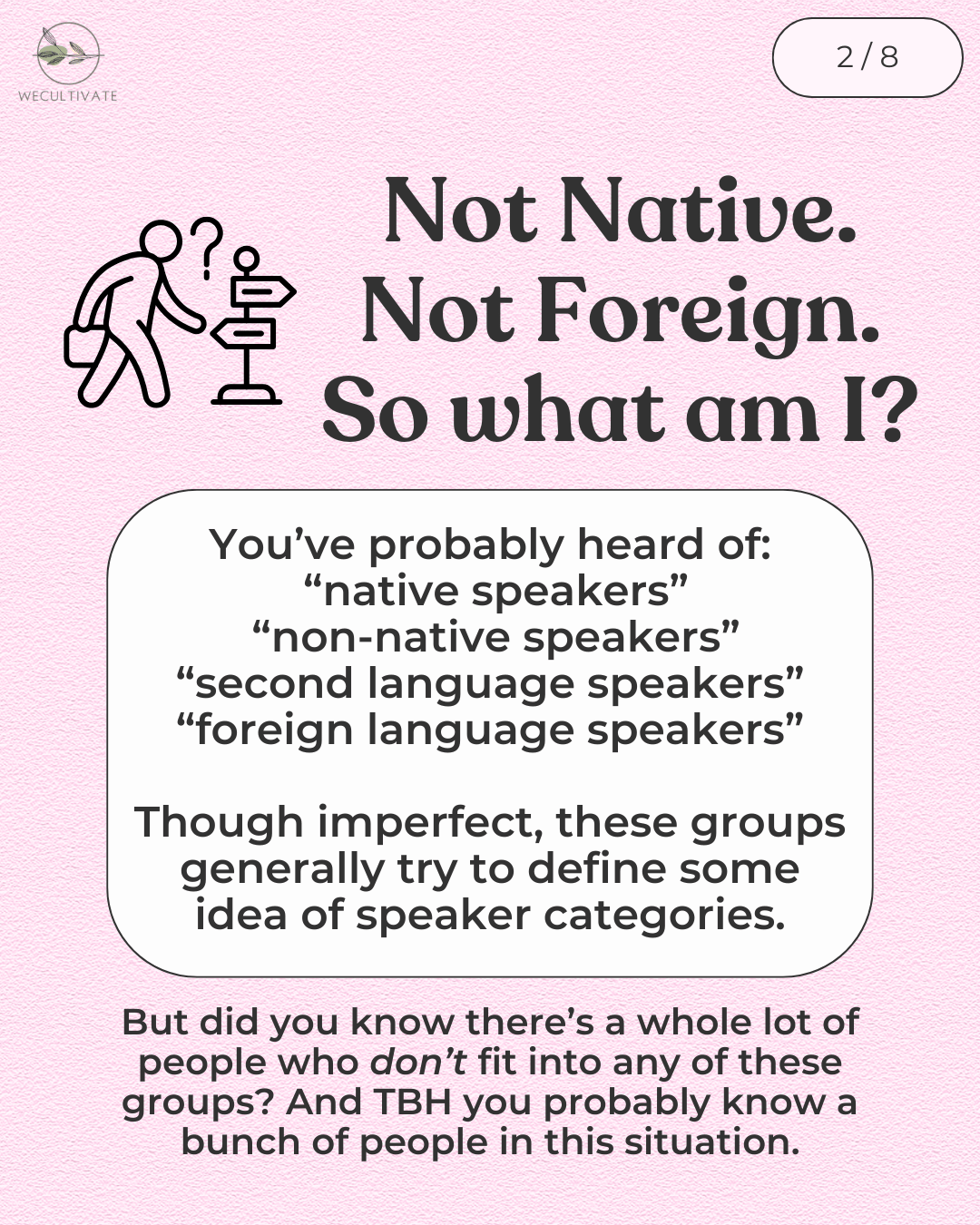
Drawing from her own experiences growing up with Mandarin alongside classmates raised with Spanish, she reflects on the tension between textbook language learning and lived language realities. The episode examines passive bilingualism, multilingual identity, family language dynamics, and why two people from the same household can emerge with completely different relationships to language.
More importantly, this episode asks listeners to rethink how we categorize language experiences in the first place — and whether fluency, grammar, or “correctness” alone can ever fully capture the person at the center of it all.
This episode kicks off a month-long series across podcast episodes, essays, Instagram content, and Substack features focused on heritage language as it is actually lived: shaped by family, environment, identity, interruption, and individual experience.
Topics include:
heritage language and multilingual identity
passive bilingualism
language beyond fluency
textbook language vs lived language
assumptions around culture and communication
why language experiences are never uniform
Transcript
Michelle:
It's officially May and we are kicking off this entire month spotlighting heritage language and heritage language speaker experiences. Welcome to the first of four mini episodes that I will be putting out on this topic. And I just want to use this time to set the stage for why I think this is such an important discussion to have. I know here on We Cultivate the Pod, we cover so many different things. One of the most frequent comments I get is how deep and how robust and how diverse the conversations I have with my guests or the solo episodes I put out, how much we cover, how much variety there is. And to spotlight a category or topic has honestly been really rare. It hasn't happened yet, actually. Now, what is heritage language? Why do I care about it so much? I've put the formal definition out in the resources and in the show notes.
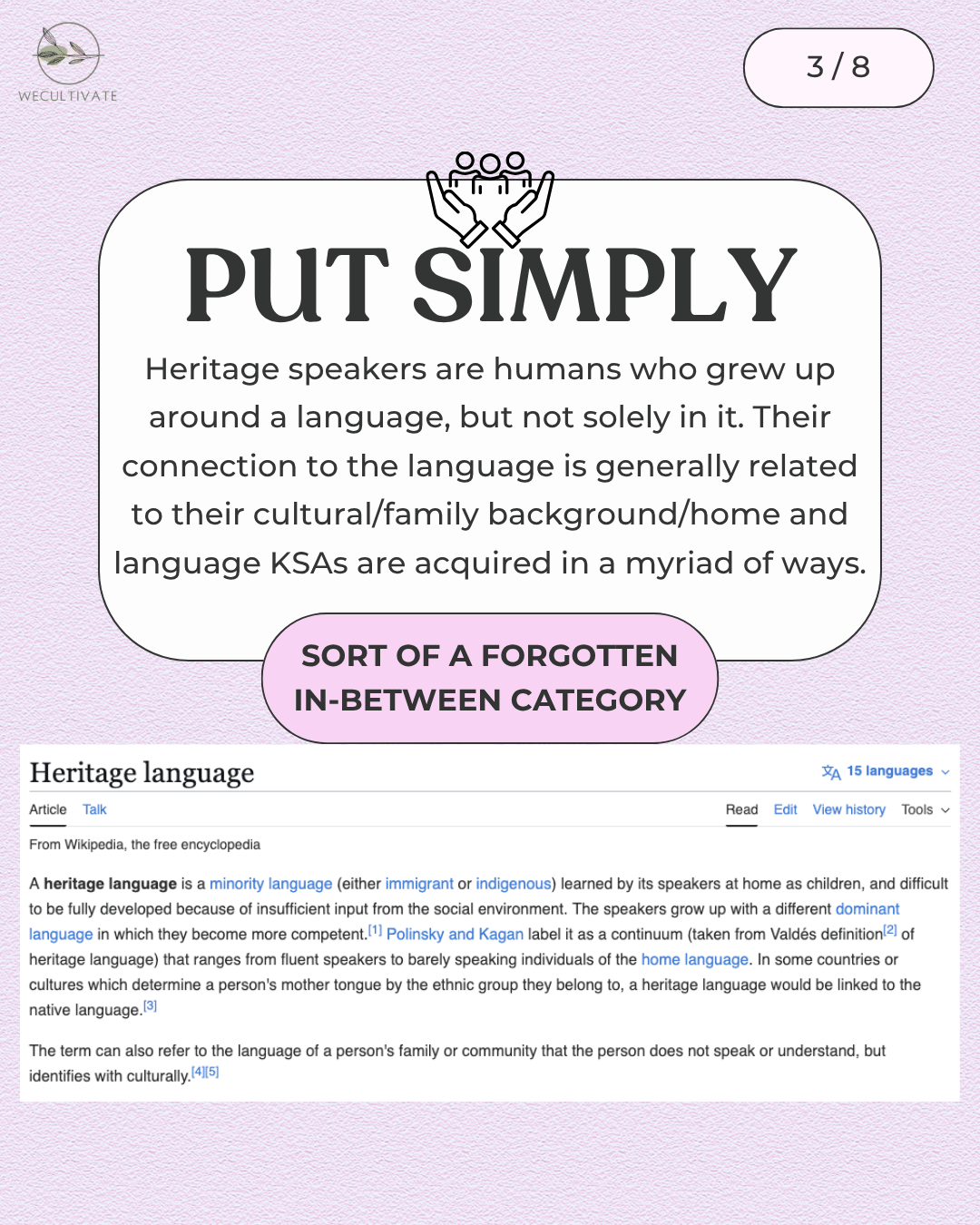
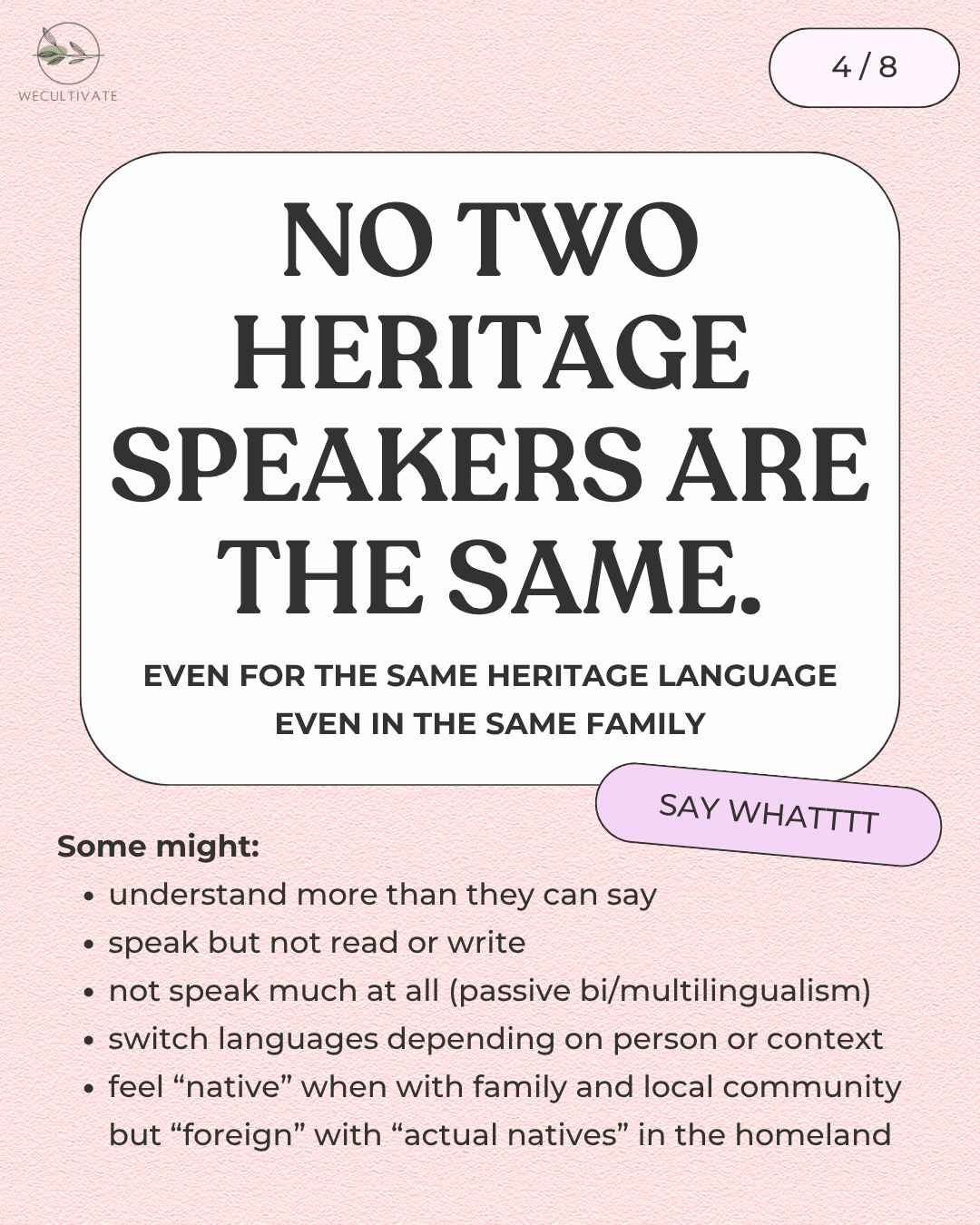
You can find a link to that in the episode description as well. However, if you were to ask me for a sort of simplified definition, I would just say that it's many different things. But precisely, heritage language is one that you kind of were just born into in a way. Now, I'm not talking genetically. I am talking as a product of your environment, usually your family, usually your ancestry, usually your larger community, although these things do not necessarily all go together. And we're going to get into why. Heritage language also does not mean that everyone speaks. So even though we use the word speaker, those who are familiar with the concepts of passive bilingualism or passive multilingualism will also understand that language is not just what you're speaking. It's also about interaction, it's behavior, it's listening, it's reading and writing. It's a lot of different things.
There is a huge spectrum of what an individual experience looks like for heritage language. Being born into a family that speaks a certain language does not mean that you will come out of it speaking as well. A lot of it has to do with individual choice. A lot of it has to do with the reinforcement models around you. A lot of it honestly has to do with the array of different variables influencing your individual situation. Two people born into the same family do not necessarily come out of it looking the same, sounding the same, using language of any kind the same. Yet a lot of this is taken for granted. A lot of this is just washed over like, "Oh, you speak this, your sister does too. You do that, your brother does as well. Your cousins, all right, that means whatever. That doesn't mean anything." If you've been following the podcast for the last year and almost a half that we've been doing this, you know that I always say that we need to be rethinking the way that we talk about language, not just which subjects we discuss, but how we actually categorize and characterize conversations about language.
So this month you will be hearing these four many episodes from me. You'll be hearing a guest conversation and we are co-spotlighting on Substack. If you're not following there yet, we are kicking off our new heritage language series called Inherited Interrupted. We also have a ton of media going out on Instagram. I've made a bunch of reels. I took a lot of time. Social media is not my favorite thing to do, but I have done it because this is big. I mean, I want to give heritage language it's due. The next episode, I'm going to go into contrasting these different potential experiences to better reinforce what I'm talking about. But before that, let's do a quick kind of storytime moment or time travel. I would like you to close your eyes and jump back in time with me not too long ago, depending on how you look at things, but long enough since when I was in high school, maybe jump back to your own high school language, class experiences as well.
And I want you to just think about what happened there. If you grew up in the US and you were also forced to choose a foreign language and you, like me, decided to choose Spanish because you figured that you heard enough of it everywhere that you'd have a higher chance of getting an A compared to a crazy language like French, which irony of life, then maybe you've had this type of experience as well. So teenage Michelle was sitting in a classroom with tons of different types of people, people who had taken Spanish before, people who like me had only heard Spanish around but had never really formally learned it. And also people who spoke Spanish fluently because it was their family language or their heritage language coming from their home environments. So like me, they would go to school, speak English, do their lives, go around society, I don't know, buy stuff, talk with friends, whatever, but at home they would be speaking in a different language.
For me, that was Mandarin. For them, it was Spanish. Now, I want you to sort of imagine what was going on in my head when our teacher, this woman who bless her heart, not only did not grow up with a language, but had the audacity to tell these people, my classmates in the school, that despite speaking the language fluently and growing up with a whole array of Spanish speaking cultures, that they were wrong because they weren't speaking textbook Spanish. Now, I know that we can get into a lot of argument about this, but there is no argument on one thing. Heritage language and foreign language are not the same thing. And we're going to go into this in our next episode and in an upcoming Substack piece. But what I want to get really clear is not exactly what friction was between the teacher who honestly, I really hope that she learned a bit more and got more training as her years went on.
But I want you to understand that for me, sitting there in that classroom and watching this happen made me really take stock of how I thought about language. So sure, for me, it was a foreign language, but I asked myself, I mean, who's right? As a teenager, you're not sure yet. As a teenager, you're still trying to figure out a lot about the world. You're trying to parse through all of the different messaging you're getting in life. And I was like, "Well, sure. Okay. There's the textbook." But I also know based on speaking my own heritage language, Mandarin, that there's the textbook stuff and then there's real life. Same for English. We would all go to English class. We would all learn the proper way to do things or the nicest way to write an essay. But I also knew that I would speak all sorts of different types of English with friends, with other people in society, code switching.
I didn't know these words, but I knew that I did them, even if I didn't have the vocabulary to describe the phenomena. And in this classroom, here we are also being told that the people around us who are fluent Spanish speakers are not supposed to be representative. Whereas our teacher, who probably had only been to Mexico on spring break and Cancun was somehow supposed to be right because she had a book that told her that she was right. And don't even get me started on when they wheeled in, the AV team came in to wheel in the TV and show us a tape about breakfast foods. I'm doing air quotes. I know this is an audio episode. I know we've gone back to these, but showing us what you're supposed to eat for breakfast in quote unquote Latin America, which is so kind of ridiculous now that I think about it.
But this is what I want to talk about. I want us to kind of zoom in, focus the spotlight on heritage language experiences. Point being that many times on the internet, on social media, even just in regular life, we talk about language in a way where we just treat it kind of the same. I'll go into this more in the other episodes and the other Substack pieces, but we kind of just flatten everything across the board. I want us to just pause and really ask ourselves if it's possible to know the journey, the experience of individual people, what they've had to overcome, how they've integrated a particular language into their understanding of self and cultural identity. And I want us to get into what actually happens instead of just flattening everything across the board. So I invite you to follow along this series. It will be on the side, it will be on Substack, it'll be everywhere.
I really, really invite you to just ask yourself these questions. Is there anything that you need to rethink in how you see language? Are there any unintentional perhaps assumptions that you're making in how you think about particular languages and their connections with culture and identity? Even making space for this as a category doesn't mean that we will always feel represented or reflected based on what we see. This is not to criticize people who are trying to raise awareness about heritage language or language acquisition and education, especially for kids, but I think we're just at a point where we need to pause, look around us and say, do we actually think that heritage language or language experiences themselves are uniform because not only are we thinking about benchmarks of fluency or mastery or grammar or vocabulary or exams or any of that stuff, are we actually just completely flattening the person at the middle of it all?
My hope is that with these episodes and all of the rest of the media that we put out for this month, that you'll just learn a little bit more about why this matters, about why we need to be more nuanced, why we need to get back to thinking about the individual people, even if they belong in these larger categories, that we need to stop making assumptions and taking for granted that we can understand the experiences of others without actually having made the space to learn about them first. So before I leave you today, make sure you are going to wecultivate.world/podcast to access all the show notes and resources that I normally put out for these episodes, but also specifically for this Heritage Language series. There will be a special tab that you can access and find all of the episodes related, mark your calendars because every other day, basically, there will be something else, an essay, a spotlight, a reel, a something.
So make sure you're following everywhere so you don't miss it. And I will see you in the next mini episode.