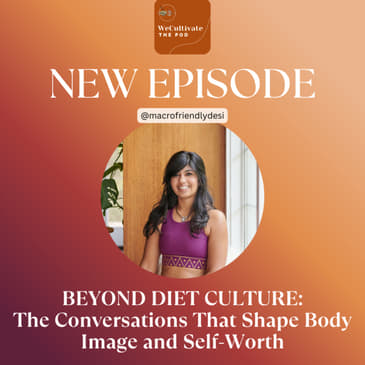



Many conversations about body image begin with nutrition. Others begin with exercise or weight loss.
But what if the beliefs we hold about our bodies start much earlier, and have just as much to do with culture, communication, and identity as they do with food?
In this episode, Michelle sits down with macro nutrition coach Neha to explore the messages we inherit about our bodies, the expectations placed on women across cultures, and how those experiences shape confidence, self-worth, and our relationship with health.
Together they discuss growing up between cultures, immigrant family dynamics, sustainable nutrition beyond diet culture, raising confident daughters, and the importance of learning to work with our bodies rather than against them.
Whether you're navigating your own relationship with food, breaking generational patterns, or simply curious about how culture influences the way we communicate about health, this conversation offers a thoughtful reminder that lasting wellbeing isn't built through textbook templates.
It's built through understanding ourselves more deeply, first.
Main Takeaways
Our relationship with food is shaped by far more than nutrition.
Family expectations, cultural traditions, gender roles, identity, and childhood experiences all influence how we eat and how we see ourselves.Confidence begins with learning to trust yourself again.
Slowing down and paying attention to your thoughts, emotions, and physical cues helps you recognize what truly supports your wellbeing.Health isn't about shrinking yourself.
Sustainable nutrition focuses on strength, nourishment, and long-term habits rather than restrictive dieting or chasing unrealistic body standards.Parents model far more than they realize.
Children learn not only what we eat, but how we talk about our bodies, respond to food, handle boundaries, and define self-worth.Small, consistent changes outperform extreme transformations.
Lasting progress comes from sustainable habits, not crash diets, perfection, or trying to overhaul your entire lifestyle overnight.
Actionable Advice
Spend 5–15 minutes each day slowing down.
Give yourself time to notice how your body, emotions, and thoughts respond to your environment before automatically reacting.Make one sustainable change at a time.
Instead of changing everything at once, focus on one realistic adjustment and build from there.Learn the basics of nutrition rather than following trends.
Understanding protein, carbohydrates, fats, and overall balance makes it easier to adapt your own meals—including cultural foods.Practice listening to your body's signals.
Pay attention to hunger, fullness, energy, and satisfaction rather than eating out of guilt, obligation, or external expectations.Model a healthy relationship with food for others.
Whether you're a parent, partner, friend, or simply talking to yourself, emphasize nourishment, strength, and self-respect over shame or appearance.
Related Resources & Recommendations from Neha
Below, you'll find a few links tied to the topics we discuss in this episode, all provided by our guest. WeCultivate does not unequivocally endorse the material or its creators beyond a cursory review of the material presented. They have been shared here on behalf of our guest to encourage further exploration and independent learning. This is a dynamic list and subject to updates as time goes on. If any of the links become broken, or if you have a suggestion for the list, please let us know. Thanks!
Articles & Research
The Science Behind Intuitive Eating (Food Insight / IFIC): A plain-language look at the research on the non-diet approach to food.
Why People Get Stuck in Yo-Yo Dieting (News-Medical, North Carolina State University): How social pressure starts the cycle and how regaining the weight deepens shame.
Protein (Harvard T.H. Chan School of Public Health): How to build meals around plant proteins like lentils, beans, soy, nuts, and seeds.
The Healthy Eating Plate (Harvard T.H. Chan School of Public Health): A simple visual for balancing a plate without counting anything.
MASALA Study: Vegetarian Diets and Metabolic Health in South Asians (National Institutes of Health): The landmark research on why vegetarian eating affects South Asians differently.
YouTube Channels
Pick Up Limes (Sadia Badiei, a registered dietitian): Calm, beautiful vegetarian and plant-forward cooking.
Nutrition Made Simple (Dr. Gil Carvalho): Evidence-based myth-busting, no fads, nothing to sell.
Abbey's Kitchen (Abbey Sharp, a registered dietitian): Debunks fad diets and toxic eating content with humor.
Podcasts
Biceps After Babies Radio (Amber Brueseke): Macro and mindset coaching for moms who want results without cutting the foods they love.
LiftingLindsay's More Than Fitness (Lindsay Parker): Strength training and sustainable nutrition for women, big on ditching the all-or-nothing mindset.
Magazines & Books
EatingWell: Reputable, recipe-forward, evidence-checked food and nutrition coverage.
Intuitive Eating by Evelyn Tribole and Elyse Resch: The foundational book on eating by hunger and fullness instead of food rules.
EPISODE TRANSCRIPT
Michelle (intro):
We are back for another episode of WeCultivate The Pod. I am your host, Michelle, and I am so pleased to be here with you. It's summer guys, most parts of the world, it's in full swing. The heat is extreme, especially where I am currently. If you're online, you are probably also receiving all of these, get beach ready, get summer fit types of posts. I feel like it's a great time for us also collectively to maybe slow down, maybe kind of take stock of what this year has already been like. We are halfway through 2026, and because this podcast requires so much nuance, I am so grateful that my guests and I just have these wonderful never expiring conversations together. So today's episode I actually recorded with my guest Neha last year. It was also summer. It was also very hot, but I wanted to bring her in right now and release her episode now because in the midst of all these conversations on health and body and nutrition and consumption, one might think about where culture is inside that mix or how communication works, whether that be talking to yourself or talking with your kids.
It's actually genuinely too hot in this room currently for me to do too long of an introduction. You're welcome. But before jumping in, I just want to say a huge thank you to Neha for coming on. Our conversation gets into topics that kind of float in those in-between spaces. I really appreciate the deep dive into her background, her journey to figuring out the work that she's done and the work that she does. Now we talk about cultural influences on body image, particularly for females or women, for young girls growing up. We talk about so many things. I will let you get into it. At the end of the episode, I will let you know how you can access more of her work. And so here we go. My conversation with Neha.
Neha:
So thank you for having me. I'm really excited to be here. My background is so diverse that I'll just start from the beginning. I am the third child in the family and my older two are doctors. They're much older than me. So when it came to me and when I grew up, it was basically do whatever you want. Find your own passion here. Here's life. This is your playground. So I really did a lot of things. I always thought I knew what I wanted to do in my life. I excelled in chemistry and I thought that you were supposed to pursue what you were good at and the love will follow. And while I did love chemistry, I majored in it in college, I did a PhD program. After one year I dropped out. It wasn't for me and I was really confused, but I ended up studying in France.
When I was in college, I studied abroad. So then I went back to France, I taught English and then I decided, okay, let's be a teacher. I seem to be good at that. And again, I wasn't choosing it, it kind of chose me. So I became a high school chemistry teacher for almost 10 years, and in the middle of that I did a coding bootcamp with my husband was supporting me. He was like, I really think that you should be doing something else. I see so much potential in you. He kind of pushed me. So I became a software engineer after a coding bootcamp. I am currently a software engineer, but during that process and while I was teaching, I had two girls. They both happened to be C-sections and in Indian culture. So I grew up in America, first generation. However, I feel like I grew up Indian in America because both my parents are from India.
So I really didn't have a similar childhood to other Americans, I would say. And in that process, body image is huge. So after having the two C-sections, my body did not go back to pre-pregnancy naturally. But it was hard for me to see myself like that when I looked in the mirror and I was so desperate after trying diet after diet to lose the belly fat to get into my pre-pregnancy genes. And nothing was working because I was older, my metabolism was slowing down, but I thought that something was wrong with me until I finally hired a macro coach. And what I learned about nutrition transformed my life and I learned so much about food, yes, but myself, I learned so much about myself, my identity. I feel like the journey that I have been on in my life, still not over, but I am finding my passion, finding my own voice. And now because of that experience, I feel it is my mission. I've made it my mission to empower other women in finding their voice in feeling strong and confident in their bodies when they might have wanted to shrink and be small all their lives.
Michelle:
I love this and I love that we're touching on so many. First of all, the same themes that I have. We actually tick a couple of the same boxes in terms of career moves and different versions. But yeah, I did a bootcamp, was previously also in a PhD. So literally it's really, really, I love when you have those moments, you're like, oh my god, me too and so we’re not crazy. But I also love that you're crossing over some themes that we have had on the podcast already, basically on nutrition, on what is it to be healthy. How does that actually play into how you see yourself? Also another parallel or a point of overlap, you just said that you feel you grew up Indian in America. Something I say frequently is that my home was going into home was like China and then going outside was the us. And so I was like these worlds that were so massively different and knowing that from such a young age. So I want to be like, what was your childhood? It was kind of the direction I want to go, but I'm sort of wondering what was that like going between these worlds and having to do that from a young age. I know that you said you had siblings, but still you'd have to figure it out for yourself.
Neha:
And the reason I say that is because I am recently in therapy for this, not realizing that it was a traumatic event to me because of how my body responded, not because I felt it was traumatic, but my mom left our family when I was five and at that time my siblings were 16 and 18,
So they grew up, I even had a different childhood than them. They grew up with our mom. I didn't. And because my mom wasn't there, my dad was doing the best that he could. My siblings were doing the best that they could, but they were also grappling with the fact that my mom had left and they were in their own stage. My sister had gotten into college, my brother was in high school and I was just there. I did the best that I could and I think that in the environment that I had. And so because of that, I really held on to all these traditions and routines that we had in terms of our food, in terms of our social events. I was in a Sunday school and I really, all the friends that I have met in that Sunday school were like family to me.
I didn't have anyone else that I could really ask for help or guidance. And I feel like you can make your friends into family if your relationship is that strong. So it was school life, the Sunday school life, the home life. It was like different lives. Absolutely. And it wasn't until recent, I would say the past few years maybe since COVID, my life was always go, go, go. And when COVID hit and we were home and I had all this extra time, that's when I really feel like I asked myself questions that I never asked before about am I doing something I really enjoy? Is this really what I'm passionate about? Am I the person that I want to be? Do I feel like I've found my purpose in life? All these deep questions, all of these books that I read. And so it was just different childhood. It was a different childhood than I have had with anyone else. Yeah.
Michelle:
Do you feel like the sort of almost, I'm tempted to call it a delay, I'm just not sure if I'm happy with that word, but it's almost like you're living and you're just trying to manage life and you're trying to just make sense of it. That's why I don't like the word delay, but it's sort of like the latency is maybe what I want to describe, but so you're born, you're having to go through all this and then it's like you're processing it, but you're not consciously processing it. Maybe it's also, it's like the nervous system stuff. And so by the time COVID hits and everything has to slow down and the whole world kind of stops, do you feel like it was because you finally got the chance to sit without running around? Maybe a lot of people were describing that at the time. It was the first time they didn't have to rush from place to place. And do you feel like that's what helped kickstart all of this internal questioning?
Neha:
Absolutely. And also what was happening with the news and just in terms of the world didn't know what was going to happen with COVID and there was no vaccine at the time and people were dying. So I feel like death could actually be a really good teacher where you reflect on your life and you ask yourself whether you're living in a way that you would be proud of. And you're absolutely right. It was the first time that I was working from home. So I had all that extra time. I wasn't running around trying to get ready, making my lunch, getting out of the house, being on time. I was a teacher before and I was a software engineer, so I was always in transition. It was always moving from place to place without even a thought to what was going on inside. And then that was the first time where I had time to slow down. We were all basically asked to slow down in a way. I had always looked externally and it was the first time that I had the time and energy to look internally
Michelle:
For your, just jumping back a little bit to the family environment stuff. And I just always find it fascinating because I think most people I know who have siblings, even if they are close in let's say chronological age, they are not actually treated the same by the parents because of the fact that you go through the first kid, parents learn a couple things and then they apply differently to the second kid. I've seen it in a multitude of ways. What would you say is the biggest contrast between your siblings and you? So in terms of the philosophy, so I think you touched on wanting to keep the culture and the food stuff, and obviously a parent leaving the house is definitely a huge game changer in the situation. But what are some of the other things?
Neha:
So it's funny, my sister and I are 13 years apart, but we are so similar in personality. We did have different childhoods because she grew up with our mom and I didn't. However that tendency, the type A tendency, very high attention to detail. That's something that we really have in common. We also look very similar. We have similar height, similar taste. However it wasn't, and growing up actually, she was my role model. She was my inspiration. I wanted to cop everything that she did. And then when COVID hit and I had that extra time to myself, I realized I am not her. And not only am I not her, it's okay not to like the same things. So she grew up loving cooking. While I do cook, I don't particularly enjoy it as a hobby. I do it because we have to eat. I know that if I know the ingredients in my food, I have a better, more accurate with my macros.
We can get into that a little bit later. But I also enjoy gardening. I also love reading. There's so many other things that I fell in love with because that's when I realized I don't have to be like anyone else. It's okay to be me. And so that was a really big distinction that I was able to make when I had that time to reflect. And then my brother, I mean, he and I are actually very, very close. And despite our age difference of 11 years, I feel really grappled with that trauma that when my mom left. And he is a mama's boy and I think that he's still suffering from it, sadly. So I mean, he's unmarried and living with my parents, but we're very different.
Michelle:
Yeah. I wonder if you might be able to touch on some of the cultural aspects as it pertains to being female. So we talk about everybody's different circumstances and this can vary a lot across the world, but how you lived this experience, I think that it also, I have questions to ask you about how you're parenting and I see a lot of content related to your daughter and stuff. So I'm sort of wondering was it ever challenging to be your version of female as it pertains to heritage and culture?
Neha:
Oh my gosh, absolutely. Because I have a lot of family in India and I visited, I visited India all the time, especially growing up. And I feel so fortunate to have such a strong relationship with my family in India. But growing up female, it really, the first impression was we are responsible for so much, so much externally as much as internally in terms of emotions, in terms of just taking care of everyone around you. Whereas males only have to take care of themselves. But it really, I felt that from the beginning because my mom wasn't there. So I was able to grow up with my grandmother and she really taught me I have to do all the cooking. I have to do all the cleaning, I have to take care of everything in the house, make sure everything looks good, make sure everybody is well fed.
And that was really hard, especially because as I learned more about myself and going through childbirth two times and having a husband, and also my father-in-law does live with us. He's lived with us from the beginning of, even prior to marriage and that feeling of always having to make sure that he's okay, well fed, he has some health issues, making sure that he's taken care of, he has his medicines, we take him to his doctor's appointments. And then also finding my voice and realizing that I'm important too. How do I take care of myself in the mix? How do I prioritize me, my help, my eating? And now it's just become this fine balance of how do you do it all? However, we can't do it all. So recognizing that it's okay to ask for help, not even, okay, it is necessary. You have to ask for help if you're going to do everything that you are required to do.
Michelle:
And I think it's hard for a lot of women, especially those who come from cultures. So I think it's at this point, all cultures. I can't speak for the whole world, but I think most cultures do place this burden on women to be the caretakers, to be responsible for in a modern age, responsible for a career and for family and for in-laws and for the functioning, basic functioning of society. And so I wonder how many women, I think this is the challenge that's presented, I think a lot of females today, the personal journey of wanting to find your own voice inside of a role or inside of a world that's basically told you that you're responsible for caring about other people and at the expense of your own. That's a very, very hard thing to do. I think you me, a lot of podcast guests, we've talked a lot about the importance of finding your own voice and owning your own authenticity, but I think a lot of people actually don't even know where to start. Do you have any advice for people who, especially on the cultural side of things, kind of can't break out of it because especially when it comes to ethnic and family culture, it's a lot of like, this is your role, this is how we value you, this is how we honor you, this is how you're supposed to honor and value yourself. How would you start?
Neha:
So as someone who is type A very high attention to detail, who feels like if I'm not busy, then I'm not productive. I am proud of myself that I have recently really tried to slow down and pay attention to how I feel because in working with nutrition, in figuring out what kinds of foods fuel my body, what feels good to my body, I have learned that it's not just food that we're consuming. We're consuming thoughts, we're consuming social media, we're consuming news, we're consuming relationships, conversations, discussions. We are consuming so much that we don't give our bodies a chance to catch up, our nervous system to catch up. So when you slow down, you have to recognize that rest is part of being productive and realizing what does it mean to feel good? What does it mean to feel to do something that's in alignment?
And that's how you really recognize, oh, this food doesn't suit me. Oh, this conversation, something's coming up for me. It doesn't feel good. This relationship, this is actually toxic. I don't want to be around this person anymore. When you slow down and you pay attention to how you feel, you can really get insight into what's serving you and what's not. And then you can make informed decisions from there. So I highly recommend just 15 minutes a day, even five, five to 15 minutes a day of just doing nothing, observing, meditating, light a candle, look out in nature, listen to calming music and just ground yourself. Because there was a time when I thought if I wasn't doing something then I was wasting my time. But I honestly feel like the slower I move, the more intention I have, the more clarity I feel with what I should be doing with my time.
Michelle:
Yeah, personal struggle for me also. Well, it was a lifelong struggle and feeling guilty just sitting there. It's amazing. You're just sitting there and you don't do anything and somehow you feel guilty because you feel like you should be doing something. That was definitely pointed out to me when I was in college university people, I've never seen somebody run on such little sleep before. And I was like, yep. Because even sleeping was apparently wasting time. So that was insane.
Neha:
I mean, I remember being in France and being like, everything is closed on Mondays. What the heck? Wait two hours for lunch. Wait, I'm done in 15 minutes. I scarfed everything down. I love the feeling of taking your time and really enjoying what you're doing with intention. It's so different from the culture here in US. I'm not afraid to say no anymore because I have to put in my calendar time to rest. I schedule the rest so that I don't have meetings scheduled. I don't schedule any check-ins or even social events. I'm like, I need a weekend where I do absolutely nothing at home. And I am allowed to do that. Not only allowed, I encourage my kids. I don't like to overschedule them.
Michelle:
Wait, let's get into this. So I think especially if we pair the immigrant background thing, the high achieving thing, the sort of on the go type A, let's talk about parenting and not overscheduling kids, please.
Neha:
It's so hard. It's so hard, especially when you compare to other kids and they're listing all the activities and the tutoring and the instruments that they're playing and the lessons they're going to. I mean, forget it. I don't mind having them try something out for a season or two, but if they're going to commit to something, how can you commit to 10 things? It's not possible. I want them to have experiences, but really just commit to one or two things that they really love and they enjoy. I want them to experience what it means to find a passion or be in alignment with what they're doing earlier on so that they don't have to go through the struggles that I did.
Michelle:
What are some of the things that your kids have tried?
Neha:
Oh, they've tried horseback riding, ice skating, fencing, tennis, swimming, soccer, lacrosse, guitar, cello, violin, choir. They've tried a lot, French, they've taken French classes, they've tried Sunday school, Hindu culture classes. They've tried a lot.
Michelle:
Yeah. What are the things that stuck out of that?
Neha:
My older one does fencing and violin, and my younger one is doing horseback riding until she can start fencing and cello.
That's it.
Michelle:
Yeah. Yeah. I think it's important. I mean not only as kids but as adults too, that we, and maybe that's why there is a disconnect I think for some parents when they want to make choices for their children, you do have a lot of decision-making power, especially if they're very young and as they grow, I feel like the disconnect often comes when the parents aren't doing things that they want to be doing. Maybe they're working a job that they absolutely hate. And your entire outlook on life is built around. I suffer, therefore everyone around me should also suffer. Rather suffering is a requirement for existence. And so I think maybe that's where we see a lot of parents. I mean, I was for sure forced into all the things I did, but it's okay. Forgiveness is here. We've worked through it in my family, and that's why maybe it weighs also on immigrant families so hard.
A lot of the immigrant experience. I mean, we're not talking voluntary immigration A lot of times we're talking, trying for escaping countries, escaping dictatorships. I'm trying for a better life somewhere else. It is very, very brutal, very stressful is an understatement. And so when everyone is going through that together, I feel like that's what provides the context, at least for why many people when they look at their own parents and they're like, well, why did they force me to do all these things? And it's like in the name of a better future, why would you make me do something I didn't want to be doing? Especially if now you have your own kids and you're like, I would never impose that, right? Or I would never force my kids to do things that they didn't want to do, but that wasn't even a choice because survival came first. So Maslow and everything we have, we need food. And then you can think about your feelings, right?
Neha:
Exactly. And to that point, my dad came for opportunities here in the US that he didn't have in India. And because my mom wasn't there and I grew up in a single family, IT parent household, I didn't have any opportunities to do anything until college when he did allow me to study abroad. And I was so grateful for that. But I was so interested in doing so many things that I wasn't able to because we literally did not have the means nobody to drive me, not enough, couldn't afford it. So I want to be able to give my kids the opportunity, but I also, I want to teach them that they get to choose. I'm not in charge. I can help them, I can guide them. That's honestly the role of the parent. I feel bad for the kids whose parents feel like the kids are an extension of the parents because I want my kids to have everything that they need so that one day they're not going to need me. And it's sad to think about that. That day is going to come, but that day is going to come.
Michelle:
But I think also maybe you don't derive your self-worth from their, it's not even their validation. I'm sorry. Today is a day where I'm not happy with the first word that's coming into my brain, and some days are just like this, but I'm like, no, that's not what I want to say. But it's almost like there is a model sometimes presented where the parents who want their kids to be the extension. I think it's also the control and the live through them vicariously sort of thing. I think because you have your inner worth and your inner voice, you don't need to be doing that. You can be free to also be a partner and a guide for them so that one day, yes, they can fly on their own.
Neha:
I agree. I agree. And it took time, took time for me to realize that I am my own person and we are all worthy because we don't have to earn that worth.
Michelle:
I definitely think it's a lot of unlearning, a lot of relearning for a lot of people, but I'm sure that there are a lot of people who need to hear this in some form. So thank you for talking about this. I wonder if for you, did you ever have moments maybe in school or with your peers, friends, classmates where you mentioned you realized that you weren't American like everyone else? Did you ever have moments where you were like, God, they do not understand what I mean when I'm trying to describe my life?
Neha:
Absolutely. Absolutely. Especially growing up. I would say in grade school years, elementary school, middle school, there were not a lot of other Indians where I grew up. So the one or two, we really stuck together. But in terms of speaking, in terms of food, I mean the food that I used to bring for lunch every day, being vegetarian, that was also a hurdle. It was very uncommon. I feel that there were maybe until college, I think college was the first time where I really saw a lot more people and also that Sunday school, but that Sunday school was only on Sundays. It didn't feel, it took me a long time to feel like I actually belonged.
And that feeling of belonging, we all desire it. We all just want to fit in and be like everyone else. I remember there was a time, I'm going to say first, second grade where I actually had powder and I put it on my skin and I was like, how come my skin's so dark? I want to be white. Everyone else. I remember that and it took a long time, but I'm really proud that now I'm so glad that I'm me. I'm so proud of who I am. I'm still learning a lot, but I can feel like I am my authentic self and I'm not afraid to bring my authentic self. And I have some friends from middle school, high school who are really shocked to hear that because I put on this persona of how confident I was growing up, but it was all a show because I didn't know how else to present myself. Going through a therapy, talking about it really has helped me realize that I love who I am now, and you can figure out who you are. Yes, I'm a mom. Yes, I'm a wife. Yes, I'm a friend, a sister, a daughter, but all of that is part of who I am. I'm still me. I am just me. And I can see all these different versions of myself and be proud of all of them.
Michelle:
Yeah. That's so beautiful, by the way. That's amazing. I love those moments. I've had a couple of myself as well, but they have to be really, really at certain points in time, I have to be like, I am so proud of just existing and it's not tied to something that I've done or something I've accomplished or something external. I think that it's really beautiful when you can find those moments and you can almost do this sort of healing that you and the story about you wanting to be white I'm putting powder on. I mean, I matched myself to different crayons because people were trying to tell me what color I was, and they were trying to tell me I was yellow and I wasn't yellow, and I took a yellow crayon one time and I was just like, I don't match this. I don't know why.
I don't know why you're calling me yellow when it doesn't make any sense. I'm like, more peach. I should be. I'm this crayon. But I think that that's something, these are stories that a lot of kids and adults both need to hear. I think they need to hear that real people also went through even real people who seem very confident today and maybe have seemed confident for a long time, that external persona and what was going on internally matching up, even if it was more recent, at least it happened, right? And at least you get to be here today and just be, so that's empowerment, at least to me.
Neha:
Oh, absolutely. And this is exactly why I have created my business because I feel like when you don't like how you look, that clouds your judgment. That clouds your worth, that clouds your voice, and you can't feel your power if you don't feel confident in your body, if you can't see and appreciate what your body is doing for you and how it looks. And that does not mean that you need a six pack. That doesn't mean that you have to be skinny. That's not what I am aiming for in my business. I just want women to feel good, feel good, so that they are able to make decisions from a place of power and control, not from a place of defeat and doubt.
Michelle:
Let's talk a little more about your business then.
Neha:
Sure. So I am a certified macro nutrition coach, and I use macros, which is short for macronutrients of which there are three protein, fats and carbs. And I offer group coaching, one-on-one coaching with women who want to essentially lose weight. You can use macros also to build muscle and maintain, but also it just teaches you how to eat for your own body. Everyone is individual, everyone has different health factors, but a lot of times what I have found is women just copy what they see on social media. They just copy this diet, they just go keto. They restrict to the point of bingeing, and then it's this yo-yo dieting, this cycle of just losing weight and gaining weight, and they're essentially not getting anywhere. And as you get older, thirties and beyond, your metabolism does slow down and the same methods that you might have used before will not work anymore because your hormones and just growing older, every decade of life, you lose three to 5% of muscle mass.
And so I'm sure you've seen your elders, your parents, grandparents. You don't want to be weak. You want to be strong as you age. And that's what I help women with. And as they become strong, they realize how powerful they are, they find their voice and it translates to so many other areas of their life in their relationships. They're so much more confident with their employers, they ask for raises. They're not afraid to speak up in meetings, conferences, they get more opportunities, not because they get more opportunities, but because they see challenges and other situations as opportunities. It helps to reframe their thinking in life. And so it's so rewarding to see.
Michelle:
Yeah, and personally I think I do follow a couple different people, but I also see what's on social media overall, especially in the health and fitness space. A lot of it is vanity and a lot of it is you want a body like mine join my crazy expensive program that is completely uncertified by anything. So I always have an issue with that. What I really love about your content and your story, and obviously this is why I was interested in connecting with you deeper, is basically because it's not that It's not the superficial stuff. You're not saying follow my program has, that's the same for everyone. Doesn't matter who you are, doesn't matter what you like. Eat three leaves of lettuce and two carrots and one peanut and basic. It's very nineties I feel to be. It's very slim fast. It's very, when we, was it the cabbage diet, anything else from that time to still pedal that information today in 2025 is absolutely shocking to me. And yet it works. People match the image with, I guess the old formula. Do you feel like you often have to work against this ingrained model that already exists for what healthy and health looks like to a person? Do you feel like you have to push back against that in this space?
Neha:
I mean, there's a lot of unlearning. A lot of my clients, they have done so many of these diets and they're still coming to me because it doesn't work. And they're tired of hopping on the next trend, the next fad diet. They want something that is long-term, that is sustainable and can work with their lifestyle. And listen, I don't have a six pack. I still have fat on my body. I'm still working towards it, but I get to enjoy every single moment when I go out, when I go on vacation, when I go to parties, I eat out all the time. I don't feel guilty, I don't feel bad. I have an amazing relationship with food, and that's what I want for my clients. I want them to live their life in harmony with achieving their health goals. There's nothing wrong with having an aesthetic goal. It's just a matter of I don't want you to have to sacrifice to get there. I think slow and steady is the way to go, and I am willing to take longer, but also maintain it and be happy throughout the process.
Michelle:
Yeah, there is a couple phrases coming to mind. No pain, no gain, or what is it? Something about suffering for beauty? I can't remember right now, but it's like all of this, these outdated slogans that I think we all need to at least put in context. I think that obviously we do have to work towards things when we go on any sort of road endeavor. We do have to put effort, but it's like the cost of what you're giving up in the process. So sure, it can be painful if you do a thousand pushups, it'll be painful. But we're not talking just about the physical pain here. We're talking about the fact that which also is valid. I mean, that's not good for your body, but the constant mirror checking, I did it a lot. Also, I think a lot of people, especially females, have had to go through that phase of being judged in school by peers, by boyfriends, by partners, by whatever things, because your body also changes so much.
And especially when you're a teenager, oh my God, everyone remembers. We all remember when we got our period and our bodies changed. So we all know all know the struggle. And even if today, and I don't talk about this much, not obviously what I do, but I've gone through a ton of things as it pertains to my physical health and body and fitness and whatnot. I really feel like a lot of us might be better served just giving ourselves more grace in the process and knowing that even if we did follow some of this bad information, it's okay. We didn't know better at the time and also everyone was doing it. So let's work to find better options now, but let's unlearn what we don't need anymore.
Neha:
Absolutely. And I just wanted to touch on one thing that you said. Yes, there is a little bit of sacrifice, but even that I would like to push back on, it's more about prioritizing what's important and being intentional. You can eat anything you want, you just can't eat all of it at once. So it's about being intentional. What is important? Is it the fries or is it the cupcake? In a perfect world, we can have both. We can have all of it, but when you do have goals, how about you have fries one day and the cupcake the next. It is just about figuring out what you actually want and what it will take to get there, being intentional about it and prioritizing,
Michelle:
Which also requires having that internal space already carved out to hear your inner voice, which if you are always on the go, which is okay, we all have busy lives, not just by the way, France is not perfect, okay? So we're not saying that they have it all figured out and everyone's just out there because smoking is definitely killing the country. Obesity is on the, I mean, it's beyond on the rise. It is here and cancer is running rampant. I just saw a news broadcast on this and especially in people under 50. And so what we need to recognize is that it's just, I think what you're talking about here is just balance and finding your own version of balance, which I think a lot of people take into a very almost calculated transactional quantified space. They're like, okay, so I ate three fries today, tomorrow I can only have, it's so micromanaged sometimes that it's really shocking. Definitely. I mean, I'm not only guilty, I had other friends who modeled this for me, and so I think I thought you were supposed to do it like this. How does one find balance in a more holistic way?
Neha:
I mean, my life changed when I hired a coach, someone who could really hold my hand.
Validate what I was going through, all of the emotions. Telling me that it was normal for the scale to fluctuate. It is okay to have a piece of cake you don't have to restrict. So having that coach to guide me, to hold me accountable to my goals, remind me. It's basically having a mirror of wait, I thought this was important to you. Are your actions showing you that this is important? Is that reflected in your actions? And reminding me, making me question myself like, wait, I didn't say that. What choice am I going to make in order to stay aligned with my goals and my values? I wasn't going to eat meat. I'm a vegetarian, but how am I going to increase my protein? Which is something that it was such a transformative experience. I said it once and I'm saying it again, learning about what foods are good protein sources and what foods are secondary and complimentary protein, just basic nutrition knowledge that I think we really need to teach our kids at a younger age, not in a punishing way, not in a way that makes them feel bad about what they're eating, just literal knowledge.
Bananas are carbs because it's a fruit, but there's also fruit that has fiber. There's saturated fats, unsaturated fats, there's protein sources, complimentary proteins, just literal facts that I had no idea how to read a nutrition label. So many things and it was mind blowing. So having that coach really, I think helped.
Michelle:
I think that's a great point that a lot of people think that they need a coach because they can't, I think enact some form of discipline, but it's actually the opposite. I think the coach actually tells you how to just put the discipline where you need it and not all the time because a lot of these people are very self-critical actually, which is actually sabotaging your goals half the time. I mean, I work with people who are the same. And so I think any type of training, coaching one-on-one spaces like this where you're like, oh my God, listen to you basically getting in your own way every single time. Stop it, right? And you need someone to just say, stop it. It doesn't work like that. You're not it. See the full picture, see where you are right now, see where you want to be, and let's figure out how to go through this together and push back where you need to encourage where you can. It also makes you feel less alone, I guess, if you have a coach that you can kind of go on this journey with and confide in because it is a very, very personal experience.
Neha:
Absolutely. I mean, it was such an amazing experience. There's no judgment at all. And really your coach is supposed to help you grow. Not only in that particular, for me it was nutrition and losing weight, but just as a person, anytime you go through any challenge, it's not about reaching the end destination, it's about who you become at the end of it, at the of the process. And it's fascinating. I mean, I have so many coaches now because now I understand. It's not that you can't get there yourself. You want to skip the mistakes, you want to get there a little bit faster and having that guidance is so helpful.
Michelle:
Can you break down quickly for those, I should have done this in the beginning, but I didn't want to interrupt while we were talking. The difference between looking at nutrition and health from a macro lens versus what's been done conventionally historically through counting calories or a lot of people will basically be like, oh, carbs, bad, bad, bad, bad, bad. Macronutrients are like the building blocks of food and life. And so if you could just break this down and maybe kind of clarify for some people who aren't seeing the difference between macros and calories.
Neha:
Absolutely. So counting macros is a lot like counting calories, but counting macros is going into more specifics. So there are three macronutrients, protein, carbs, and fat. In one gram of protein, there's four calories in one gram of carbs, there's four calories in one gram of fat, there's nine calories. And so it's just talking about the breakdown of where those calories are coming from and why that is important because protein helps with muscle recovery. Muscle building helps with brain functioning, immunity helps with our immune system, helps with our nails, hair, bones, all of that. It also helps us to stay full in our meals. Carbs, there's basically two types of carbs. There's fiber, which is complex carbs, and then there's simple carbs like simple starches like rice, pasta, bread, and the fiber is really important for your digestive health in order to make sure that everything is working smooth and that you're having bowel movements every day, every so often.
Very, very important. It also takes a lot longer to digest. And so it also helps us to stay full. Fats are really important for our hormones and also for dissolving fat, vitamin fat soluble vitamins and minerals. So these are the macronutrients, of course, there's micronutrients, vitamins, minerals, all of that. And why this is important because yes, while the original formula is true, your calories in versus your calories out, that will determine whether you gain weight, maintain your weight, or lose weight. The type of calorie, whether it's a protein fat or a carb, will actually figure out your body composition. Are you going to be more flabby? You're going to have more fat on your body, are you going to be more muscular? And then carbs are really the body's number one source of energy. You could technically eat donuts and candy bars all day long, and if you stay within your calories or under, you will lose weight. Will you feel good? Will you sleep well? Are your hormones going to be out of whack? Are you going to look as fit and as toned as you want to look? That's a different story. That's where the macronutrients come into play.
Michelle:
And I think it's just taking a more precise lens at the whole thing and just saying they're not all created the same and they all work differently. Different bodies need different things, but definitely there are certain fundamental principles like protein, absolutely, if you want, not only to build muscle, but to maintain muscle. It's what muscles are made from. But also there is something that is so compelling about the image. So it's like the image of someone looking the part that I guess media or whatever has sold us as healthy. This also changes over time. So especially if I'm just talking female bodies or even male, but let's just take the idea that even in the US, let's say 70 something years ago, being stick thin was not considered healthy because it was considered underweight. It was considered like, you're starving, so go eat more. We should see basically curves.
We should see a certain form. I think that it's very, very interesting if you track this over time. Historically, it's also interesting if you look at it culturally, because every culture has a different standard. And it's not just because, oh, genetics people are built different. It's also what is encouraged inside of the messaging. So the whole family might be involved in what's on your plate, what's going in your mouth, which is a whole other level. And so I do think that many people, I think, who were maybe raised and people are still raised in these environments, even if we don't hear about them, these stories as often culture, tradition, we can go on the opposite extreme. There are cultures where it's like you need to eat a lot or else you're not one of us. And it's like that is probably over consumption. So how can one fold in this cultural piece for themselves? And especially if we look at different foods, we had a guest touch on this. How many of the ethnic foods in the states would be considered unhealthy if only measured by MyPlate? I keep doing this because it's just what it is, but a lot of our staple foods don't fit inside of the US Dietary guidelines. How can somebody think about health without it conflicting with their cultural heritage and background?
Neha:
So the first thing is the knowledge. You need the education about what kinds of foods have, what kinds of macros, and that's one of the top things that I learned. I worked with my macro coach for a few years, and the first year that we worked together, I was super successful in losing weight because I cut out all of my cultural foods. I didn't eat Indian food because I didn't know how to make it fit in my macro targets that she gave me. And so what happened was I was done losing weight, and I moved into the next phase, which is called maintenance. I was trying to maintain my weight loss. I couldn't do it because I went back to eating my regular foods, my Indian food, all of it. I gained everything back. And the second time that I went into a cut or a caloric deficit in order to lose fat, I finally figured out, okay, I need to incorporate what I love, but I'm going to make these adjustments from what I learned about nutrition, what has excess fat, what has more protein, and I'm going to make it fit into my macro targets this time. I actually have that resource. It is a free guide that I would love to share with your listeners. It is to my top 10 tips in the kitchen on how to adapt any recipe in order to make it fit your health needs, whatever your health needs are. And so the education is key. Learning what foods have, what kinds of macros. And then if you have your recipes or if you know how your favorite foods are made, you can make slight adjustments. I'll give you an example. So in Indian cooking, there is a lot of GH or a lot of fat, a lot of butter. One simple ways, literally just to reduce the amount of oil, the amount of butter that you use. Fat has a lot of calories, double that of carbs and protein. And so just by reducing the butter or the amount of oil that you use, the taste doesn't change. You still get the same taste, but you're reducing a lot of the calories. And then another great swap that I like to make is I use tofu instead of veneer. And then on top of that, I just love Greek yogurt so much, and I just add non-fat Greek yogurt on top of everything that I eat. It makes everything creamy, less spicy, and so delicious, and it adds that extra protein boost. I'd love to share that.
Michelle:
Yeah. Yeah, I think this is a great resource. We are definitely going to put it on the episode page and make it available. I think that people don't realize just a couple of swaps, simple swaps that they can do, because again, it's such a drastic, everything is always so extreme, right? Everything's like you have to change your life. You must clear out everything in your kitchen, start fresh, buy celery and just juice it. And for 40 days I guess, and add cayenne pepper. Do you remember that whole thing? It was just, my God, I had a coworker one time who was trying to, because at the time I was actually very interested in health and nutrition because I was going through my own stuff. So I was reading a lot. I actually had a blog for it. Past life, past life, lots of things. She was talking to me about something that her own challenges.
We were just chatting at work and I was like, well, I think it's just a couple of small things. We don't have to be going through such major overhauls every single time. And she told me basically, I mean, it was a huge paradigm shift for her, but she took a month, she swapped out the cream in her coffee for something, I guess skim or almond milk or something else. Didn't do anything else, didn't change anything else. And she was like, I lost five pounds. I lost five pounds. I've never lost five pounds this fast. And she was like, oh my God. It was like heavy cream. It's not just half an hour. It was cream. And I guess she had a lot of coffees, and every time that she had coffee, she would add a whole lot of cream to it. And it was one thing that she did to have this very tangible, very real effect. And I think that was beautiful because it's like, I think we again, have to find places where we just give ourselves more of that space to have grace. It's not even like, don't be so hard on yourself. It's like, just do one thing and then
Neha:
Yes,
Michelle:
Try that.
Neha:
It's honestly about those small changes, the small tweaks that are sustainable. And once you, after that one month, you can make another swap and then imagine what that can do. And then let's say you do one thing every month after a year, that's 12 things. That's huge. I mean, there's no such thing as a quick fix. Nothing is overnight. Everything takes time. But it's so sad that you just want that instant gratification of snap your fingers and we have a six pack. It takes time. It takes time, but the more consistent you are, it's just literal data and you don't have to make it mean anything about you. You just look at the data and you figure out, okay, let me make one adjustment. And if you make too many adjustments, then you won't know what works. So it's honestly about the small sustainable tweaks and changes that you can make, that you can build on. Having girls, it was really, really important for them to see me confident in my body and confident with what I was eating so that I can break the cycle that I went through with them.
And so that was a really strong motivation for me that I empower women, but I also, I have two girls, so being able to learn about nutrition, how to fuel my body, and then also teach them. I don't feel bad that they see me tracking my food or weighing out my food because I want them to know that I want to get enough nutrients. I'm not trying to restrict, I'm not trying to sacrifice. I just want enough nutrients. I want balanced meals that will help support me in my goals so that they can learn to grow up and be strong and take up room instead of trying to shrink themselves.
Michelle:
I think the messaging that we're kind of touching on this whole cycle of messaging, and again, it's wrapped up sometimes in culture and tradition, especially with our female caretakers, many times it just comes across and you're just like, oh my God. And it's not even just contained to the family. Many times in collectivist cultures, it's the entire community. It's the entire village, so to speak. And so it's really, really important. And maybe some parents, especially mothers might be scared of doing this because of the fact that they have to be the cycle breaker. So I love what you're saying that you want to model not only behavior that is ProHealth or pro nutrition in the traditional or conventional sense, but you're also talking about it from the standpoint of how you relate to your own body. So I want to feel full. I want to feel satisfied. I don't want to starve myself. I don't want to perpetuate this idea that we should be suffering, especially as women, that we should be suffering and we should feel guilty and ashamed. Oh no, I ate an extra cupcake. Oh my God, and now I'm going to feel bad about it.
Neha:
And listening to our body too, learning what it feels like to listen to our body and adjust appropriately,
Michelle:
Right?
Neha:
And not feeling bad for leaving food on your plate because your body's not a garbage can.
Michelle:
That is so hard. Even for me to this day. I mean, I still save it. I don't toss it. We don't waste food. But to not finish my plate, I think took a really long time to unlearn. And what I had to reprogram that as was more, I just take less food. People from certain types of Chinese backgrounds in the mainland, at least people often like family members as a gesture of love, will often shovel food onto your plate. And I had to cover. And so it's shocking for a lot of, because it's supposed to be a good thing, but I'd be like, no. And in the food lands on my hand, right?
Neha:
Expression of love.
Michelle:
Yeah. There are other ways to express love more, take more. Exactly.
Neha:
Take more.
Michelle:
Go, go, go. And then at the same time, we're going to say, oh no, we think you're getting fat. We think you're eating too much. It's so crazy.
Neha:
Yes. Very quick. Very quick to judge. Oh, you gained weight. What happened? Oh, you lost weight.
Michelle:
Yeah. It's like you literally just gave me three pounds of, I don't know, Turkey at Thanksgiving to finish, and everyone made me finish it. And then all of a sudden the next day it's like, oh, you look bloated. I wonder why. So I think sometimes it does involve going through that. It could be very, very difficult, but it's taking on a new role, having a conversation with the family, just being like, can we not with the whole food shoveling thing, or at least can you put it on the side?
Neha:
My mom does not get it,Yeah. And my two girls are completely different. So my younger one, she has no qualms about telling you,
I don't want that. I'm not going to eat that. You can give it to me. I'm not going to eat it. My older one, if it's on her plate, I can tell she's stuffed. She doesn't want it, and she's still trying to shovel it in her mouth. And I'm like, listen, you need to stop. You need to listen to your body. No wonder you feel sick. Don't stop yourself if you don't like it, if you don't want it, if you're full, leave it. It's as simple as literally listening to, I definitely had to lick my plate queen growing up, and I feel bad. I feel bad for my family because they thought that they were doing the right thing. They didn't know that they were causing all this trauma. I literally had to unlearn how to, I ignored my body's cues and I had to relearn how to listen to my body in itself was so difficult,
Michelle:
Which by the way, a lot of people think that listening to your body is some sort of only psychological thing, meaning it's like the power of the mind, which it is. But most people don't know actually how related. And when we talk about the gut brain axis and we talk about how literally through cells things are connected, this is not an energy thing. It is a literal signaling pathway, pathways many that govern basically what it means to be full, what it means to be satiated, how the signals and through hormones and other types of metabolic factors essentially it goes through your body and it's like signaling to your brain, your literal brain. It's not like your mind, it's like the power again. Like, Ooh, we're going to have some psyched session. No, it's not. We're quite literally talking about on a biological level, on a physiological level, what is happening.
It changes when you are overriding those signals, and I always tell people it's kind of like, you know how we're now in different parts of the body, but you know when you have to go to the bathroom and you hold it, but then at a certain point your body's like, oh, I guess this is the new normal. I guess I don't need to go anymore. But you do. You really do. And when you go, you're like, oh my God, I dunno how I held it for that long. And people who do that for too long develop infections and other sorts of disorders with the urinary system. Yeah, that's essentially what's happening in metaphor. So basically we are overriding these signals. We're basically not allowing our bodies to function as they want to and should and instead we dysregulate to the point where, I mean, that's essentially how we create not only psychological things. I mean, I really hate to be like, it's only psychological, but eating disorders don't just have a psychological basis. It's psychological and physiological and things all the way from eating disorders over to obesity, right?
Neha:
It's fascinating. It's fascinating how our body works, but we have to learn how to work with it.
In harmony with our body.
Michelle:
And that is all of that self-image stuff. And that's also, that is cognitive, right? That's sort of self-talk and the mental thought loops, the negative thought loops that cannot be broken. Sometimes I hate it. Also, when I see it represented culturally in families and such, it's like, oh, of course, whatever relative has this because he's so fat, he just needs to eat less. He just needs to exercise more. First of all, stop shaming him. Second of all, what are you doing? You don't even understand the underlying mechanism for why this happens. And so it's not just willpower.
Neha:
No, it's not about having more willpower or more discipline. There are so many underlying factors and that's why it's so important to try to be in tune and figure out what's going on with you. It could be completely different. The fat shaming, we got to stop that.
Michelle:
I know… Your daughters, do you feel like they have this inside of them and maybe if they see it in school because you try your best inside of a family, but they also have friends and peers. Do you feel like they understand also how to speak up maybe with their friends?
Neha:
We have to teach them. The younger one, I'm not worried about with our personality, the older one, we need to practice. We role play. We go through different scenarios. I ask in the car, well, what if this happens? What are you going to do? What if this happens? What are you going to do? What if this person says something? What if your nanny gives you more of this juice or this yogurt or whatever it is that you don't like? How are you going to say that you don't want it? We have to practice.
We have to practice it.
Michelle:
But that's really great because at least they get that trial environment before being thrust into the situation. And then, I don't know, everyone's looking at me. I guess I'll eat it, right?
Neha:
Yes. Because when it's in front of you and you don't have time to think, you're going to do what is the quickest, what your body can respond to, and oftentimes it's just not resisting and just eating it, even though, and then you think about it and you're like, oh, I shouldn't have done that. But then that's why we practiced beforehand.
Michelle:
I think that this has been just a wonderful time. I mean, I love having different guests on. Part of why I really wanted to make sure this podcast, I mean it's language and communication, culture and identity, but it also touches all these other facets of life. And I think what some people don't expect, especially when you think about it, it's like, okay, language lives here. Okay, culture is here. I'm here. My nutrition and health and wellbeing is here. It's all related. And we all have, I mean, I've touched on parenting so much with people and the topics that we talk about. They're so interconnected that even if you don't have kids, they're relevant, how? Because you talk to yourself. You know what I mean? You heal your inner child, you deal with all this stuff and we were all a child at some point, right? So yeah, it's really, really great to have you on. I so appreciate you doing this.
Neha:
It was such a pleasure to talk and I know we were long overdue.
Michelle (outro):
Alright, I hope you enjoyed that episode, that conversation, as always, WeCultivate.world/podcast is where you will find all of the show notes, transcript, related resources, a really important section that all of my guests, most of my guests and I work to bring to you, so that you can go one step further in connecting to the topics that you heard discussed in the episode or topics related to their larger work. I've also added a podcast guests page on the site. So anybody that you've heard from here, you'll be able to find their website, their work, any sort of listener, promotions or resources that are mentioned on the pod or in an episode, you will be able to find all of that at WeCultivate.World. If you loved this episode, make sure that you hit a quick little rating for us please, or just share it with whoever you might think would appreciate listening as well. Now, I've had a couple of people reach out to me about guesting for this year. Guesting is still closed for 2026, but I hope to reopening in 2027. I just want to be fair to all those I've already recorded with. Thank you again for being on this entire journey with me. We'll remind you that we are also very active now on substack WeCultivate.substack.com. Our “Inherited interrupted” series is going on for the rest of 2026 and now into the beginning part of 2027. Make sure that you are following or subscribed. It doesn't take too long, and I will see you in the next episode. Let me know what you thought about this one.