


AI in education is evolving faster than most classroom systems can keep up.
In this episode of WeCultivate: The Pod, Michelle sits down with educator and author Karl C. Pupé to explore what AI in education actually means for classroom learning, teaching practices, and the future of how we prepare students for a rapidly changing world. They discuss why many education systems still reflect outdated structures, how classroom learning in the AI age is being challenged at every level, and what happens when institutions fail to adapt to technological and societal shifts.
The conversation also highlights the human side of teaching, including emotional regulation, student engagement, and the role of educators in an increasingly automated world. Beyond AI itself, this episode looks at inequality, cultural capital, and access—examining who benefits, who gets left behind, and why education reform cannot be separated from broader social realities.
This episode is for anyone thinking about the future of education, teaching in the AI age, and what meaningful learning should look like moving forward.

Related Resources
From Karl:
How the West Indian Child is made educationally sub-normal in the British School System (5th Edition) (Amazon) by Bernard Coard
Karl: This is probably the best book on how institutional discrimination affects the education of Global Majority children in the school system. In 1971, Coard identified these challenges, and they remain a major issue 50 years later.
(Extract from the Preface) "Back in 1971 when this booklet was first published, the principal Weapons of Mass Suppression, or WMS, of Black Caribbean children’s educational and life prospects were the ESN school, ESN streams and ‘Remedial’ classes in regular schools. New versions of WMS appeared over the ensuing decades, as the original model, and each replacement, met with Black Caribbean resistance and even open protest. In each case, the objective of these ‘new’ iterations was not to concentrate more resources and more experienced and skilled teachers to meet the needs of the children designated as ‘in Special Educational Need (SEN)’, but rather to assign less of these resources, and less experienced teachers to their care. It was a dustbin solution, not a lifting-the-child-up operation. It was a life sentence, not a life-line to greater opportunities. The last 50 years has taught us not to rely on pleas to or the goodwill of those running the system to effect the changes our children need. Just as we did a half-century ago and since, we have to accept that future progress for our children on all fronts depends on our actions, our initiatives..." — Bernard Coard
From Michelle:
AI Snake Oil: What Artificial Intelligence Can Do, What It Can’t, and How to Tell the Difference Hardcover by Arvind Narayanan & Sayash Kapoor (Amazon)
Description: "Confused about AI and worried about what it means for your future and the future of the world? You’re not alone...While acknowledging the potential of some AI, such as ChatGPT, AI Snake Oil uncovers rampant misleading claims about the capabilities of AI and describes the serious harms AI is already causing in how it’s being built, marketed, and used in areas such as education, medicine, hiring, banking, insurance, and criminal justice. The book explains the crucial differences between types of AI, why organizations are falling for AI snake oil, why AI can’t fix social media, why AI isn’t an existential risk, and why we should be far more worried about what people will do with AI than about anything AI will do on its own...By revealing AI’s limits and real risks, AI Snake Oil will help you make better decisions about whether and how to use AI at work and home."
Full Transcript
This is an auto-generated transcript. There may be mistakes and typos. For the best results, please navigate to the transcripts generated alongside the episode on Spotify, Apple Podcasts or Substack.
Michelle (intro):
So today we're talking about classroom learning in the AI age, and I for one, will be so transparent with you. I was not planning to release this episode yet. I have so many still to work through and so many to edit, but I actually moved up the release because this is just such a now topic. This is such a now thing. Karl and I recorded last year. By the way, I was sitting at 5:00 AM Eastern time in my closet. If you see me kind of reaching for my coffee during the episode, this is why. Okay?
And sure, you could say it's been somewhere between seven to nine months and that's enough time. But I just think that goes to show exactly the pace that we are talking about. It is moving and developing so fast. It is evolving beyond anything that any of us can understand. Even if you work in the field, I don't think any of us quite know what's to come. And rather than ignore it, bury your head in the sand and be like, well, things always change and everyone's going through it together. So no need to tackle something as antiquated as classroom learning. It hasn't changed by now, probably won't ever. What I love is in Karl's approach and everything that he does, his work, the books that he's written, his newsletter, which I am subscribed to, I think it's amazing now to the podcast that he just started.
I feel like he's one of those rare humans out there who isn't shying away from the problem and acting like it doesn't exist. But simultaneously he's working to find these actionable steps that one can do in this time of beyond comprehensible evolution. Too often we feel really, really stuck, and Karl and I talk a lot about this. We feel like when we work inside of institutions or entities that just are so much greater than us, how do we enact or affect change at all? And I invite you truly after this episode to follow Karl's work. I invite you to think deeper about how you might approach your own work, because too often we look at an unsolvable problem of which there are many and just say, well, we shouldn't put in any time or energy. And yet we still have to go to work every day. We still have to come in contact with different people. As a huge pragmatist, I just also know that what we really, really need going forward, I personally believe, is just more people willing to find the gray areas, the in-between space, no matter what topics we talk about here to work through the unknown, the uncomfortable together. So let's dive right in. Episode 35, we are talking about some big things. Let's get right into it.
Karl:
Hello. Thank you. Thank you for the opportunity to be on the podcast. My name is Karl C. Pupe, FRSA. I am an education consultant, an SEN and SEMA specialist. So that's special educational needs and social, emotional, mental health needs. I'm an author, so I've wrote two books called “The Action Hero Teacher, Classroom Management Made Simple", that was number one. And “The Action Hero Teacher II, Teachers of the Lost Class. I'm a fellow in the Royal Society for the Arts, Commerce, and Manufacturer, which is a big achievement. I have to say. It's a big achievement. So this is like a think tank gathering the best thinkers, movers and shakers in society to make the world a better place. Previous fellows included Charles Dickens, Karl Marx, Sir Steven Hawkin, I believe Nelson Mandela. So that is something that I'm immensely proud of. And yeah, I am also a long suffering Arsenal fan for all the football soccer fans out there. That's what it is. Okay. So yeah, that's me in a nutshell and I can break that with that.
Michelle:
Just to touch on the last part, as I am not a football or soccer fan, neither of any sort, I assume there's some rivalry or something happening.
Karl:
Yeah, a lot of rivalries with a bus club in London. I'm sure some listeners back will be like, no, you're not. Yes, we are. So yeah, arsenal, it's a big premier league club. I'm sure you've heard of Man United, Man City, Rome, Madrid, Barcelona. It's all in the mix of there. But yeah, there's lots of local rivalries with Tottenham, them, Chelsea, we won't get into that. We're the best club in London. There you go.
Michelle:
I see. So as we continue in this conversation in the whole, not generalizing, not making oversimplifications or anything, we'll just, we'll leave football out of it. We'll make sure that we always cite your team as the best and yeah, sure. I'm down
Karl:
I love this interview already. I love it already. I love the podcast. It's great.
Michelle:
Well, so let's go into your, you just name dropped a couple of small names. So Charles Dickens, Karl Marx, Steven Hawking. Oh, just a few of my counterparts here. So let's just talk a little bit for all those who are not located in the UK and may not have myself included enough appreciation beyond just a name dropping. What is the fellowship exactly about? You mentioned think tank, but
Karl:
Yeah, so I'm going to start with it back to front. I'm going to answer your question back to front, right? So I'll break it down a bit about my background. So I am an African born, so I was, I'm an African born British raised person, male, okay. My parents are from a country called Zambia, which is in the south, the southern part of Africa. And I was raised in the east end. Alright, so I was raised in a place called Barking, which is the east end of London. And for those who dunno, to give it an appreciation, Barking is not the nicest place to be raised in. Barking has the ignominy of being voted one of the worst places to live. I think it was voted twice in a row. This is like a proper championship team of bad places to live. Alright? We've had terrorists, we have a lot of drugs, we have a lot of gangs, we have a lot of not very good things.
It's not one of those places you want to grow up and you have to learn how to navigate those situations. My parents, bless them, very concerned, try to send me out the area to another school. And I'm not saying I was a gangster or anything, I'm not coming you shooting people or stuff like that. It's nothing to do with that. But what I am saying was that it was not a very conducive environment. And until I left that environment, I could understand why when you are in something, you don't understand how bad it is, if that makes sense, you think it's normal. And it's, when I started becoming an adult, I started to realize and appreciate that seeing drug dealers or seeing people's guns or seeing people holding knives is not a normal thing because you become desensitized to it. So the reason why I talk about the fellowship so much was, I'll give you a little story, was because when I was in school, I was a bit naughty.
I was a bit of a naughty child. So I was labeled as somebody who, and that's why I'm quite passionate about my work now, looking back on it as an adult, I think, I wouldn't say I was super intelligent, there were some real brain boxes, but I was smarter than I let myself believe. And I remember that I had a lot of teachers say, no, if you really apply yourself, you can do really well in school. And I didn't. Alright. There's another story I won't say because it's still the intro, but we'll talk about that later. But basically for years I had a real regret know people say, oh, there's no regrets in life. I have several and I believe it's good for you because no, you've got to learn from them. So when I've got FRSA based on action here at teacher and the work, it was kind of like a bit of a vindication because people that come from where I'm from don't get those types of things.
So it's not, oh, I'm better than anybody. It's to say that, my gosh, I never thought I would get this far, if that makes sense. So it wasn't, please forgive me, I hope it didn't come off as bragging or something like that. It's not that at all. But if you saw how I began to where I am, not even where I am now, but to what has happened, because when I wrote the book, I didn't imagine that it would happen. That is what I'm kind of talking about because from where I'm from, good things don't happen like that.
Michelle:
Yeah, I see the book. And this is also your handle, this is your website. This is for lack of a better term, your branding, right? Also, this is what I know you as even before I knew your name is really funny, actually,
Karl:
A good brand.
Michelle:
It's very good. Can you talk a little bit about what led you to writing it then?
Karl:
Absolutely. It's very much connected to my past as well. When I was growing up, what I came to realize was there were certain things that happened to me in my life which had a detrimental impact on my emotional health and wellbeing. And at the time, so I won't age myself here, I'm trying not to age myself. We're talking eighties, nineties, I'll let the mathematicians work out how old they think.
Michelle:
We also prefer just kind of keeping out all the personal identifiable information.
So… We're good with this.
Karl:
Yeah, yeah, yeah. I won't put dates or places, but when I was growing up, there wasn't a lot of talk about mental health. There wasn't a lot of talk about why a child would misbehave or why a child would not respond well in school. So it inevitably led to me getting suspended or me getting myself into all manners of problems because people did not understand that. So fast forward a couple of years, I became a youth worker. I became a youth worker, and I started. I was very lucky to be in an organization where they had psychologists and they had people, counselors and people that could explain certain things to me. And I realized that a lot of these kids that are deemed as bad, it's not just that they're, there's some kids that they're spawn sent from the Neville realm and Hades, yes, but it is a lot smaller than what you think.
But a lot of these kids have had trauma and because we couldn't address the trauma, in fact the kids that I dealt with were often excluded from schools and people didn't see their needs. So that's where my passion came in. I thought about my childhood and I started to learn a lot of stuff. So I used to work in something called alternative provision in the uk, which basically means kids that get kicked out of mainstream school and can't cope have to go into this place. So we had to try and our best to kind of get them at some form of qualification or some form of work, otherwise they'll end up on the streets or being a victim or perpetrator of antisocial behavior or crime and all that type of stuff. And I realized a lot of it was to do with the psychology. So the reason why I started actually a teacher was because I felt that a lot of my peers in education in the UK certainly did not have the skills that I got because I got these skills.
Because I was very fortunate to be in this place where I had psychologists on hand to talk to me about the amygdala and talk to me about neocortex, emotional dysregulation, all this type of stuff to help me and all these buzzwords. But a lot of my peers in mainstream education didn't get that. And again, in a weird way, a selfish way, it was I wanted to be the teacher I wish I had when I was in school. And that's what led me to my passion because there's so many young people who are so gifted, smart and talented, but because they do not have the emotional or the adults may not have the emotional toolkit to be able to reach them, they get lost in the source. And that was kind of my whole passion and that's why I did AHT.
Michelle:
Yeah, I think some background context, we, you and I connected online, which once more people are probably tired of hearing me say. It says, oh, social media has its good parts and bad parts. This is one of the good parts and I keep saying it, all the podcast guests and people I have met just talking and chatting online. I think it's wonderful. I think it's great. Something we connected on initially was just essentially on how outdated traditional methods of teaching any subject can be and how it's not only detrimental. I think you're talking about things that one might say, oh yeah, well specific for a certain type of learner population. Well that makes sense. You had to take a special focus. I don't know if people realize how relevant this is across the board. So the breakdowns in terms of systems, in terms of policymaking, in terms of institutions and what they choose to uphold, what they choose to fund. I think also in terms of what you're actually teaching students, no matter where they're from, no matter what subject it is, what you're instilling in people who are going through, we call it K to 12, I don't know what you guys call it. I assume those early, those first few, what do you guys call it?
Karl:
Okay, so that's what we call key stage. So what you're referring to is key stage one, key stage two. So key stage one all the way to key stage four, six form. Yeah, that's what we'll call it.
Michelle:
Okay, that's fine.
The pre university years, let's just call
Karl:
It that. There you go. Yeah.
Michelle:
So essentially things that are also happening, if we take, and I appreciate you bringing up those buzzwords, they're not actually always buzzwords, right? Amygdala is very, very much related to if people don't know, it's essentially one of the oldest parts of how we all function as mammals. And essentially it governs a lot of our response behavior and how we are able to regulate or not perhaps our nervous system. It's information we have now. I agree that mental health was not a thing before. And a lot of this talking about net regulation and what does it mean to be, what does it mean to actually lead a classroom also when you are a teacher or an instructor, because a lot of times I feel a sense of disconnect with instructors who have essentially been taught, here's the book, here's the manual. Just read out of it. What brought you into teaching initially?
Karl:
Totally accidental. I wish I had a fancy story to say that I needed money. No, I'm joking.
Michelle:
Is this the field people go to for money?
Karl:
There's a lot more money than people think. No, but in all seriousness, I worked in corporate for a little bit, I worked in corporate, it just wasn't satisfying, it just didn't satisfy the soul. So I started off as a youth worker. So I used to work in a music studio, so with all the kids making those grand bits and spitting those hot bars as they say. And then I had a manager who I was very fortunate to have who said, you know what? I think you're really good with the kids. They listen to you. How about have you thought about teaching or the next steps in your career? And I was like, oh, teaching. But if my teachers could see me right now, they would never thought I'd be a teacher. It's kind of like the criminal that becomes the law enforcement. That's how I kind of felt.
I'm betraying the side now, but all things considered, I was like, alright. So I basically got my qualifications through that way. I started off in a youth work way, whereas my normal peers would go through the university route. I went through what we call further education routes of dealing with, as I said, older children and children that have got particular needs, what we call in the UK special educational needs. But I really found my passion when I started teaching these excluded kids because I realized a lot of these kids, a lot of these kids were, as I said before, a lot of them had a lot of problems. They had a lot of emotional problems. The way that they processed information was different. So what you found was a lot of these kids had dyslexia, dyspraxia. And what it was was that, as you mentioned, if you look at the structure of mainstream school, and I hate the term neurotypical because that is quite loaded, but it is built for a particular person in mind.
There's a lot of skills that in order to learn in these formal settings, you need a heck of people don't realize how many skills that you need. You need to be able to organize yourself, timekeeping, delay gratification, read social cues. So if you're dealing with a child, so for example, if a person might be on the a SD spectrum or have autism, reading social cues might be absolutely impossible. So for example, if a teacher's teaching and then a kid's talking and you go, he frowns. Now for somebody who is again, for one of a better term, neurotypical, they'll understand that means stop talking. But if you're dealing with somebody who can't read social cues, then it starts to escalate and then they get thrown out of class and then you'll see the child saying, what did I do wrong? I didn't do anything wrong. I told you not to talk.
No you didn't. You just looked at me. And that's where there's the disconnect there, you see. So that's where my passion was because I felt that the school system and school system is not built for everybody. For example, I love history now, I hated history in school, I hated it. I won't say the teacher's name. There was a teacher, this was before internet, it was a fat book. It was almost like a bible there. And you open page 25 and you'll be talking about Queen Victorian. And for an hour you had to sit there, you're trying not to sleep, you've got one eye open, that type of thing. But give me a good Netflix documentary about history. I'm all over it. But what is it? Is it that I didn't like history or is it because of the mode of which I was taught was different?
Does that make sense? Yes. So what it was, the challenge was when I was teaching these, so when you work in alternative provision, you've got a lot more leeway. So in the UK we've got something called the national curriculum. And the national curriculum is what the department for education decides that everybody should be taught that you follow it to a letter, but an alternative provision, you've got a lot more. It's a lot forgiving. So part of the puzzle or part of the game, for want of a better word, was saying, okay, we've got little Johnny here, we've got little Meghan here. How can we help them to access the content? Are they more visual learners? Are they more keen aesthetic learners? Are they people that like people talking at them and you realize some of them couldn't write. So how are we going to do it to make it accessible for all?
And if it wasn't working, I could say to my managing director, my md, I say, look, this is not working. I've tried to do it this way. The MD said, have you tried it that way? And I had so much freedom to see the light bulb when you did things in a way. So for example, I remember I had an English class. When you work in alternative provision, it is almost like primary school where you teach multiple classes. So in the UK, especially in the higher years, you have a maths teacher, you have a physics teacher, you have a geography teacher. But that in alternative provision, it could be me teaching everything. So I remember I had a group of kids in the class and they hated English, they hated Shakespeare, they hated, what am I learning this? Oh my god, this is so boring, man, what were we doing here, man?
But I knew a lot of them like music and they like rap. So I said to them, okay, you think it's boring? And I said, name your favorite rappers. I go, they're using alliteration, they're using onomatopoeia, they're using similions, they're using, I don't even know all the English terms are coming out of it, similes, they're using all this stuff. And when I started, I said, okay, let's take Shakespeare and put it in modern language. Let's put it in a modern context. And it's like, oh, you know what, sir? That's so deep. I love it. And I lived for that. It's like, oh, they get it now because I changed the mode in which it was delivered. But if you put these same kids in the classes, William S hakespeare, Romeo and Juliet, and therefore they're not going to listen. They're not going to listen. So that's the thing. And I think we need to modernize it. The education system,
Michelle:
What's amazing is that not, I don't know, maybe one week ago I had a conversation with somebody about this exact thing. So the US first off does not have a national curriculum. And I know it's really common for a lot of countries, but we don't have national standards, which is why when you consider how many different types, we have over 13,000 school districts which govern. So essentially each school district has a board of education that oversees what the curriculum looks like. But each school can also decide, public schools can decide what they teach and which parts they emphasize, meaning no one is educated in the same way at all, which is why when you talk to different types of Americans, it's like, why did one know this? And the other one is the earth is flat, the earth is round, stuff like that. So it explains a lot, I think. So I was lucky enough to be in a school the time I was learning Shakespeare and being forced to where I had really creative teachers. And I was just telling somebody
That the only reason that I probably learned it was because of exactly what you were saying. So a lot of the kids in my school were into music into all different genres. It didn't have to just be rap or whatever. It was trending. It was essentially the teachers having enough awareness about what they wanted us to learn, but also the packaging and the messaging and how the presentation was. So they knew for sure that we were not going to listen. If it was the, yeah, well, I did have a teacher make us stand in a circle and read out loud and we had to do the accent, which it's ridiculous. It's ridiculous. So what is this drama class? But I had another teacher who allowed us, this was in 10th grade, so you're something between 14 and 16, but your birthdays are everywhere. And so we got to submit projects that were okay.
So we had our little camcorders and we could make a scene from Macbeth or you could submit a rap, you could write it as a spoken word piece. And it was so great. To this day, I will still remember some of what my classmates created. I don't remember the exact lyrics or something, but I do remember that it was opened my eyes to how teachers could approach very, very antiquated, archaic, perhaps material in a way that they had the awareness and they had the forethought in terms of how can my students receive it? Not just what do I need them to learn? How can I meet the requirements set forth by the board? How can I please the administrators and show that I'm the best teacher and everything like that. And I just love the creativity brought because I don't know if it's, I want to say it's above and beyond, but it's like it takes a lot more energy I think from the instructors side to do this. Because oftentimes, at least here, if you don't have a very forward thinking and progressive school board, you'll be blocked and then you'll be fired. And so some of these teachers do take a huge risk, I feel, in implementing these things.
Karl:
I mean in the UK with alternative provision, I could get away with a lot more than I would if I was working in mainstream. So I did go into mainstream because the thing is not to go into the deep politics of it, but alternative provision has a different funding pot to mainstream schooling. So in the UK we had something called austerity, I dunno if the states, you had something like that. So this was after the credit crunch, which was the, what do we call it now?
Michelle:
Which one?
Karl:
The financial crisis. Financial crisis,
Yeah, absolutely. We called it the credit crunch for some, it sounds like a serial. But anyway, so we had to go through a period of something called austerity in our country, which meant a lot of public services had to be cut in order to pay it back. So what that meant was all the things that we did in the UK to support our young people. So this was badged under basically it was further education. So the mainstream education pot is what we call ring fence. There has to be a minimum level of funding in there. The government can't say, for example, we're going to take all the money out of education to put it in military never happen ring fence. But further education's not so quite long story short, a lot of the stuff I used to do just got cut. So I had to go into mainstream schooling to be able to pay my bills.
And I realized that my colleagues were not as lucky as me. And as I said, it's not because I'm particularly great, it's just because I came from a different area and I realized, and that's what formulated actionary teacher, I said, look, people need this information. My colleagues were like, oh, you're really good with the kids and whatnot and the way you do things. So what we did, what I did was just wrote a book, compatible book of all these things in it. And that's what became actionary teacher. Because as you said, it's the same thing with mainstream teachers in the UK that you have to teach to. So we've got something called the teaching standards with the teachers. So there's 15 points and they have to do this and have to do that. And basically if you don't do those things, you can get struck off.
I don't mean just fired from the school, I mean literally struck off. So I was very, very lucky that I started in that way. I don't think there'll be an action here, a teacher, if I started in mainstream schooling and then went into alternative, I was very, very lucky. But again, to pick up on your point as well, I've started something called teach outside the robot as well, because I've realized that behavior is not the only problem. We are in the age of ai. It is deeply concerning how the education system has not changed in about 150 years. So in the UK we had the Children's Act of 1896, which said that all kids have to be educated. That was part of it. If I had a TARDIS or a time machine or whatnot, what you and I went back to Victorian London, I think, was it Edward on the front?
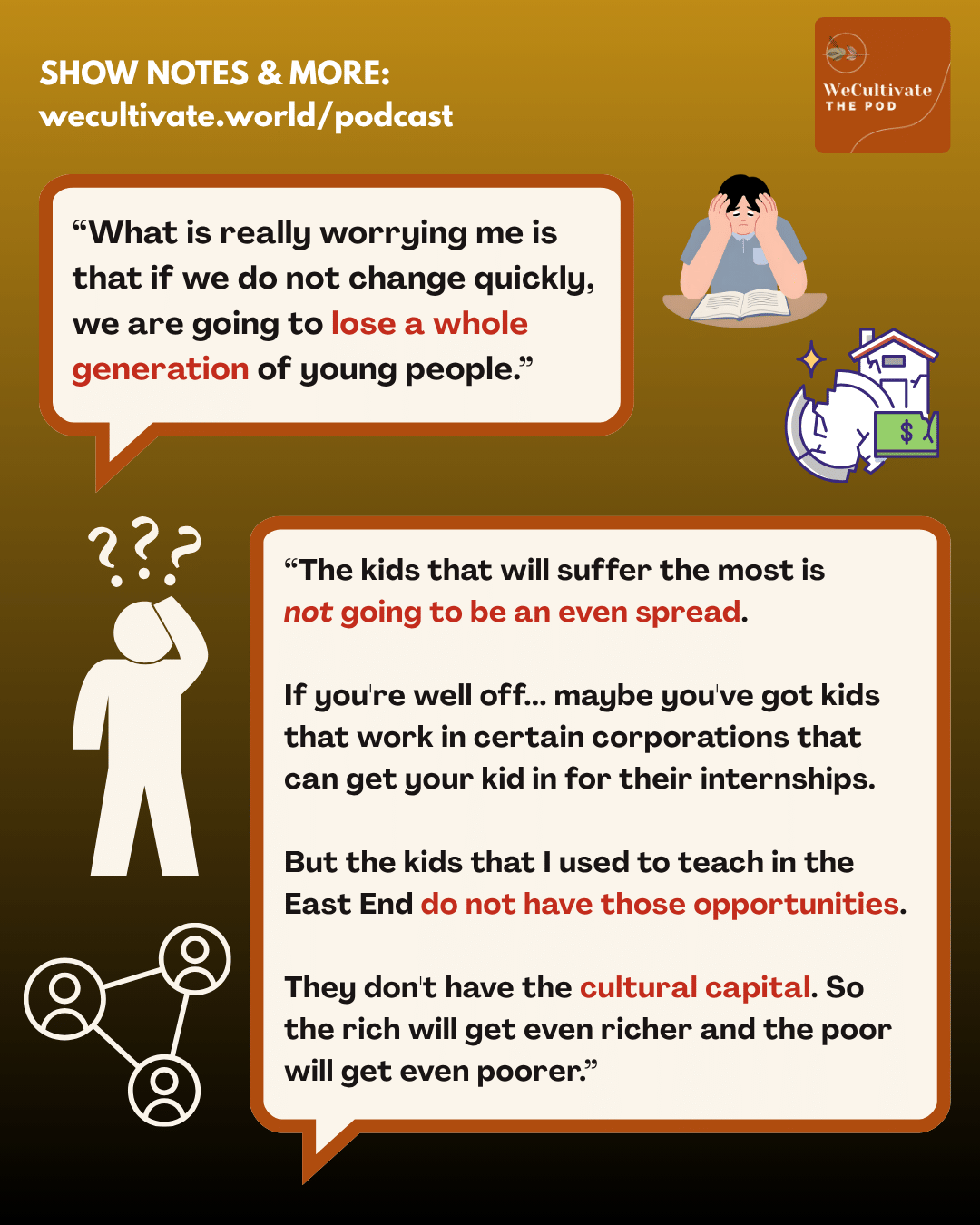
But you get the idea not modern. And I said, Montgomery come with me to the classroom of the future. And I took him in my time machine and we traveled through time and buffeted by all time anyway, but we got into the classroom, Montgomery from the 19th century would be able to still teach, right? If you took the whiteboard away, you took away the internet, you took away the projectors. It is still the same. It's still the same. I could give Montgomery a textbook and I'm sure within a month you'll be teaching exactly the same. There's no other industries that I know or there are very few industries that I know that so many people count on where it's not being disrupted in that way. And the thing is, what is really worrying me is that if we do not change quickly, we are going to lose a whole generation of young people.
I dunno what it's like in the states, but I know certainly in the UK graduate jobs have halted graduate jobs. So typically people go to university or colleges used to lots say in America, they come out and again, entry level job may be accounting or finance or law or in the medical field. And what you do, that's the bottom rung of the ladder and you start climbing up that ladder to build a career, that bottom rung of that ladder is being taken away. Why? Because corporations and many businesses can get AI to do it. So how are these young people, so these young people come out of university with bucket loads of debt. They can't get on the corporate ladder. They might work a retail job, but even with the retail jobs, they're cutting back now, I dunno again what it's like in the estates, you can tell me, but I know in the uk when you go to the major supermarkets kiosks, what are these young people going to do?
So that's another passion of mine as well. And the thing is, the kids that will suffer the most is not going to be an even spread. If you are well off, if you are upper class or middle class, maybe you've got kids that work in certain corporations that can get your kid in for their internships or they can squeeze in. But the kids that I used to teach in the East end do not have those opportunities. They don't have the cultural capital. So they're the ones that are going to get, so what's going to happen is the rich will get even richer and the poor will get even poorer. And that's a crime as far as I'm concerned.
Michelle:
Absolutely. I really appreciate you bringing up, and I know it's a topic that we said that we would discuss also the fact that we're not only speaking to the need for institutions to reform, to change, but also in the age of AI and everything that we see going on now, the speed at which all this change in development is happening in the world around us without having, I think any sort of indication of systems or policies changing. And I think this is where definitely we'll have an offline conversation about all the differences in the states. Too many, and I'm not going to be able to talk about anything on your end, but we have 50 states, so it's very, very different depending on the state and local markets and funding and all that stuff. So just the way I say it all the time is just think about the 50 states as 50 individual countries and it makes a lot more sense in terms of how the US works. So the big topic, AI being here, a lot of people I think are concerned about, well I think to back up for a second, can I ask about the standard for technology in most public schools where you are? So are your students required to learn computer skills, basic computer skills, or let's take it to programming or anything. Has that been integrated at all? No. Okay.
Karl:
No. So what tends to happen, just to break it down, I'll break it down through key stages, okay, what is key stages
Michelle:
We need to go?
Karl:
What does that mean? Of course, let's, so key stages are basically key stages are the learning journeys for a particular group of children at a particular time. So you've got find called early years, which is zero to four. And then you've got key stage one, which is, again, I'm not primary key stage one, which I believe goes up to year four. So that is four to eight. And the key stage two goes up to eight to 10 or 11 and key stage three, so on and so forth until you get, so it's a journey, it's a learning journey. So in that particular, whatever key stage they're at, so it's like a stage, they've got to pass certain requirements and that's a way that we as educators can monitor how they're doing. So we can kind of predict. So key stage two, which is what we call primary level, primary school, I think you are.
Michelle:
We have elementary, middle, and high, and middle school. Yeah,
Karl:
Perfect, perfect. So it's middle school. So for middle school, so basically you could be able to look at a child and looking at where they are in a stage, think of it like a marathon. So you know that okay, you've got people running and you've got people at different stages of the marathon and you know that, okay, just say halfway through the marathon, you've got these particular runners, Sharon and Sarah who are front runners, you know that if they keep their pace, they'll win the marathon, if that makes sense. You've got some people at the back and you know that if they keep their pace, they're going to lose. Now of course some people do really well, they accelerate some slow down, but generally speaking, I can look at a child in key stage two, which is middle school. So roughly when they're about eight or about nine or 10 years old and say, okay, if they go on this particular, what we call flight path, they will end up here, right?
They will end up with a's b, I dunno how you grade in the us, but they'll end up, we do numbers. Now it gets confusing, but let's just do old school. You got a, which is the best or a star, B, C, D, E, F, G, right? What people have got to understand when we have these conversations about AI is, I think there was a quote, I believe it was from one of your former education secretaries out in the US for the life of me, I can't remember his name, but he said that we are preparing children, a generation for children, for jobs that don't yet exist. We are training children for jobs that don't yet exist. How do you do that? Now the thing is, and I'm sure it's the same in the us, what you've got in the uk, when we were growing up, we were told, especially coming from an African household, there's only three jobs you can have. Could be a doctor, a lawyer, an accountant that was the only three jobs engineer, you can kind of squeeze in there, you could do that. But doctor, lawyer, accountant, if you didn't get those jobs, your parent
Michelle:
Failed. Your ancestors judge you. Exactly.
Karl:
That's the only job. So these were traditional safe jobs. It was almost like guaranteed you have a guaranteed salary, you'll be able to buy a house, you'll be able to do all these things. But if you look at these jobs now, so I know people that work in finance and they're saying to me that I spoke to one individual who's a bit older than me, closer to retirement, and we chatting and he said to me that I'm so glad I managed to have a career in accounting. He goes, I feel sorry for when I look at the juniors. So he's like a finance director. He goes, when I look at the juniors in the office, they're not going to have the opportunities that I had. Because AI is starting to take these accountancy jobs. There's software you can literally get on your phone that can do accounts for you.
When we look at things like law, and we look at how, now, again, I don't know the US policy on it, but the UK policy lawyers are not allowed to use AI because now we've got lawyers that are going to AI and getting them to research cases. Whereas again, a way into law in the UK would be you start off as a legal clerk. So the solicitor or the lawyer will tell you, look, we need to research that. And the clerk will literally go and look up laws about traffic violations in Scotland. That was his job. Now you can do that at the touch of a button going even away from careers. We are looking at house prices. So in the eighties and nineties, in the seventies, you could buy houses in the UK for 50,000 pound basically, okay, yes, it's not adjusted for inflation, but basically you can have a situation where you had one breadwinner, whether it's male or female, and there could be a stay-at-home parent and they could live with one salary.
Okay? Now I'm not going to go into the politics of that, and I'm not saying that's why I didn't gender it. I'm not saying the woman stays at home or whatnot, whoever, it doesn't matter. You could live with one salary and you could have a fairly good life. You could buy a car, you can go on a holiday in the uk. So in London for example, the average house price is something like 675,000 pounds. So in dollars, that's probably $800,000. In order to buy a house in London, you are going to have to be earning over 130,000 pounds. The average salary in the UK is about 30,000 pounds, which in US dollars is about 40, $45,000. How are people going to be able to afford that? So what we've done, and this is why I get really passionate about it, is that, so you've got a group of young, especially from disadvantaged backgrounds, you're telling them, go to uni, go to uni, go and get a job, work really hard in school.
And then once you get your job, you'll be able to get an entry level job and you can start climbing that ladder and eventually you'll be able to buy a house. All those things have been taken away. All those ruts in the ladder have been taken away. So again, if you are upper class, and again, I'm not going on eat the rich, kill them all. I'm not saying that at all, but we've got to talk. We've talk about the realities. If you come from an upper class background where baby your parent is a barrister lawyer or a doctor, they might be able to put you in private schools. You've got that social capital, you've got those connections to the universities, you can jump up. Those missing strongs are not there. They're still there intact for you. But I'm talking about a kid that lives in what we call a council state in America, I dunno, you might call it the projects, I'm not too sure, but lives in low income housing doesn't have all those connections.
Parents are working around the clock to feed them and clothe them. They go to a state school and they go to uni, they get themself a decent degree and a decent subject, but they still can't get ahead. And what ends up happening is it starts to affect their mental health. They start saying things like, maybe I'm just not good enough. Maybe it's my fault. No, this is a systemic problem. So this is why I started something called Teach Outside the Robot, which is a newsletter because I want educators, parents and everybody to know that no, it's not you and there's, but there are ways around it. There are ways that we can still change, there's still time. So that's what I'm really passionate about.
Michelle:
Thank you for using the alternative words as well. I appreciate the attempt. Even if we can't make direct parallels sometimes just due to the nature of being in different countries, I feel like sometimes what I really like about all of the conversations I generally have in my life, but certainly on this podcast, I like the fact that, okay, well I don't know if I can like this. I appreciate that we can see similar themes no matter where we come from. I think that many countries are facing this now. I don't know who said that quote, but I like it. Our education secretaries I also think have, at the federal level, it's a little bit different because it's really states that decide how education happens. It's how you have the Bible being taught in certain states and not how you, it's like the same thing with everything else in the us, but I feel that what you're touching on is a common theme. I see it in France as well. I see it in many other countries. I've talked with people who are teachers in other countries as well. I do think that there is sometimes a misconception, especially in the US
Where let's just put continental Europe as a whole, but definitely former imperial colonial powers as having things figured out. And I think I have burst many a bubble explaining the way that France works now. And I think I've been met with some resistance because it's like, oh no, no, they were supposed to be the better version. I think what a lot of people don't understand, and I appreciate you breaking down exactly what median salary is these days where you are, is people have this almost idyllic dream that public education is nearly free. You can go in, I guess, I don't know, it just seems outdated. So you can go get your education, you can work hard, and there'll be jobs available. What I noticed just living in France versus the us, I noticed a lot more rigidity in the structure in France, which I feel is mirrored across many different European countries. I was a little bit surprised, I think definitely finding people who are in my generation who had never seen, not necessarily seen a computer, but are relatively new to using it. And so how does one then empower or how can one even start to empower themselves if you are in this, it feels hopeless for a lot of people,
Karl:
I think, to be honest with you. So to answer your original question, we've got very basic computing skills. So each key stage, that's where aha. Now the question you asked why we were talking about key stages. So each key stage, computer literacy and the ability to be able to use computer is implemented. But I mean if you're looking at middle school, so if you're looking at between 10 to, I'd say 13, 14, it's basic using the internet to do searches, and there's a lot of emphasis on safe internet. So for example, if somebody says, can I meet you? And how do you know they're a real person and whatnot, but there's nothing in terms of, oh, we're going to teach you to, there is, it is basic coding like website type of coding, but nothing in terms of build the next Facebook or whatnot, what have you.
And then at key stage three kids get to drop the subjects. So the curriculum narrows so to speak. So you have something called options. So you have option between geography or history or sciences tend to be no options. Hot geography, history, drama versus food tech, I don't know. So you have these options, but it's people don't come out of school and they're not computer whizzes. The thing is, our young people already know this and they're already making adjustments now. So when I look at this question, is it hopeless? The young people already kind of know when I used to teach properly, kids will be like, you know what, sir? What is the point of going to uni and doing these types of things? So what they do, they become a lot more entrepreneurial. They start starting their own businesses, they start learning about social media and branding, and they create their own alternative career paths.
I mean, what has started to happen now is that a lot more people realize that it will be better to build something called a portfolio career. So I've got a portfolio career in the sense that rather than what we've been taught, if you look at an industrial age way of thinking about education is you go, you get educated, you stay in a job for about 20, 30 years, then you get a pension, a gold watch, and then you go on a cruise to the Caribbean and that's it. And then you just wait, you wait to die basically. But what people have realized is that you're not going to have that job for 30 years anymore. Companies are not lawyer. You touched upon it where you said things are moving so fast, the company that you're working in, if you are working in a particular company, just say like Blockbuster video. Imagine there could be a person that worked in Blockbuster video.
Michelle:
I miss blockbuster.
Karl:
It was great. It it was brilliant. But now that whole company's gone. What do you do then if all you've ever known is Blockbuster video? So our young people have cottoned onto this for good or ill, they're using the internet in very, very clever ways. They're using their Instagrams to sell products. They use AI now to be able to create avatars of themselves so they don't have to go to work. Hence why the uk, they're saying everybody has to come back to work now, right? Because it's all about remote working. But people, you know what? It's the idiots online that spoiled. They're in Dubai or they're in space.
And they Bo things say, my boss doesn't know that I'm in Dubai. I'm like, idiot, you are. I know, and I don't work with you. Your boss will find out. But what I'm saying is that I think we've got to take the lead. And the thing is, it's not that all education systems around the world are poor. There's some really forward thinking education systems. So in Finland for example, what they do is, and a lot of people from the UK education scholars have gone there to see what they're doing is they say, okay, fine, up until the age of 12 or 13, middle school, we'll do the traditional subjects. But what we start doing is we start dropping the traditional subjects apart from English and maths, which you still have to do, but we are more built on project-based learning. So you are going to build a business or you're going to build this or whatnot, because they said that is the best way to prepare them for the world of work.
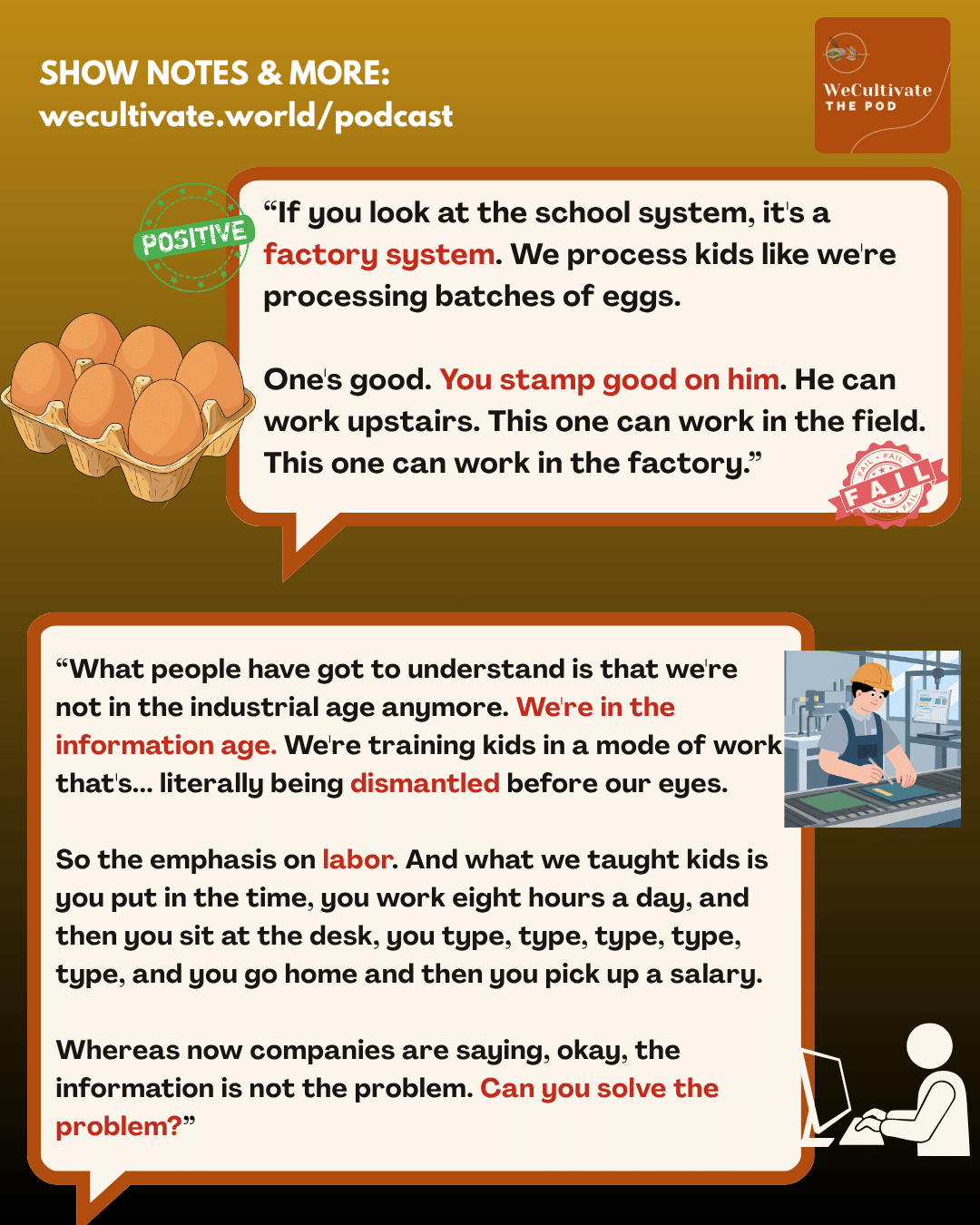
So they've had brilliant results with that, and their children are much more equipped to be able to handle that. And also on top of that is we are, what people got to understand is that we're not in the industrial age anymore. We are in the information age. We are training kids in a mode of work that's not, it's literally being dismantled before our eyes. So what we talk kids is you put in the time you work eight hours a day, and then you sit at the desk, you type, type type, type, type, and then you go home and then you pick up a salary. Whereas now companies are saying, okay, the information is not the problem. Can you solve the problem? Can you information, because you go to a job interview, why should we give you the job? Because I know this, that and the other or whatnot. Now where's pace? Like Google are like, okay, here's a problem. Can you solve it? It's a different way of thinking, critical thinking. And this is where I think a lot of people are falling down, and this is where we're perpetrating a fraud. So yeah, this needs to change.
Michelle:
I think a lot of people have brought up Finland. I don't think I can go a week without somebody citing Finland's education system. I have not been to Finland to see it yet. However, I do really enjoy seeing clips on. There was something that surfaced the other year, perhaps on media literacy and how to tell fake news from real, actually real sourced and researched news. I thought that was interesting because it was happening very, very, very early. I think the kids were something like 11 or 12, and that's incredible. And also what's happening in English, which is not, it's like how many things changes can we make? So I thought that was really nice to see. And I definitely agree that different people, different countries can learn from each other. I think the question is always, and definitely people can become entrepreneurial. It's more on institutions, it's on these systems, it's on the powers that be. Many times, I think I notice in a lot of us born people how there is a almost ultra myopic way of looking at education and the economic situation and jobs and teachers and teaching and all this stuff. Because then it also blinds you from what's happening in other places of the world. And you also cannot see how no matter where we are, the world is changing, the world is globalizing. So if you can't learn how to talk to other people in other countries, it doesn't matter how great your local school district was because you're going to have an issue.
And this is, is the area that I work in generally between countries, between cultures and on multinational international teams. When my clients are there, this is where people start to have communication problems. Because you start to have issues of, well, how come you don't know this? What do you mean? How come this thing doesn't work that way in your country? Why don't you live my experience of life? And yeah, I really think this is so relevant because I can hear a lot of people saying, oh no, I don't see why it's important. Oh, this seems like a UK problem. This seems like a Karl problem. And it is not.
Karl:
No, no. I've touched upon it or danced around it in this podcast about cultural capital. And we don't talk about that enough. So what does that mean when I refer to cultural capital in the uk? I dunno, I presume it's similar to the US when we talk about class, we don't only talk about money or socioeconomic status, but there are certain things that certain socioeconomic people of certain socioeconomic status will do. Okay? And these become markers for your ability to be able to fit in into a team. Now, people talk a lot about race, but people don't talk enough about class IE. So for example, thank you. Yes. So for example, I know I've had good friends that have went to private school, and what they tend to do, and their parents are quite well off barrister, solicitors is they'll go to the Swiss Alps, they'll do skiing.
Now, you might think to yourself, Swiss Alps, what's going on there? But obviously if you've ever gone on a school trip, I understand this costs thousands and thousands of pounds, and it's not only the Swiss Alps. You've got to buy the skis or rent the skis. You've got to get the great equipment, you've got to get this. So what this starts to become is this starts to become a marker of where you fit in. So for example, if you are going to work in the city and you're going for a job interview and people, you get talking, it's like, where did you go on holiday? Oh, I went to the Swiss Alps. Oh, you went to the Swiss Alps? Or what part? I went, I dunno, anywhere in the Swiss house, but you went to this part and this part and blah, blah. Oh, did you go to that chalet?
And then what that shows, the other person is he's like us. She's like us. She fits in. Now, if you've got somebody that lives in the East End or somebody that comes from low income housing, they're not going to be able to have access to that particular type of conversation. In fact, I've heard stories where to enter certain financial institutions in the UK or to work in the top financial, you have to get a tie from a particular shop in something in S Row, right? Sa Row is like the designer street in London. That's where all the top business people get institutes and stuff done. And I dunno the name of, see, I haven't got the social capital to work in finance, but I dunno the name of the designer. But you have to go and get a tie from this place and people will say things, oh, what suit are you?
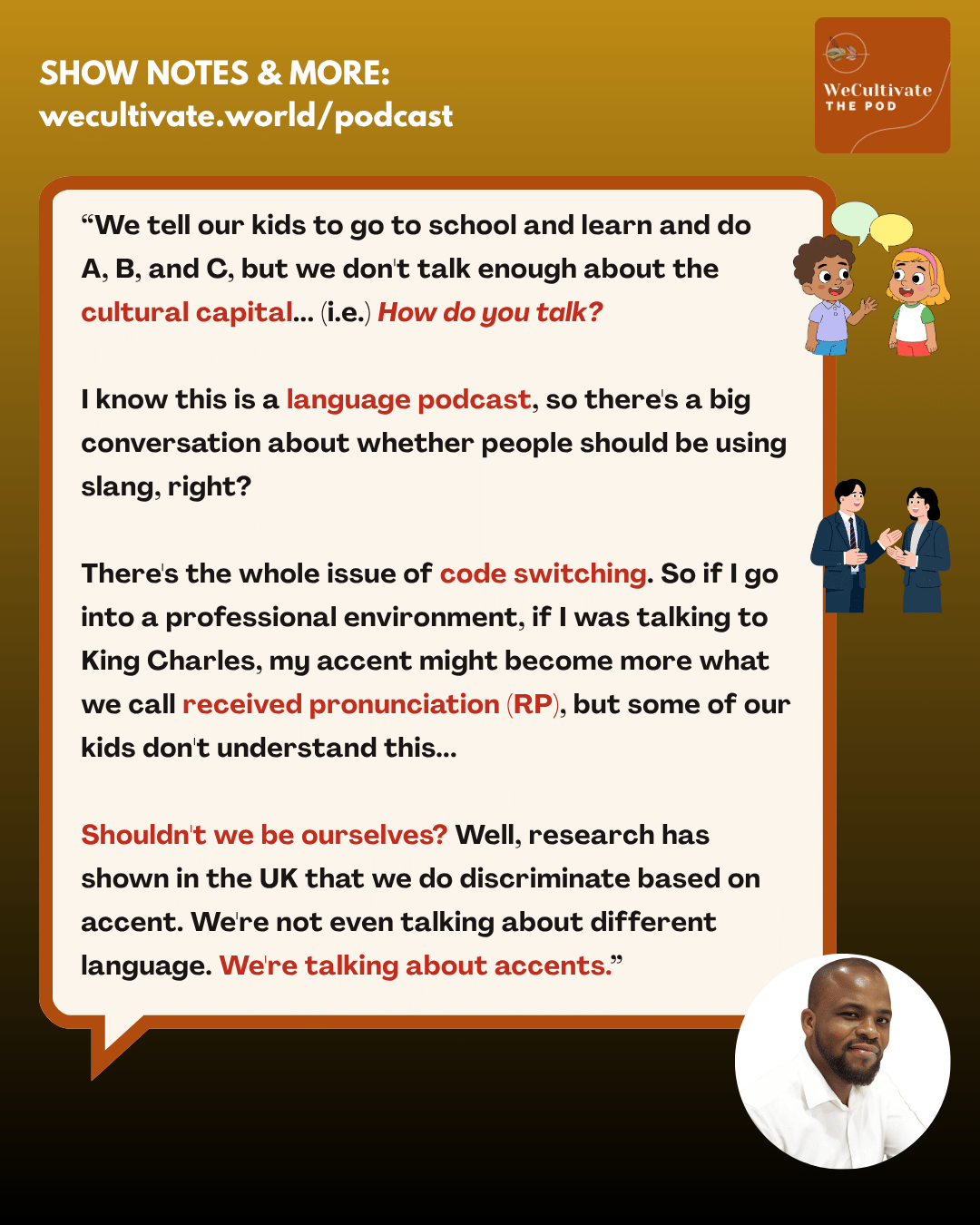
Because these are all markers of where you, right? So we tell our kids to go to school and learn and do A, B, and C, but we don't talk enough about the cultural capital. How do you talk? There's a big, I know this is a language podcast, so there's a big conversation about how whether people should be using slang, right? So I talk in a London accent. I talk in quite a London accent, but there's the whole issue of code switching. So if I go into a professional environment, if I was talking to King Charles, my accent might become more what we call received pronunciation. But some of our kids don't understand this. And rightly or wrongly, should we be code switching? Shouldn't we be ourselves? Well, research has shown in the UK that we do discriminate based on accent. We're not even talking about different language, we're talking about accent.
So people in the northern regions of the uk, places like Liverpool or Manchester or Leeds, they've started to soften their accent, the south of England so that they can be perceived as one of the gang. And these are the problems that we're facing. So a lot of our young people might, what we've in London is called MLE, which is multicultural London English. You know what I'm saying? Yeah, greasy and that and all that type of stuff. But if you walk into an office talking like that, you're not going to get a job. So are, again, this is what I'm really passionate about, but unless you are coached in this, this is something that should be taught at home. Unless you are coached in this, you won't know. So you might be, I'm going for a hundred job interviews, no one's hiring me. You're not wearing the right shoes, or you're not doing this, you're not doing that. So these are all the factors that kind of come into it and create the situations that we're in now. So there are some similarities with what you were saying.
Michelle:
I love that you brought up accentism, because I think people think sometimes it's only about foreign accents and they don't realize that it happens with local and regional accents. We hear about it a lot with those who, let's say you're from the southern part of the states and
You learn very quickly that you need to change your accent because everyone's making fun of you. Everyone is like, oh, you work on a farm. And they make these jokes that probably, even if you're from a city, why would you be making that farm association? And farm, of course, is associated with uneducated and low class. And yeah, I agree. I also think it's reminding me of those who, so no surprise, I'm Asian American. No surprise that there was pressure to go to an Ivy league. I did not go to an Ivy league, but my friends who did very quickly had to strip themselves of any of that poor person energy, as they call it, right? It's very, yeah. That's so tough. Well, I mean, yeah, talking about slaying, right? So basically we needed to, who's not me?
There is a pressure to change and adapt and match. It's the Swiss Alps version. So if you go to a Harvard or Gale, you very quickly have to start speaking differently. You have to dress differently who you date, who your friends are. And it's all in the interest also of securing that first job, that first entry point. So if you want to go work on Wall Street, you need to know the right people. It's the same equivalent of buying the tie from whatever store. So you need to be dressed in whatever brand. I don't even know what brand. I agree. I don't know. It's also probably never mattered to me, but I have seen in London for sure. I think the, what is it, like the vest that everyone wears? Why is it such a finance bros thing? Like everywhere? It's so annoying.
Karl:
I could tell you it's either the gilet, you wear the gilet, the blue suit or the black suit. You have the black shoes or the brown shoes. In fact, one of my students was super quickly just to add onto your point was going for these jobs and he cut a long story short, wasn't getting an interview and somebody had to tell him and pull 'em aside and say, you're wearing the wrong kind of shoes. That's why they're not even looking at you. You're not getting past the first you changed the shoes and he started to get more success. So yeah, that's finance bros. That's a new term I'm going to use.
Michelle:
Yeah, we use a fabric tech bros. Finance bros just slap on bro for anything. I think there is a huge conflict that arises in those who,
I mean if you were raised that way, if I don't know, in a certain type of family that revered these sorts of things, I guess it would be more natural. But for a lot of people I feel they have to change and adapt themselves and fit that. It's like how many ways can you fold yourself to fit this mold? And you have to laugh at the right time and say the right things and yeah, change the accent and really change everything about yourself to fit in to get that career. And once more, I think people are dead inside for this reason as well, but let's also take it to marry the right person, have the right type of wedding, plan the right type of honeymoon.
Karl:
And the irony is even of these finance bros or tech bros, is that the irony is that the way things are going with ai, even those guys are going to be struggling. I think, and again, I'm not going to go down the conspiratorial path, but I'm just looking at facts and data here. You've got all these people like Elon Musk, you've got Peter Field who was a part of, they call it the PayPal Mafia. He was with Elon Musk and other investors and Reid Hoffman who did LinkedIn and whatnot. Reid Hoffman from LinkedIn as well says the same thing that in the next by 2030, a third of jobs will be gone. And we're not talking jobs like the menial jobs. In fact, what will start happening is that the so-called menial physical jobs like being a plumber, being electrician will become more popular again because the knowledge work, jobs, IE sitting at a computer are starting already to be decimated.
We're seeing it as I said at the top of this podcast interview, they're saying up to half of graduate jobs are disappearing. What will happen to the society then? So even these markers of success, IE, you've got the house and you've got the BMW and stuff. And I'm not saying that these are bad things necessarily, but if you come to a place where your job gets automated, just say you're that junior accountant, you've made it, you've climbed up the ladder and all of a sudden they say, we've got an AI accountant, what are you going to do? Then it's that thing where we attach our identity, our job with identity. I hate when you go to a party where you're meeting somebody, hi, my name is Karl you. And inevitably, within a minute I always count in my head, what do you do? What do you do?
And it is used as a way to judge you. It's used as a way to assess whether you are good enough to talk to or not. And I think we've got to move away from that. And what people have got to understand, I feel for the young people, the younger generations, the generation Zs or Zs, the generation alphas, because when I was growing up, I was competing with people that were local and then it was competing with people that are global. These guys are competing with machines, they're competing with machines. But I don't want to make it depressing or a downer because I want to say something which is quite positive. I think what this younger generation has that maybe our generation don't have is that a lot of them are starting to rebel. They're starting to be their authentic. They realize that this way of living is not paying off.
Maybe it paid off for Generation X and boomers, but it's not paying off for us because they could afford a house, they could do all this. We're working our butts off and we're not getting any of the rewards. So now we're going to be our authentic selves. And one of the things, again, talking personally with me when I was even working in education, I felt that I climbed up to management level and I felt that there was that pressure to be able to conform, to be able to talk certain buzzwords. I felt there was a high scrutiny. I remember when I became a manager. So this doesn't only apply with teaching, this applies to any industry. So you are a normal rank and for office worker, just say for example, you become the manager. And I remember when I became a manager in my particular field, the big one of the senior managers pulled me to one side and he is like, oh, you can't fraternize with these guys.
Normal. You can't really chat to them. And I was like, why? I get on well with 'em? And he said, because they have to fear you a bit. You have to keep a bit of a distance. Now, I've always fought against that because I'm not saying I'm a greatest manager, but I think you can be humane as a manager if somebody's not doing what they're meant to be doing. There's ways that you can have that conversation and say, look, John, come into office. Look, we need this. What's going on? Let's get this done and let's get this sorted. But this thing of separate you out, you are one of us. Now, I always kind of struggle with that, but I think with the younger generation, what I'm starting to see is that especially because of the ubiquity of social media, because social media everywhere, they're willing to express themselves and they're more willing to take those risks and they're being rewarded for it. Because now as you've probably seen on LinkedIn and Threads, when I look at social media, a lot of it's bots now, a lot of it you can tell if you special on LinkedIn, I'm sure you've seen it, Michelle, where it's like five ways to be more efficient in the office, use dynamic communication. You ripped that or sis, you ripped that off chat GTP, man, it's like five ways to be better in your, I'm like, oh gosh,
Michelle:
You know what I love? So I got off LinkedIn, but I have kept a pulse on it because it just keeps coming my way. I got off before all this. It was already becoming insufferable. And now what I love is those how am divorce taught me to be a better manager. How the passing of my dog led me to reevaluate systems and change management. I don't know, there's something always tagged on and it's like, oh dear God, what is, and everyone I think coming out with the, what is it, like the great work, so inspiring, love this, right?
Karl:
Oh my God. Now the best ones were during Coronavirus. They were actually, I was sitting and laugh in my head off. It's like if you haven't learned a skill, a new skill during the coronavirus, then you've wasted your time. I'm like, we're in a flipping pandemic my friend, people's mental health. It started to drop. I know I use Corona to make myself rich. I'm like me just be a human. And I think the piece, what I'm trying to say is that I think we're coming to a time where
I think humanity will be valued. Again, what I mean by that is because AI makes it so easy to write posts and do videos. I've watched YouTube where it's literally AI done the whole thing from top to bottom is AI done. I think people have a greater appreciation of being human again. And this is what the young people, I think they've got this better than the people I've had to kind of boil it out of myself. Because the way that the industrial system was set up, and this is not conspiratorial, this is actual fact you can go and look this up, is we moved from an agrarian age to the industrial age. And in industrial age basically you have a job to do and you have to do it right, you have to do it accurately. You had all these big industrialists, whether it's the Carnegies, the Rockefellers, you go and look these guys up yourself and they were like, look, we need a way to get these guys trained so that they can go and work in the factories.
And if you look at the school system, it's a factory system. We process kids, we're processing batches of eggs. This one's good, you stamp good on him, he can work upstairs, this one can work in the field, this one can work in the factory. There was a great guy called Sir Ken, I think it's Ken Robinson guys put it in the chat or whatnot. Tell me if I'm wrong, but sure it sir Ken Robinson. And he said that the education system has to change. I think at the time it was was the most watched Ted talk of all time. He broke the whole thing down saying that the way, and this is what I say to people as well, that a lot of these young people, they may not talk him, received pronunciation, but they are extremely talented. I mean, I'll tell you a really funny story.
I remember I did before I became, went into a alternative provision, I worked in a primary school, this was years ago, and there was a kid, so this was the time before Netflix, there was a kid. So what you could do is burn DVDs. What we found was cut a long story short, there was a kid who was quite naughty and all of a sudden he really wanted to be a library monitor. So he was year five, that is what, eight or nine years of age. And he was like, I want to be a library monitor. And the guy's behavior changed and everybody said, this is brilliant, this is great, it's fantastic. His behaviors changed. Then he started coming in with more expensive trainers, designer bags, and people were like, what's going on here? Cut a long story short, he got rumbled. What he was doing, the reason why he become a library monitor was he was doing a DVD enterprise.
He was like a little blockbuster in the school. So what he'll do is he'll come to her kids, it'll give the book, and inside the book was a menu of films. So you say you can watch X-Men or you can watch this. The kid will obviously return the book with the thing. He'll go give him another book with the DVD in it right now, obviously the reason why he got rumbled was because he should have learned from corporate, he should have that quality assurance. The dvd, some of them weren't working, so the kid complained and said, this kid gave me a dodgy DVD. Now this guy got excluded. Now what I was arguing with people was saying, okay, what he did was illegal, and I'm not justifying that, but I said, can you not see the entrepreneurial flare, the fact that he had a supply chain, he had customers inventory, you had to think about inventory, profit markup.
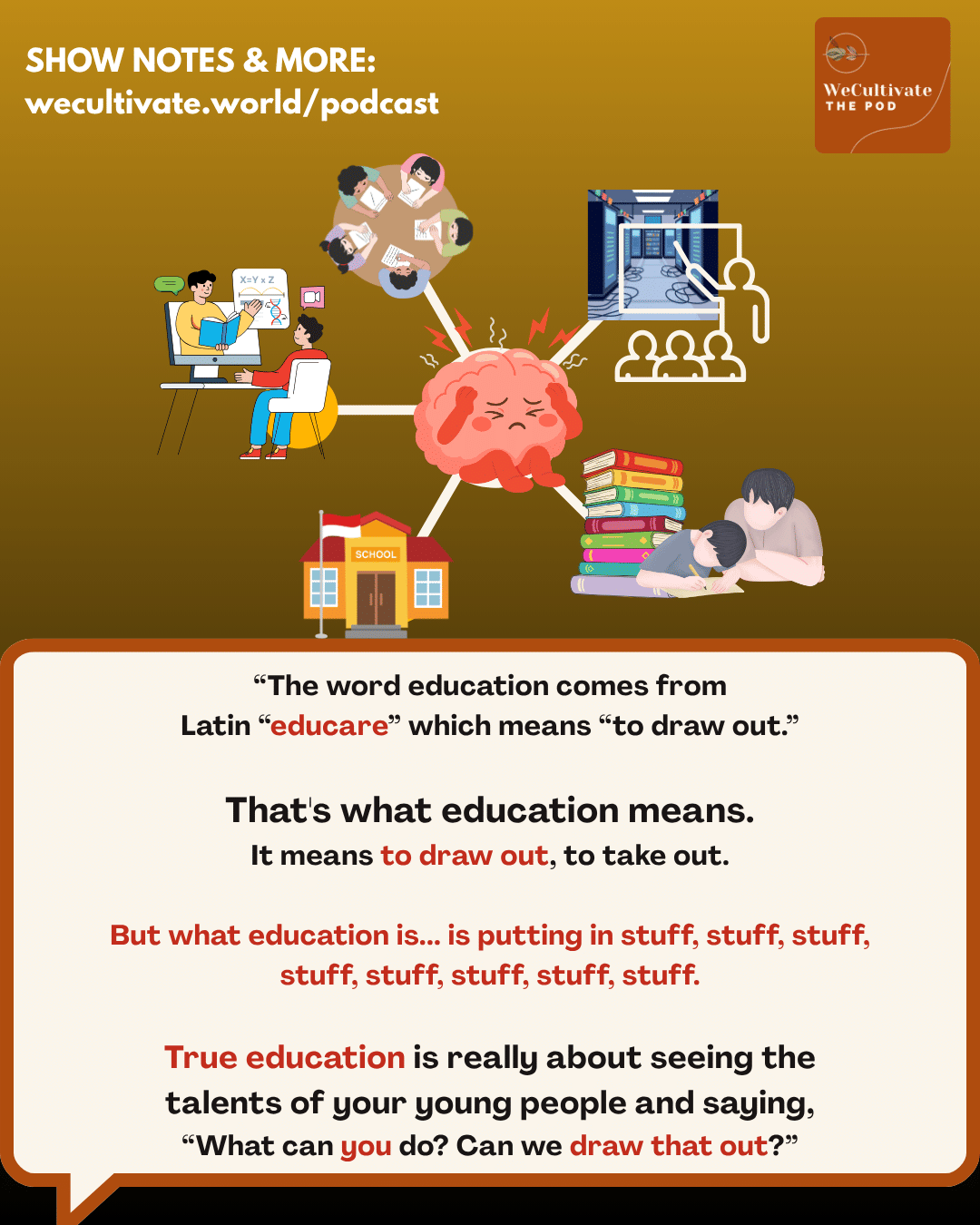
This guy is a prodigy, this guy is a prodigy, he's a business prodigy. But what we've done is punished him. But okay, it's an amusing story. And again, for the record, I'm not saying do a illegal activities, but what I'm saying is that people rather the head teacher just disgusting and the grateful, get him out of the school. I'm like, he's talented. Maybe, okay, don't do the DVDs but say, okay, there's a school project. Why don't we give you the website to run? Why don't we give, okay, we've got a tuck shop. We want you to be in charge of the tuck shop. This is what education needs to do. The word education comes from Latin, which is educatio, I believe, which means to draw out. That's what education means. It means to draw out, to take out, but what education is putting in stuff, stuff, stuff, stuff, stuff, stuff, stuff, stuff. But true education is really about seeing the talents of your young people and saying, what can you do? What can you do? Can we draw that out? And I wish, I dunno what happened to that young man, this was several years ago, but I remember thinking this young man, there's a talent here. Okay, he did it the wrong way, but rather than punish him, why can't we do something with it?
Michelle:
Yeah, I support it. I support.
Karl:
There you go, everybody. This is an exclusive illegal activity. Michelle supports illegal. No, I'm joking.
Michelle:
I don't support the illegal activity part. I do recognize the entrepreneurial spirit and I appreciate a unique take on being solution oriented. I think that we need all kinds of out of the box thinking. And so
Karl:
If I find them, I'll send them your way, Michelle.
Michelle:
Yeah, I mean I've had a lot of these conversations. I had a friend who had an apartment that was overlooking this one spot that was a hotspot. And the only way he found out was because
There was a whole operation, it was run by teenagers, but essentially there was one who would relay it to the next person and next person and they would divide it up and then where they hid everything, where they had their stock, their inventory, and how they passed it off and at what time and who would be on the lookout for police and everything. And then how they would make the call. And it was, yeah, I think it's a really, really beautiful thing. If you just step out of the whole, oh, it's bad, it's wrong. How can you, I mean leverage is a big word I use a lot because we have different experiences and different talents. Sometimes we just need a little bit of redirection. I think,
Karl:
And this is where I think education, again, if I had a magic wand, then I could change the education system. I would very much be along the lines of what you've just said rather than looking at, okay, this particular subject, of course, I'm not saying abolish all subjects, but I think that there is space now with technology because everybody talks about technology like Termin AI is going to come and kill us all, but now we can start doing things like more personalized curriculums where I do agree with that a lot. People are like, no, we shouldn't do that. So a lot of the Silicon Valley types are talking about having a personalized AI that grows up with you. So a kid gets given it at the age of five all the way to 18. And the AI literally, so imagine you've got some form of Google glasses or some form of advisor.
You get instantaneous feedback. So the ai, I dunno how you'll connect it, but the AI looks, you write the paper and then it literally tells you would've got a grade A or B or something like that. And this is what you need to improve on because people say, okay, if the AI comes, teachers lose their job. No, I don't believe that. I believe that what we'll have to move from is instructing to coaching because what people miss out on education is that there is an emotional component. I'm sure it's the same when obviously you deal with learning languages. If you've got somebody you're teaching a language, let's say you're teaching them French, I got kicked out of French, right? I flunked out completely. But the emotional component of learning is where if you've got a teacher, just say, I'm reading the book and it's hard and you're like, I can't get this.
You can be like, you can do it. What you've said is not curriculum based, it's not based on the actual instruction or the diet structure of it, but it's the emotional component. And AI can't do that. You can do it. You're not going to believe the ai because the AI does have the empathy. And as you said, you did BioOncology, we're biosocial animals. The worst thing you can do to a human is put it in isolation. That is the absolute worst thing you can do. Because we are social animals. And this is what I cannot foresee a, especially if people know it's a computer. Unless a guy, I'm going really sci-fi, you go on Android that nobody knew was an Android, maybe it'll work. But the moment you present and say this is an artificial being that it's a massive part of the component of learning, you lose that instantaneously.
I cannot see a T 1000 Arnold Schwarzenegger. I am the T 1000. I'm here to distract you about French. It's not going to happen because the kids will know you are a robot. But when you've got a human or you've got somebody who can say, okay, I'm finding French really hard. And you say, I've been there, ai, AI can't say it is been there. I've been there, I've struggled with it. And this is what, so I think the future of education for teachers, I'm quite confident that teachers, okay, I'm confident for the next hundred, 200 years, maybe 300 years it'll be normal. But definitely for this generation that teachers can't be replaced because of that emotional aspect. And people always underestimate the emotional aspect of learning. The reason why kids love computer games is because there's an emotional aspect of it. You've got the characters, you do the big battle.
There's the cut scene. You could talk to your friends about it saying, oh, I beat the big boss. There's an emotional element of learning and I think that is what teachers should be mastering. Now I always say Maslow, Maslow's hierarchy of names comes before Bloom's taxonomy. Any teachers know that education and this. So basically if you satisfy those needs, especially the higher end needs in Maslow's Triangle of Meaning, why am I learning French? I always said this, I always use this example. When I was in school, there was no contextual meaning of learning French. None. Zero. That's why I didn't want to learn it. But I remember when I was about 20, I flunked her. I was 20 years of age. These are my clubbing days. They're way behind me. Now I met a French girl who was beautiful. She could not speak a word of English. I was desperate to learn French, absolutely desperate. I was like, give me the book, give me the dictionary. I want to talk to this young lady. But it was the emotional aspect and the contextual aspect. And that's where I think education is going
Michelle:
Well. I think a lot of it is also motivation. So what motivates one person will not be what motivates another. And when we treat everyone as the same and we treat them basically as robots, children in schools, I think that you forget that reward and motivation are not the same thing. And not everyone is going to be motivated through extrinsic rewards or something like, oh, here's a lollipop. Or here, every single teacher that tried to make everything a game is so annoying for me because I don't need a game. I need to know the why behind it. And I agree with the lack of context in a lot of subjects. I mean most subjects, teachers being important in the age of ai. But I will put a caveat, maybe it's the teachers who understand this, the teachers who will work to do this. I don't imagine that the teachers who want to come in take out the book, turn to page five, make you memorize everything, tell you how bad you are. I would not say that's teaching, but it's a big thing to say no,
Karl:
No. And hence why actionary teacher exists. And I would say to those teachers, it's going to be a tough ride for you. I get this all the time. So I talk about this all the time, the emotional aspects of teaching, how to build engagement. As I said, I don't like the term classroom management. I prefer classroom leadership. Management is very much like you do as you are taught. And that's what they're taught on the teaching courses. I dunno what it's like in the States. And I always say to people, no one cares how much until they know how much you care. Eleanor Roosevelt, by the way, first Lady, right? If you want to be that teacher, the thing is that you could get away with that in the fifties, sixties, seventies, eighties, even nineties, even two thousands. You can't get away with that now because a kid will go to you, okay, I have to learn this, but why?
I could literally pick up my phone, type it in, what's the capital front done? Why do I need to learn that from you? This is where the emotional aspect of it and the contextual aspect of it, if you are that type of teacher. And the thing is, what we've got to understand is the young people that we've got now are the most empowered young people in the history of young people. Let me break that down right now. So Keir Starmer is the prior minister of the uk. Donald Trump is the American president. A kid right now could pick up his phone when Keir Starmer sends a tweet or whatever, Donald Trump, he can pick up his phone and say, you are to the leader, I hate you. That is unheard of. If you went back 70 years in the time of Winston Churchill and I stood in the street and I said, Winston Churchill, I think you're I the daylights will be beaten out of me.
If you go back 200 or 300 years ago, in the time of the Kings, we had a Tower of London where if you disagreed with the king, you got locked up. So what we've got to understand is that the layers between those who govern us, the governors and those who are governed, it's becoming thinner and thinner because of social media. Whether you like it, I've got mixed opinions in it or not. So young people are used to having their voices heard. Also, what is happening because of social media is the speed of information. So whereas before, just say there was, I'm trying to think of World War II, we'll literally have to wait. You could wait up to a week for any information or news because they had to be the reporter who would wire it back to London. And now it's instantaneous. That's why when we are looking at certain conflicts around the world, we're seeing it in 4K.
People say wars have got worse. I'll say No wars. Were not in 4K streamed in 4K live. It is been proven. I studied this in media, even things like the Vietnam War, it was heavily edited because they wanted to make sure the American public were with it until certain things started to come out. So if you come to the classroom, so when I do trainings, people are like, Karl, I'm a teacher. You're trying to make me a psychologist. It's not my job. It's not my job. It is your job now. It is your job. Because a lot of the things in the uk, I dunno about America, but a lot of the things like the health and social care, a lot of this stuff is being cut, right? So whereas before you would,
Michelle:
We have no healthcare, public healthcare systems, yes, it's gone,
Karl:
Fair play, fair play, literally pay for it. But it's becoming like that in the uk whereas before, so for example, if I had a mental health emergency where I'm saying, look, I've got suicidal ideation or whatnot, what have you, they'll send me to a NE, they'll send me to the emergency doctor, they'll give me some drugs and send me home. If I needed to talk therapy on the NHS, I could be waiting up to two years. Two years. So you've got a lot of these kids coming into your classroom with all these particular issues. Social media. I'm not saying you can fix the problems. I'm not saying that if a child's got dv, domestic violence at home, you can fix that or their housing situation. But your job is to stabilize and soothe that young person and create a stable environment for them. This is where the emotional aspect comes in because that teacher that comes in and just says, just read the book and do as you're told, it's not going to work.
And on top of that, one last thing, attention spans are going down. This has been written in science, people saying, are we becoming dumber? I remember I could sit for an hour. Me personally, I could sit for an hour and read a book. Happily. Now I struggle. I struggle. I'm not saying I'm a scholar, but to sit and concentrate and look at a book and just say, you know what? I'm going to read this book. I'm not going to, your phone goes off. You look at that, that comes in. That comes in. We're in an age of distraction and we've got to learn and factor that into our teaching as well because it's not, oh, the good old days when the kids used to, that's gone. It's finished. And now with ai, that's got to be, it's going to be even worse. It's going to be crazy times.
So we have to factor that all in. We're coming to a time where people, because everything is so mass produced by AI and everything is, so the thing with AI is a bit soulless. It's not creative, it's derivative. All these large language models do. They suck up and hoover up all that's already been there and they tweak it and they add it to something else. But it doesn't have that genesis quoi, it doesn't have that originality. And I think that if people can come back to themselves, you said earlier when you work in corporate, a little bit of you dice or you die a little bit inside
Michelle:
All of you is
Karl:
A little bit, not 10%, 20%,
Michelle:
99.9% of you,
Karl:
99.99%. But I think the key message I think I'm learning, and this is what I've learned for myself, is to be unashamedly myself. And I think that if more people can do that, then I think the rewards will start coming in. I'm not talking just rewards in terms of financial or clout, I'm just talking about being happier inside. And I think the age of AI is allowing us to do that and create that platform. So be yourself. Own every part of your identity. Don't feel you have to lock, chop parts of yourself off the fit a box and create your own box.
Michelle:
I think we'll leave it at that. Is there anything else that you feel you want to make sure we capture?
Karl:
If you want to find me, if you enjoy this talk, just head over to Action Hero teacher. Come on. It's cost of Living Crisis in the uk. I'm joking, but yeah, action hero teacher.com and everything's there. But no, Michelle, honestly, thank you. I just want to say really quickly, I went on threads. I've kind of jumped off it now. There was a big wave after a certain billionaire ruined the Twitter. I won't go into that. But what was amazing was, I dunno how we connected, but I just loved your material. I loved your spirit, I loved the things that you are presenting. So it's a real honor that we made this happen and you invited me on the podcast. So I, I've jumped off. Maybe I was just on Fred's to meet one or two people and you are one of two people I love also. I gave up, I gave up. Everyone was like, yeah, we're off X. And it's like, what do we do? Hello? And everyone just started leaving, so I'm glad we connected, but I loved your content, so thank you for inviting me.
Michelle (outro):
So I hope you enjoyed that conversation. I know I did remember full show notes, transcript related resources, actionable advice, guest bios, everything is on the main site. We cultivate world slash podcast. Make sure you start following Karl's podcast as well. The Maverick School podcast is new. Our a teacher instructor. If you work with kids in any way, if you don't and you just really care about this stuff because maybe you are passionate about education or you just want to get to know more, follow, follow, follow. It takes two seconds from one podcast host to another. It is the best thing that you can do to help other people find our shows. Now I have been teasing the fact that bonus footage is and will be available this year. Yeah, I am working on it and I will get more news out as soon as I can.
Karl's episode, like many other guest episodes that I've had, does include a bonus section. I will have so much more news on that when it's done. If you want more people to hear these conversations and you want more people to discover the podcast, I would so appreciate all of those who are listening now to go quickly and leave us a really fast rating. If you have a little more time to write a review, it's free. Would so appreciate it. I know that everyone is busy these days, but I so appreciate the support and the small community we're starting to build. I, for one, can absolutely see the difference between this year and where we first started. So thank you for being here and I'll see you very soon in the next episode.