


You’ve scrolled through thousands of TikTok and Instagram reels about international families. But what does multilingual life actually look like in the day-to-day?
In this episode of WeCultivate: The Pod, Michelle sits down with Jovana, host of the Real Moms Talking Podcast, a mother of three originally from Serbia, now living in Germany with her Cuban husband. Together they navigate the realities of international family life while raising their children across four languages: Serbian, Spanish, German, and English.
Their conversation explores the lived reality of multilingual parenting inside an international family. Rather than rigid rules or perfectly designed language systems, Jovana shares how language grows naturally through relationships, everyday interactions, and the cultures that shape a household — not just the catchiest trends going viral online.
Together, Michelle and Jovana discuss the challenges and rewards of intercultural relationships, navigating life between countries, and why modeling imperfect language use can be one of the most powerful ways children learn what it really means to be multilingual.
This episode offers an honest look at multilingual family life beyond theory, classroom rules, or social media ideals, and dives into the messy, meaningful reality of language lived in everyday life.
Key Themes in This Episode
A Family Between Four Languages
Life inside an international household raising children across Serbian, Spanish, German, and EnglishMoving Beyond Language Rules
The realities of multilingual parenting outside classroom-style expectationsBuilding Relationships Across Cultures
How intercultural couples navigate family life and communicationWhy Imperfect Language Matters
What children learn when adults model real-life multilingual communicationWhere Multilingualism Actually Grows
How language develops through everyday interaction and lived experience
Actionable Takeaways
Model language naturally instead of forcing it. Children often learn languages best when they see them used organically in everyday life.
Perfection isn’t necessary for multilingual environments to thrive. Allowing room for mistakes and mixing languages can support confidence and participation.
Create environments where languages live together. Guests, family conversations, and daily routines can help multiple languages coexist naturally.
Intercultural relationships benefit from intentional communication. When languages and cultures intersect, couples often need to be more conscious about how they communicate.
Multilingual parenting is a long-term process. Language development can evolve over time as families adapt their approaches and children grow.
Related Resources
Below, you'll find a few links tied to the topics we discuss in this episode. WeCultivate does not unequivocally endorse the material or its creators beyond a cursory review of the material presented. They have been shared here on behalf of our guest to encourage further exploration and independent learning. This is a dynamic list and subject to updates as time goes on. If any of the links become broken, or if you have a suggestion for the list, please let us know. Thanks!
Podcasts On Living Between Worlds
Quiero Un Panino Con Cheese Podcast
Bilingual Avenue With Mariana Du Bosq
Dam Parenting
RealMomsTalking (Jovana’s podcast! Note: Michelle’s guest episode coming out here April 2026)
Educational Material on Linguistics and Language Acquisition
MIT Introduction to Linguistics MIT OpenCourseWare (Youtube)
Video resources on the topic of Language Learning
Endangered Languages: Why it matters Mandana Seyfeddinipur (TEDx Talk)
Creating bilingual minds Naja Ferjan Ramirez (TEDx Talk)
Identity, Empathy, and Belonging: Multilingual Learners (Discovery Education)
Books useful for Parents
Bilingual and Trilingual Parenting 101
No Bad Kids
How Babies Talk
Children books great for multilingual, multicultural families
The Smeds and the Smoos J. Donaldson (English, Spanish, Serbian, German...)
El Crocodilo Que Vino a Cenar (Spanish)
Jezurka Jezic Branko Copic (Serbian)
Set of books about feelings and emotions (publisher JBJ, language serbian)
Articles
Translanguaging in bilingual education (Ofelia García and Angel M.Y. Lin)
Full Transcript
This is an auto-generated transcript. There may be mistakes and typos. For the best results, please navigate to the transcripts generated alongside the episode on Spotify, Apple Podcasts or Substack.
Michelle (intro):
Welcome back to another episode of WeCultivate the Pod. Today you will hear from somebody who I've gotten to know just so much better actually since we first recorded this. I mean, this is the case for a lot of my guests. Many times when we sit down, it's kind of the first time we've been able to have such long discussions with each other unless they've been a close personal friend of mine for years. I am often getting to discover who they are and their backstories in the process of doing this work. But what's also really amazing I think is in the brief time that has passed between Jovana and I sitting down to actually record this episode for my podcast, she and I have actually recorded an episode of me as a guest on her show. And what I think is really wonderful about this is not only were we able to talk about all these topics that we find so extraordinary and important, but also kind of reinforce why I even chose this format or this kind of angle to kick things off.
I have talked so much on social media and again and again if you see what I post about what I write about, the fact that this type of work has to be collaborative, I feel like this is just such clear evidence of that, of the direction that I've been trying to push for, of the types of connections and collaborations I've been trying to make all across the world. I mean, that's the beauty of technology. We're able to connect with people everywhere. So not only did we get to talk about all of the amazing topics that I know we both feel so passionate about, but I think Jovana actually is one of the rare few who take it that additional step. So she invited me on her podcast to essentially discuss what it was like to be a kid growing up in a certain environment in terms of languages and cultures and the sort of lessons learned or insights from the journey from being a child to adulthood.
And I feel like that's a perspective that is so missed by so many people, not to call out anyone individually. It's just so important that we remember that even if you, let's say are focused on the area of multilingual parenting or of multicultural exposure for children, I often feel that people forget these kids will one day become adults and one day become kind of like us. And I also want to bring in the fact that it's almost as though the world wants to divide us into certain categories and say, well, these aren't applicable to you. Oh, well you didn't grow at multilingual. Well, you're not going to be interested in this, or you're not interested in learning another language. Well, you know what, you don't even have to care. And I feel like what I appreciate so much, and it's what I'm trying to do here as well, I'm trying to reinforce Jovana does this, but I'm also trying to reinforce the fact that even if on paper things may not apply to you in the same way that it might to another person, that doesn't mean that we are somehow all living in isolation like independent of each other.
So for example, you don't have kids of your own that are in this situation. You might have friends that do, you might have coworkers that are, and you might have family members that are part of your family and going through things that are sure going to be specific to them and that are going to be different for you. But we all come into interaction with each other in everyday life. And I think especially online, especially the way the algorithms work, they try to box people into this section, that section, you're supposed to think this, you're supposed to do this, you're supposed to care about all this. And I just appreciate so much the way that when Jovana talks about these things, she talks about them from an integrated perspective. And the more I've gotten to know her, the more I appreciate the way that she thinks about things, the way that she will express and re-express let you hear for yourself.
But I just wanted to put this small note and just say that be very careful not to put yourself in a box just because you feel like you're supposed to, be careful just assuming that things don't apply to you. For instance, many people think that this podcast is only for people who might be learning a new language or might be dating someone from outside their culture and it's like, what? No, it is not necessarily going to hit everyone the same way. But the reason I work to bring a diversity of perspectives and guests and topics is because this will hit us everywhere. This is universal and these patterns, these topics, they are relevant over time. This stuff doesn't really expire, even if the topics that we're specifically talking about do fall into the line of history going forward. So thank you to Jovana for sharing her time for inviting me on her show as well, for allowing me to share my experiences. I've been so focused on producing this show of getting this set up that I haven't had a lot of opportunities to guest on other shows and to kind of speak from my personal lived experiences. But don't worry, hopefully that's more that's coming in the future. I will absolutely add a link to the episode I did with her on her podcast once it's up until then, I would love for everyone here to get to know a little bit more about her and her work and I will leave it at that.
Jovana:
Hi Michelle, and thank you so much for having me. I'm Jovana, and as some of the listeners might know, I am Serbian and living in Germany and in a international relationship I would say because my husband is from Cuba and we are raising our kids in nor two nor three but four languages because we use basically on a daily basis German and English and Spanish and Serbian.
Michelle:
Let's start with maybe a little bit of a walkthrough of how you even got to where you are today, this family dynamic, this life in Germany.
Jovana:
How I got to Germany, hard question, but I would say long story short, I kind of always had some attraction towards Germany and it started with the language actually I must say because it was always feeling so natural and easy to learn it or it went so fast for me learning German probably in a half of a year I picked up on what I was supposed to learn in eight years in the elementary school when I decided to switch languages at school. Since then, I think I kind of liked the culture and everything that I would learn about Germany and when then the time came that I could think so to say if I want to do my master somewhere besides Serbia. I thought, okay, why not? Let's try Germany. It feels so me.
Michelle:
Yeah,
Jovana:
And then I came here.
Michelle:
Did it feel you still once you finished that move once you got to Germany, did you have impressions like, oh it's a good fit?
Jovana:
Yeah, I mean I really liked it or I really like it still. Even though I must say that I think through the years, one learns all the little stuff in the society or maybe even to say in the area where you live because I think, I don't know if it's in other countries like that, probably a little bit, but Germany is very specific in that sense that it's very decentralized, meaning that all the so-called bundes republics, the small states that are in the country are very different. I think people are very different in the culture. Rules are different in each state. So I feel that here where I am, I'm learning also the negative sides. But let's say on the big picture, I really liked it since the beginning and still feel like that about where I am. Of course, I think also, at least at this point of my life, I was not like that before. I think that that, curious about that, but I feel really, let's explore. So it's a very open question if we want or maybe to try to relocate at some point, just try something new because nothing tie us so much to Germany in the end of the day.
Michelle:
Right. Are you still in the same city that you started out with in Germany or have you moved around?
Jovana:
Germans would say yin like yes and not
Michelle:
Nice. Oh, I didn't know that existed.
Jovana:
Yeah, there is that. So I came initially to the city that is 30 kilometers from where I'm now, so not moved too far away and I think it was just recently that we moved a bit away. But yeah, basically I stayed in the same, it's still same friends, stay same neighborhoods and so to say
Michelle:
I feel like something that I have personally learned through my own experiences staying. It doesn't matter how far or close you stay, I think from your original point, but the longer you spend in a country of course the more you learn. Do you feel like there are certain things in your time there that you see differently now compared to when you first arrived? Of course everything is new when you first arrive, but are there places that you're like, oh, I see it in a different light now?
Jovana:
I mean I feel that in the very beginning I feel that there are phases in the very beginning when one moves, everything is so purple and everything is beautiful and you like everything. Even the stuff that later you will not like everything looks so fun. And then there is this after I think one month or something comes this blues, yeah, you're like, oh god, I miss everything. Even the start, the stuff that annoyed me about where I used to live and then I think also after some time that all never late and you come to some middle point with the time, I dunno, I developed different, it's not because of Germany or because of the place where you are or the stuff that you have around you, but maybe people are changing. I dunno, for me it's now have been 11 years. So I think you evolve as a person a lot in that time. So definitely I see some stuff differently, even social stuff, how people react. Something that maybe 10 years ago would be for me like oh my god, why people do that? It makes no sense. Now I'm like, I understand where they come from with that. Where from this behavior or reaction comes from.
I think you become more accepting and open for differences because you're learning more about culture that is just different than yours
Michelle:
I think. And it's also a longer period of time for you to see how it's almost like you're thrust into a new environment. You get a chance to, I almost want to say map the pattern. It always sounds like
It's too much, but it really is what it is. Like a neuroscience thing. So you map the pattern of behaviors, of thoughts of whatever the culture and you try to, it is all pattern recognition, but then it's also like what is my pattern? How do I react or how do I interact? Why do I have these things inside of me? Do I like them? Do I want to change them? I feel like those are the kind of key questions that come up over time as you live somewhere and it is kind of cool. It's a good experience I think.
Jovana:
Yeah, I mean I feel really that I don't know, but for me it feels that the whole experience of living somewhere where you didn't grow up or maybe where normal is not what is maybe normal for you makes you just more open and you start questioning everything. Or not questioning everything but saying, okay, whatever someone says or does, let's think why that happened. Maybe it's not how I think maybe it's not because that person is upset or I dunno doesn't like something, maybe they just something else. So I like that part where you become more adaptable. It's a little bit becoming multilingual in adult age.
Michelle:
Yeah, I feel like I completely agree. I do think it's not exactly questioning everything, but it's more like you are more open to going through that exercise of deep reflection and introspection and then kind of deciding. Then I think your opinions start to shift. You see that there is rarely one perfect or true answer. You see that everything is an interpretation and that I think that that's probably, I dunno, I'm running personally into an issue where I'm like, I'm struggling to talk to people who haven't moved from their countries, which is a problem when I talk to my friends back at home because I really didn't realize how much this changed for me until I spent a prolonged time outside of my home country. I'm like, why are you guys seeing the fact that the world doesn't, it doesn't work this way. It's not all in a box. It should shift. Yeah,
Jovana:
That's really what you're saying. I really feel that I live that not with everyone. It doesn't necessarily have to be people that never moved. I think in general it could be the people while traveling or whatever. I dunno, for whichever reasons they learn to open their mind in that sense. But yes, even many people that they didn't move or I don't know what could be the reason, but they assume that the truth they know is the truth. And if you think something else, oh my god, you're wrong. I think it's not annoying for me it's more tiring because I feel like, oh God, not only we cannot have conversation like this deep, honest, but I have even to put energy not to react to the stuff that I feel are not necessarily true.
Michelle:
And then you had to work on keeping that inside of you because you're like, okay, I remember. And yeah, I agree. It's not only because sometimes people miss it. You can move out the country but go live with your family That put you in a closed environment that gives you an impression of a country that is still quite sheltered and closed. There are also people who have traveled a lot. You would think that after so much travel they would see the world in a more kind of that fluid and dynamic way. But instead it's always travel in a certain context or a certain, I would say sometimes it's even a certain socioeconomic class. If you're traveling in five star hotels, then you're traveling to see the five star hotel experience in every country. It may not be what that country can represent as a whole.
Jovana:
I mean I don't think it necessarily has to do with economical situation of a person, but it's rather a decision that they make
Michelle:
Exactly.
Jovana:
Deliberately to go and travel like that. And they sometimes even see like, oh my god, poor you. Why are you traveling to mingle with people? The law comes and so on. It's such a trouble. It's just probably, I mean it's okay. I think it's fine for everyone. Maybe someone wants to stay in their bubble and it's perfectly okay if it's enough for them. I just feel like we have one life and one chance to experience everything that is around us. Let's embrace that. Let's try to catch as much as we can.
Michelle:
Yeah. And yes, no one can kind of decide how someone lives their life. And I think that's all that it is. That's where I feel like the friction is for me because when I do get frustrated with people, I think it's from many times people will ask me questions especially, so now I'm back in the States and I'm seeing a lot of reconnecting with different friends and their friends and such. And of course they're like, oh, you lived in these places. Oh so cool, so whatever. And they ask me a question and I try to answer the question, but then it's like, because they want to have this mentality that's like a box, then that's where the energy for me is. I just feel so tired trying to, because it's not this open conversation on how did you see things, how did you experience, oh, let's look at it from that almost observer and detached way. It's more like, but I heard this, but what you're saying isn't matching that I don't get it. Aren't French people supposed to be happy all the time because they love the country? And I was like, oh my god, there are questions that come my way that I'm like, I don't know how to begin to, and you would think that I would get better after all this time of practice. And I don't think I get better. I think I just, because for every person there is that different level of how much energy should I put into this conversation when the base framework is already kind of not, it's not matching, it's not aligning. So yeah, it's exhausting.
Jovana:
No, I mean I feel you in that sense. I don't feel that luckily I think I don't experience that too often, but when you're kind of in that situation, it's really exhausting to keep your energy explaining some stuff or keeping up with the dynamic of the conversation.
Michelle:
Let's go back to your path in the country.
So then I assume at some point you met your husband,
Jovana:
Right? Yeah. Somewhere around me being almost done with my master. I mean accidentally, I by chance met my husband through a friend and then we kind of started dating. One thing led to another. So to say we both were not a hundred percent clear on that if we were staying in Germany independent on each other before we met. So to say, I was like, maybe not. Why not to try something else? Or maybe I will go for some time back home or I dunno. But then when we met, somehow we didn't think about it. We just continued being there because we are together and I mean we traveled but stayed located there and yeah, I dunno, 10 years later, here we are plus three kids, plus dog.
I don't know, life is so busy. It was not like we sat and are we going to stay? He was still doing his PhD at the time when we met. So it was like, of course he's doing something that he has to finalize. Then once when he was done with his PhD, we were already married and had our son and it was Corona time. So it was again, not the best time. I mean you could relocate and everything, but we were continuing our dynamic and I cannot say that or that we are unhappy with being here because we both kind of like this kind of organized, I mean I know especially Germans might say not so organized and there are many stuff that are chaotic and it's true, but in comparison to many other countries, I think Germany is quite, you can rely on certain stuff that are going to work how they say they're going to work.
Michelle:
So it's not like you sat down and you were like, okay, we're going to map out all the countries. We're going to decide which one for X. Yeah, I feel what you're describing is a very natural and organic process.
Jovana:
I really think even if we would want to be a stereotype, it's really hard to be a stereotype because we are somehow untypical, not impossible combination. But I think in this, what, 11 years, I think we heard of one more couple, this Serbian Cuban living in Germany. So it's not something that happens every day. And I think, yeah, I dunno, it's just what is going on, it's life. Because we were thinking at times, okay, would we do this or that? Do we want to move maybe here or there? And it's also for us, we are completely open to everything. Sometimes it's like, would we move maybe more north? And then sometimes we're maybe something more south or maybe Asia, why not? So there was everything at some point of our life on the table, I must say all these options, but somehow at those moments when the possibilities were there, it was like, okay, now at the moment we feel it's better if we stay here for us. But who knows, maybe in few years I talked to you from, I dunno, Singapore,
Michelle:
Exactly, in two years when we do another episode and then you can tell us all about the journey and we'll do an update for this.
Jovana:
I mean I'm totally, I am not too adventurous in a sense of going for dangerous stuff, but I think it's nice to try and experience nice new stuff, plan the move, but then move.
Michelle:
Yeah, yeah, yeah. Well I mean it's this interesting combination that I think a lot of people who, and let's just back up for a second because I feel like there are some people who may not understand. When we talk about your unique combination, I don't think it's just about your nationalities or your culture or the fact that you're both you met in Germany. I think it's more, and this is something I had to learn personally as well. I think sometimes we think of it's not only interracial couples, it's like anyone who's bi or multinational. And so it's like okay, you enter into a relationship and then we're like, oh naturally if there's a language difference or there's a cultural difference and love and food expression and yeah, food. And we haven't even gotten to children stuff yet. So it's just the couple. And I feel like something I really came to understand outside of my home country, so I'm from the US is that I've always seen this in a certain societal context.
Meaning I might've seen someone from this part of the world and this part of the world, not from the states, but they met in the states and they chose to make their life there. But I never saw how that would be so specific to them and their decisions and relationship until I left. And I started realizing almost it's already challenging to be with a new person in a couple. And then on top of that, your external, that's internal. So then external world is a culture that is not either of yours, but you're tied to somehow probably because of work and other things and for everyone it's different. And then top of that, you have all the different languages coming in and you have the families that are everywhere. And I feel that's why these people who choose to do this really love each other. Do you know what I mean?
Jovana:
I hope that it's like that. I believe that it's like that. I really think that sometimes it's just that couples that are in that situation, you in the beginning anyway per default have to work more so to say extra in a sense, to be more intentional, more aware thinking always. And that makes you always taking care of your relationship and thinking about it actively. And that's why it works so beautifully.
Michelle:
Consciously,
Jovana:
I hope so. That's the reason because I feel always rewind stuff. If I see that something is not fitting well, I'm like, okay, let's step back maybe because not where I come from country, but where I'm in my mind and thinking come from, that's what I wanted to say, but maybe what you thought is this, let's talk about it maybe that when you have same language, same culture, everything, you assume that everyone is thinking the same, but still you would have these differences and ideally everyone should be intentional about relationship
Michelle:
Completely agree. The stuff that I think would be the hallmark of a healthy relationship already and how you relate. I feel like those just get brought to the surface more inside of a relationship like this that is just, I think it's always kind of romanticized like, oh, so amazing people in merging the cultures. And it is, but it's hard also. And that's what I mean by it's like, I mean all relationship are hard, but you have to really because okay, so personally I had to be like, is this person manipulating me or is it because we come from a different communication background that I…
Jovana:
Yeah, I know what you mean.
Michelle:
You know what I mean? What is…
Jovana:
Even the body language is culture wise or even I would not say, or even regions in the country is different. And then you are sometimes, for example, now it comes just to my mind in Serbia when we communicate to each other friend to friend you stand, I will not turn just to show you stand quite near to each other.
Michelle:
No bubble.
Jovana:
I don't know if you know about that hand culture, elbow culture and so on. So we are very near to each other. And I think maybe in the communication, especially in the beginning probably with someone who would be from culture that is more decent, you would come off as rude and what the hell are you doing? Stand back. So those are the stuff that also in the relationship come up and sometimes you have to think, okay, that's weird for you. Right, okay, well for me it's normal so I have to think about it. And normally I think unless it's something that is a problem for you, you just accept your partner. Okay, that's how they do it. It's just normal.
Michelle:
I appreciate you sharing about your background because I feel like it's definitely the really cool part of meeting different people, especially with this podcast, because we're talking language, we're talking communication and we're going to get to your kids, but we're going through the storyline first. But I feel like we have to sometimes pause and recognize these moments because they are so cool just to discuss. Because I think a lot of times people jump past it and it's like, okay, because life is fast. Life is like okay and work and go and moved and dog. And so just take a moment and just I think to recognize all this and I wonder if you might have some thoughts on for other people who are dealing, maybe they're meeting partners in other countries for the first time and trying to navigate all that. A lot of times it could also include immigration procedures, should I should stay here, should I? And if you have a different type of passport strength, it gets into that territory. Are there things you would tell these people to help this process?
Jovana:
I think it's very hard to generalize this kind of stuff. And also I think I'm, as a person, I would not say I'm super romantic, but I am very, as a person, dreamy. And for me it's like of course you should think now from this perspective, I see and thanks God I had a lot of luck that my husband is how I could only imagine. But I think of course there are some pragmatic stuff that are important in a relationship where you should agree upon how you want to raise your kids or do you want kids or do you want to live in a house and maybe in a camper? I don't know. But I think first, for me, first condition would be you should really love that person because any kind of relationship, not even romantic, but even with a friend but also romantic even more, it's not easy to manage and there are a lot of obstacles and there are a lot of times where it gets hard, not because you guys don't understand each other or don't love each other, but because life is like that million stuff piling on you and you have to somehow keep being aware, okay, I don't want to take that out on you and so on.
So yeah, first thing is they should not go for that just because like you said, that stuff for me that's total nonsense because of the passport or something like that.
It should always have to do with the person you should want that person to be in your life. And what I think is important, not only from my experience, but I saw that because somehow I think, I dunno if I'm lucky or if we are, I would say we are lucky, but we are literally surrounded by international couples. Everyone whom we know is somehow mixed. And what I've learned sometimes also this cultural differences and if you let family to meddle into that can really get stuff messy and crazy and people should really say, okay, back off, that's us. And it's nice that you have your opinion, keep it for yourself, talk to your neighbor because it's hard enough as you said, without anything else, with all this language culture, we are dealing with that. And then to have someone else giving you extra work. But I think that, and that is not really how I imagined it. It's a killer. I think people should just say, okay, you can take opinion, but I would pause it and continue my way. That's the only way to stay in a healthy balanced relationship, I would say.
Michelle:
Yeah. And yeah, I think these are applicable of course to any type of relationship because, oh my god, it's so good what you just said. Yeah.
Jovana:
Because in the relationship where you have more cultures, depending how these cultures or people are, they might be not accepting or they might not be understanding what is the effort that the other person has to put in order to be there with a language level that they are or I dunno, with something else to know the customs or whatever else.
Michelle:
I think also the gender roles that come into play often and how that is managed in the family and especially if it's tied to, but this is your home and your culture and your values and you're not honoring our culture if you don't do this and if you don't find a partner that's like that, yes, it's really complex. And I think definitely, I mean it's my personal opinion, every couple should be deciding what to do about this.
Jovana:
Absolutely
Michelle:
But it's just, it's that much more important when you're not in one of your home societies. I mean it's like you have a chance to create your own thing, go for it.
Jovana:
And I think it should not even be tied to any culture, I must say I mean. You can say, oh, we like this. It doesn't matter if it's from one or the other or third culture, you should just custom your relationship so it fits you perfectly. Who cares what people think.
Michelle:
Yeah, and I think that's also why there's a lot of danger when people choose partners. I mean now we're a little bit on a tangent, but let's just talk about it because it's related to culture. Because when people try to choose partners that are aligned, I think to what their interpretation of culture is, that's so dangerous because even in the smallest country with I don't know what the smallest country with the smallest amount of people, it is the smallest society. If we take a microculture sort of thing, it's not going to be homogenous. I mean across the board, meaning every person is still an individual that has their own personality and their own experiences and own way to express and dreams and ambitions. And I think the danger of trying to tell someone their unworthy because they're not making decisions that especially if it's a family and it's like this very, I dunno, it's a very forceful kind of, you're not part of us if you don't do it like this. I feel that can be very painful for people who haven't gone through the exercise already of understanding how to separate their family's interpretation of culture from I think who they are and their larger society.
Jovana:
I also think it's not necessarily that the people have to say to be rude or to get into bad relationship with people around them. It's just making clear that's your zone. I think it's totally fine. It's correct. It's like, wait, we will come to that. But it's like parenting. It's totally fine to say that's something I decide. I mean it's also, I think for us or probably any couple that is living away from both families, people often ask, oh, it must be hard. It must be first of all because you're far away from families. Second of all, you're raising your family far away from family and yeah, it has for sure it has its drawbacks. But I think the pro is that you get the chance that you can try your own stuff without immediately feeling pressure how to do it or to fit into something because you're in a neutral crown so you can, it's like a custom thingy. You can do whatever you want. I find it cool.
Michelle:
Yeah, you really, I think it's an opportunity, it's a chance. Apply the very optimistic and gracious lens on it and see that you get to, yeah, when you feel like you get to do something, then I think it changes the tone of it and it doesn't feel like it's so heavy and so sad. And I agree. It doesn't always have to be this very dramatic, I'm leaving, I cannot do this anymore. No, I think you said you carve out the space, you just create your little zone around you.
Jovana:
And I honestly think that that's more in people's head like, oh God, you're so far away from whatever. There are people that live one hour from their family or whatsoever relatives and they don't see them that often as maybe we do because it's all about, again, being mindful about that, being aware and then making your decisions.
Michelle:
Yeah. Yeah. That's such a good point. By the way, also people who live, so what if you live in the same country or the same city? If you never see your family, why aren't you talking to those people? Why are you talking to the people who actually make the intentional effort to go back and see family?
Jovana:
Yeah, because sometimes I feel that's something also I kind of experienced. You go to visit your home country and then some people that you normally maybe don't see so often expect now you are abroad or wherever you are and you're here let's now meet. And I'm like, why would we meet if I'm here for three days? If we normally don't meet every month, I really cannot. We don't talk, not because I don't want to see you, of course it's fine, but I have to prioritize. It's obvious for me, but probably as you said, when you don't go through that you don't know kind of situation people are going through. I dunno.
Michelle:
Yeah, I dunno. I always try to find theories or I try to make sense of it, but I also know it can be useless because I'm just trying to find a reason in my head. I need to put this information somewhere. But yeah, truthfully, I have no idea sometimes why people think or do things because it's like I don't, okay, I don't know what or don't know. I just know what I've seen.
Jovana:
But it's also I think fine, but I think that comes with the age, I guess that the older we are, the more we feel like, okay, I'm going to do my thing politely, not being rude to anyone, but if people cannot get that who I am or why I do that, they're bad. That's okay because really we live just once I feel really, it's so little.
Michelle:
Yeah, life feels really short even though we're all living longer. It feels very well, it is very finite and so we also don't know what tomorrow will bring. We don't know what next week and so yeah, let's just do the best that we can for ourselves in the moment I guess. Yeah,
Jovana:
Totally. Totally. No, I feel the older you get, I guess that's why the older you get, you think like that because you're aware, okay, time is passing faster than I thought. Let's do stuff how we want.
Michelle:
I know.
Jovana:
Yeah.
Michelle:
So kids, okay, because we have to spend enough time on this topic and I want to make sure we really focus on it because this is also related to your Instagram account, to your podcast, to all these things. Can you maybe for me as well, because I'm just starting to get to know you, right? And so how did this whole idea come about to get online, to start your podcast, to talk about the topics that you talk about?
Jovana:
Well, it's really funny I think because it's something that probably came up very, first of all, it came really naturally because of the fact that I'm very talkative and I always like to share the experience because I feel even if it would be something more simpler, it would be nice for me to talk to people about what I'm living, what they're living and how it works to exchange the experiences. But given our, how to say, family, not situation, but how we are that mix and languages and everything through the years we get more often questions every now and then people stop us or if it's new friends of our kids and then their parents are like, wait, how many languages do you speak actually? Okay, how it looks like they really want to understand and every time I rewind and I talk the same story and then at some point I was like, okay, if people want to know about that, maybe it's not the worst thing in the world to share this.
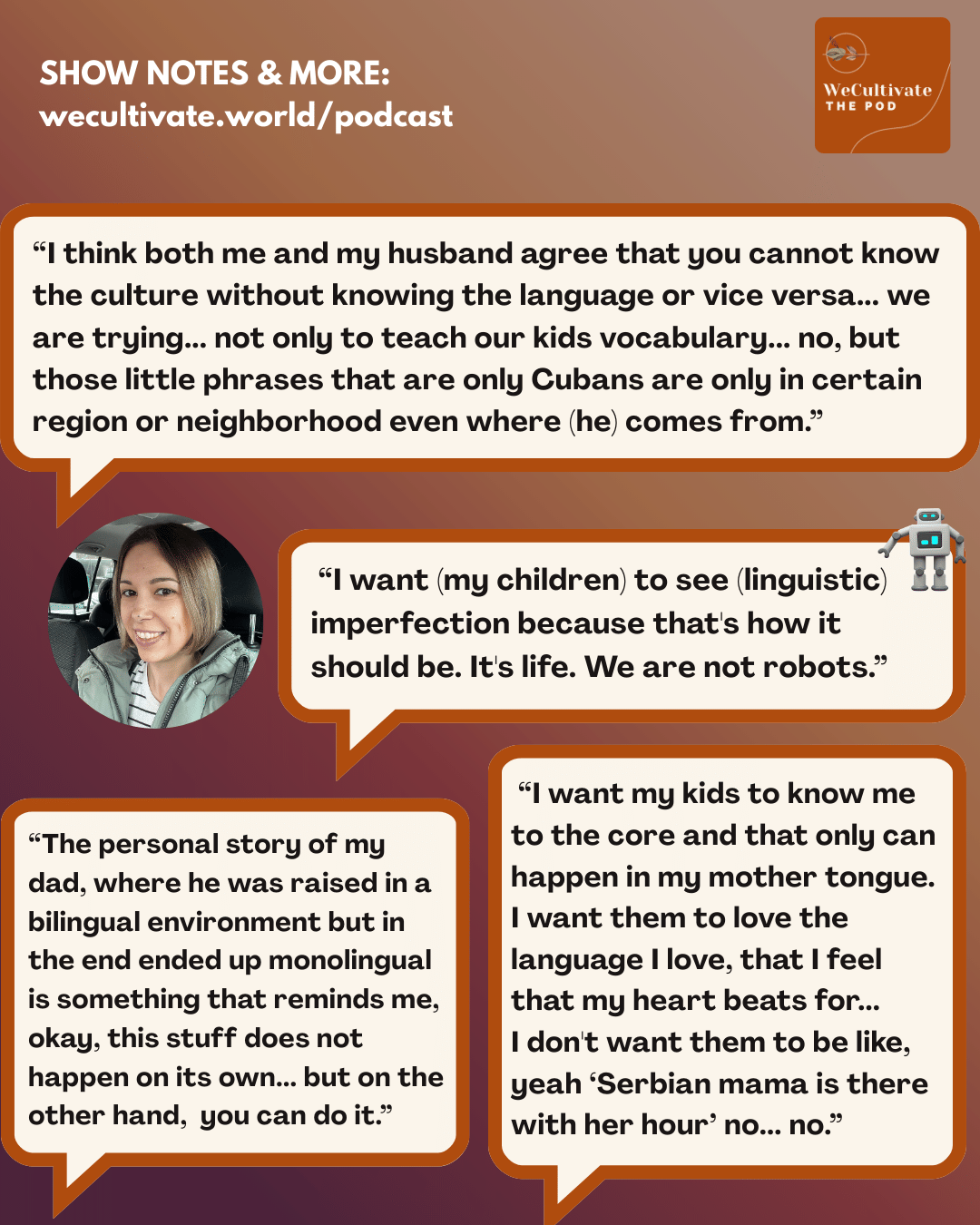
And that's how the podcast thing started and together with that, at the same time, somehow the whole multilingual parenting story was developing because I realized that more people than I could imagine are struggling actually with that when they have their own kids and when they have maybe more than one language. And also the personal story of my dad actually where he was raised in a bilingual environment but in the end ended up monolingual is something that reminds me, okay, this stuff does not happen on its own and people should be aware that you have to put effort, but on the other hand, also you can do it. It's not that complicated as it looks like as people sometimes think, oh God, no, no, no, that's too much for me. It's fine. We give up. So I felt like I want to share my experience and the methods that I employ, that I use with my kids or that we use with our kids in order to help other parents that they can come to the same point that they have kids that are happy to speak maybe two or more languages
Michelle:
And I don't know, was it interesting to come on and find a bunch more because that's how I feel, right? You're like the whole world in fact is kind of talking, we just don't know because when you're alone you really feel like, okay, I just want to share my story inspired, and then you go and everyone's like, yeah, yeah, let's talk about all these things. And that's also how we met, right? Because it's like, yeah, these topics are so important and I think it's so validating in a way to have so many more people come out and say, yes, it matters. And I agree. You have to be intentional.
Jovana:
No, no, totally. I also feel that even though I am in contact so to say on a daily basis with so many people that are international, meaning they at least speak one more language besides German, normally three, because English is also always somehow there, nevertheless, many of them are not taking this topic at all so serious and they're like, it's something that is happening in the background and I don't feel like my task or my wish is to convince the people like, Hey, come and I will explain you why. I'm just like, if someone feels that they don't know how to proceed with that or I want to do it but I'm not really sure how to do it, that's what I would like to share. Because I feel that for me, maybe it was not so easy path and we made a lot of trials and errors and if someone can just hoop over all this stuff and come to the right path, I think it's nice. I mean there is no right and wrong in that sense. Everyone is entitled to do however they want. I just feel that if someone wants to do stuff the way that I also see are fit for raising kids multilingual and there to share my experience and maybe help someone.
Michelle:
Yeah, and that's the purest, truest, most honest way to show up I think on social media. I think I really appreciate that approach. Can you kind of talk about then three kids, I admire you, so how has this process sort of been like, I know you have your page, but maybe just for our listeners also kind to talk about, so this was the inspiration, but then what was the sort of real process going through? Obviously already raising a kid is already a challenge on its own already for everybody, but let's add in that sort of multilingual, multicultural kind of dimensions.
Jovana:
Well, I think the reason why for me the languages were always, or the whole topic with the multilingual was also so striking is because I as a person, I have passion for languages and I really, since I came to Germany and I could have speak and everything till the day today, I like to understand some stuff and I always ask natives, but why do you guys say that and aha, how this dialect thingy came out and so on. So for me it's always super interesting to connect languages and to understand stuff and to connect that also to how people behave and react. And I thought, okay, that's also something. Or I think both me and my husband, we totally agree about that, that you cannot know the culture without knowing the language or vice versa. You cannot just learn the language and not learn the culture that you are kind of belonging to or so we are trying to share the mix not only to teach our kids vocabulary and you can now speak fluent Spanish, perfect, no, but those little phrases that are only Cubans are only in certain region or neighborhood even where my husband comes from are the same with Serbian. That's something that I think we want to share with them and not because of anything else, but because that's who we are and I want my kids to know me to the core and that only can happen in my mother tongue. So the whole process of that, I don't think it was so intentional. That's what I mean. I think it's maybe easier before you get kids or when they're very little, you are aware of let's say the struggles that could come up and maybe then you beforehand think about it how you're going to approach all stuff. We were quite well naive in that sense. I think in the very beginning we were always open to all the languages we were using Serbian and Spanish and German was always welcome so to say in our house it was not like we don't speak German at home.
It was something that would happen naturally. When we have guests that speak German, it would be German flying around when we have people that are speaking English, we speak English where we have Spanish speaking guests, Spanish, and so Serbian the same. So we did like that with our kids and then on the way, I think when we would see okay, something is here, not so fitting, then we would tweak the approach when we saw, okay, maybe Serbian is now a bit weaker and for whatever reason then we more intentionally approach that in a sense that maybe I'm too often falling into that pit to switch to German when I'm in the park with my kid, let's not do that or in the supermarket or whatever. Then on the way we learned kind of all the stuff that I'm now aware of and that we now with our third kids, with our daughter, I feel that she is in such a privileged situation because we know…
Michelle:
we got practice
Jovana:
And then of course I'm going to speak all Serbian to her. When I'm talking to her only, there is no reason that I speak German. That's not the relationship language I want she to feel we have, but when you know that beforehand it's so easy, but when you don't know, it's easy to fall into the trap and switch, especially if you're fluent in that language. But I mean it just sticks with me what you said regarding the rigid plans and so on. I think I hope everyone who has kids know that with kids rarely such approaches are fruitful. You can do it with anything, not with the language. I think you can say also, I don't know, now you're going to read, now you're going to play and now you're going to whatever. But I mean we are not robots. Some days you as a grownup as well, you don't feel into reading a book and if you wrote it in your little planner, I hope you are not going to do it if you don't feel for that.
Yeah, we go to work because we have to or we go to the grocery shop because we don't have any more groceries. But you try to be flexible and agile as much as you can because life is full of these rules and I don't think we should pressure our kids with that more than necessary and definitely not with something we try to bring them as beautiful. I want them to love the language. I love that I feel that my heart beats for, I don't want them to be like, yeah, Serbian mama is there with her hour. No, no.
Michelle:
I actually think it's interesting to see when there is the exactly what you described, so people try to force something onto the kids and then the kids end up rejecting it and then you're not just rejecting the language. Oftentimes if you're not in a home society, you are rejecting the culture as well. You're rejecting your family, you're rejecting a lot of things. That has definitely happened in my family has happened in so many families that I know where when the families have tried to impose something, even if the kid goes to the heritage language school or something, they're just going, they're just doing the things. Are they internalizing it? No, because every minute is like, how do I do what is required of me so that my parents don't get annoyed with me and I am obligated to be here, but every other minute of my life I'm thinking about literally anything else, and then they never actually take it in and because you don't have, I think that sort of positive connection to it, it's actually a very negative connection. It's all about punishment and force. You're like, don't really want to, don't really, and so it backfires essentially.
Jovana:
Yeah, I mean I think some stuff I think comes naturally to people I guess because I remember even though not being aware, not of the methods that you could approach that you could use for multilingual upbringing or being aware of any of this stuff. At the moment when our son, first son was starting to speak when he was, let's say two still, I was always so feeling protective of him if it would be in the environment where maybe minority language like mine or my husband's language would be spoken even if someone would be commenting on that, but he is still sticking with German or something. For me it was like, no, that's fine. That's where he feels comfortable. We leave it like that. He will come to the point where he will feel comfortable to speak also these other languages, and I'm so glad that it's turning out to be true because now he is just without anyone telling him, reminding him, Hey, speak to me Serbian or speak to my husband, speak to your dad Spanish, maybe he starts conversation in German and we nonchalant naturally continue speaking in our language and he would just switch at some point and continue talking and discussing and maybe he, of course the words are coming in German as well, but I mean no one is correcting anyone.
No one is saying, Hey, you're not using the right construction or something. It's more like we all understand it. Perfect. We're so flexible. That's so cool. Let's embrace that. Even if it's English, Spanish, Serbian, German, we do that. Basically my husband and me, we speak like that.
Michelle:
I love this and I love this conversation. Of course, same wavelength. I'm right there with you. I'm very much an advocate for, you need to find what works best for you. I mean for language learning, overall language acquisition, but then also when it comes to how you're going to navigate your own. We talked about the relationship, but also family dynamic. You have to figure it out for yourself.
What I also feel is very surprising when people say you can't use a language because you're not a native speaker, and I do this all the time because there's so many things that we're not covering, so air quotes for people who are listening on audio, almost like laws that people want to lay down and be like, no, but if you're not a native speaker, you're not allowed to use this language. I was like, why wouldn't, does anyone own language? What are you talking about? And so then they say, oh no, but it's bad for the kid because they're going to pick up the accent, and I'm like, but the kid is also hearing the language from other people. What are like what?
Jovana:
Yeah. Also, I mean in one language there are different accents. Even being native, you can have different accents. Let's take, I don't know, Spanish for example. Every country has different way how they speak. Spain, Argentina, Columbia, Mexico, whatever you want and how then you could claim one is more right than the other. It's just different way.
Michelle:
Yeah, people don't recognize that it's very imperialist to think that way, right?
Jovana:
No, and that's what I like about language is because often when we meet people, there are people that might speak some Spanish but not so good, and then they somehow engage in the conversation with my husband because there is let's say another person that speaks only Spanish by accident and I like the kids to see that, that people will try and use the language even though it's not perfect, they are making mistakes. They might be like, oh, I know this actually only in German, can you help me here? I want them to see that imperfection because that's how it should be. It's life. We are not robots.
Michelle:
To be a soundbite. This is going to be a clip for Instagram. I'm going to take it out because I feel like those are lessons you learn and how do you learn them? You're not going to learn them by teaching the kid memorize that you're not a robot. This is not the way it happens. They have to see it modeled to them. They have to see these critical moments. Even in my personal dynamic on how I navigate all this, my partner's kids are not growing up multilingual. However, we do model multilingualism in different ways to them to sort of shape that outer perspective on what is language and communication and what are the rules that you're sort of picking up because your home society is telling you or people around you or your teachers are telling you, you can't do this, you can't do that, and yet you're seeing it in the real world and so you're like, well, if we couldn't do it, how come this is happening right in front of me?
Jovana:
Yeah, I'm always kind of a bit not afraid, but worried that maybe the system in a country where we live or in general in any country really sometimes is not there. It's not so progressive our opinions and it might be sometimes penalized or judged something that kids think or do, but I hope we will be there to support them and say, no, that's how they think and how they do. That's fine.
Michelle:
You're bringing up kind of this ethical consideration I had when I met my husband and I was like, just by our association, our relationship, our marriage already, because I'm not French, I'm not born there, I'm not native speaking, I’m not any of that, and yet I'm also going to be introducing all these other pieces of me and pieces of us. Sometimes children will be criticized and I've seen it happen in the states even for not conforming to the societal expectation for their opinions on things and sometimes you don't want to, the ethical consideration is should I break the illusion that they're living inside almost should I break the bubble that their society wants to put them in? Basically I was told good that you're thinking about it, but you can't control everything and you aren't the only person that they're going to meet and so better that they learn it now, and yes, we'll be there to support them and also you can't hide who you are, so just by me being in their lives, I'm going to have to, I will already be breaking all the rules that they're being taught and hopefully that will be a fruitful exercise for them as time goes on. I actually had a question about your personal language learning acquisition journey. So you learned German while you were still in Serbia and so that was in school?
Jovana:
But before that I learned Russian for many years from the first class to the class, maybe seven, and from the fifth grade I started learning English as well because that was the system back then. I don't know if they changed now and then when I switched schools because of my parents moving, we've moved from one place to another. I had the chance to switch from Russian to German and it was not because I find Russian bad or anything, it was just I really felt like German is interesting. I don't know to explain that. I had this one class where you can just see how it sounds like if you like it and so on, and I was like, this is my language, like you and me that’s it. Love at first sight, so then to German and since then that's it. They learned German and then it was not actively needed for some years while I was studying and so on. It was mainly English, what I needed for literature because I studied electrical engineering actually, and then when I moved to Germany, it was also funny because I think of this culture of failure opposite to culture. Culture where failure is not good or at least that's how I felt. I was not able actually to speak German for first six months. Not that I was not having the tools in me, but I was having this mental blockade. I was just doing acquisition, I was collecting, listening to people. I would talk when it's English conversation because I was among students, which was perfect really to learn the language and then little by little I just felt more and more comfortable and one day I just started speaking and people were like, whoa, what? You can speak German real good. I was like, well, I waited that I can be fluent because I like to speak a lot, so I cannot be saying one word and then waiting. I have to be able to, and yeah. Then that was till then, so it was English, German, Serbian, a little bit of Russian here and there, and when I met my husband, as I said, my Spanish was really, really basic and then step by step that also happened. Now I would say I'm proudly speaking fluent Cuban Spanish.
Michelle:
Yeah, well, yeah, and also the motivation, the personal motivation, right, to improve and to sort of work towards building that bridge of communication. I love that you fell in love with the language. I feel like that's also, it's how we choose our partners to say why. Sometimes it's just like there's this connection and ok…
Jovana:
With German, there is so much, how to say, this negative campaign around German and everyone is like, oh, such a horrible language and sounds bad and it doesn't have this melody and so on, and I'm like, I understand you guys. I cannot, you cannot explain love. I just like it.
Michelle:
You can't tell me who to love, which language to love,
Jovana:
But in general, I think I'm just as a person, I like languages and understanding languages. I also pick on some Portuguese from flowers also. French is always for me intriguing and when we sit with French that is French, I'm always like, but can you explain me that? And you say that like that. Okay, interesting. That sounds a little bit like in German. That's not from Spanish because I think at certain amount of languages you can connect everything because it's so similar
Michelle:
Especially if it's a Latin sort of background, especially with looking at, there's a tree basically for a reason. And so if you just go up high enough in the ancestry, it's not confusing.
Jovana:
It's even more beautiful than that because it's also history. Because Serbia, it was conquered by basically Turkish and Empire for five centuries. And the amount of words that we have that are originating from Turkish language are quite some, we have also German words in Serbian. And it's always fun to see that because when I speak to our Turkish friends, I'm like, Hmm, this one sounds very Turkish. Is this Turkish actually? And they're like, yes, but we say it a little bit different. And then, I dunno, I just to compare languages to understand them to,
Michelle:
I agree by the way, and the reason I had this reaction is you're reminding me of all the conversations I had with Russians speaking people who realized at a certain point because it was just in conversations and all of a sudden they're like, wait, that's the French word for it. But that's what we say for the, and so then you go back, well Napoleon basically is the reason why. But yeah, it's like you do get to go back into the history and see how different words kind of slipped in and influenced each other and then culturally how you use them.
If you take them on a different interpretation, and it's really cool because it's like the Easter egg idea. You're in a conversation with somebody about a language and then you're like, wait, I didn't know you say it like that. Wait, why do you say it like that? And you go search and it's like, I found out so much more
Jovana:
BecauseI think it this learning by making a connection, meaningful connection in your brain and you're not going to forget the word that reminds you of your friend and you have a picture of your friend. I don't know. For example, we say in Serbia, "Sutlija" for milk, rice, rice with milk, how we call it in English,
Michelle:
Like a food, like a rice pudding.
Jovana:
Yeah, rice pudding. Because in German it's “Milchreis” for the moment, not sure. And in Turkey or in Turkish, they say very similar but yet a bit different word that I can recall. But nevertheless, always when I talk about this, I'm remembering this conversation with a friend of mine. It's something that that's how you can learn also pouring language very easily. Because if you connect stuff to something meaningful, probably a wine, you're drinking a wine that is really good and then you learn how you say the wine glass and they're like that I'm not going to forget.
Michelle:
I wanted to ask you then, so when you were trying to, let's say because you waited a bit before you spoke in society in German, how did you then practice your speaking? I assume some sort of at home exercises or were you just with close friends or
Jovana:
A, first of all, I think it was a wrong approach. I really think, no, I mean from this perspective, I'm like, it's stupid. I mean it's not stupid. It's just so much harder if you wait for the perfection in order to speak. And that's what exactly, I mean, it's the culture I was raised in, and I don't mean for my parents particularly, but in general, society teaches you you should not make mistakes that's not seen well. And then you feel this pressure like, oh my God, oh my God, what if I say something wrong? And then once when I actually started speaking, I noticed that no one gives a crap if you're going to use the wrong article. For example, in German, they're like, it's fine, your German is perfect. We understand you so well because they're trying to focus on the positive side and then you feel great and then you'll learn. But how I practiced, I think it was mainly by listening really, and I dunno if this should go on podcast, but student parties where you get some, there is music, it's a little bit of alcohol, and then you feel like no one gives a damn if you make mistake because you don't feel judged. It's not this official, let's say classroom situation where maybe you feel more rigid, it's more relaxed party situation. So you start speaking and
Michelle:
Well, we accept that here. I don't know if you want me to cut it, I'll cut it, but I feel like I'll also offer the fact that for me, before I met my husband, I was dating and so what did I do? I was trying to learn a lot about the country and it's kind of my strategy how even dating in the states, I used to go on dates to figure out what the guys did for work because I was probably interested in their career path. And I figured it's like if I waste my time, at least I find out more about their professional background so I can learn more about the company they work for, whatever. I don't know, I just don't like wasting my time because how many dates work out, but I would essentially go and I think through that exercise of trying to communicate with people generally in a language, so now we're jumping to my life in France.
Yeah, I mean I did have to find ways to put myself in conversations that weren't just like a language exchange or conversation because sometimes those can be very ego driven and people want to show off, figured I can't go to these very kind of almost artificial spaces. I had to have real interactions with people and how many interactions can you have in a day? You buy bread, you buy beer, groceries, you can't keep buying things, you have to have spaces. So I really feel like, yeah, conversation partners or if you were interested in finding romantic partnership or just making friends. I feel like those are the social reasons why language acquisition works well in new environments. And like you were saying, when you're a student and you're out and you're like, whatever. Right? Yeah.
Jovana:
I think it's just it takes off this pressure of needing to perform perfectly and then you feel just if no one cares that much, then you can speak and maybe no one even will remember even better your practicing. I think it was that, but as I said, my perspective changed a lot on that. And when I was already learning Spanish, or even now when I'm improving it, I know I'm making mistakes. I know I need to ask a lot and so on, but still I'm like that's the only way if I don't speak how I'm going to learn. So as long as people understand me and they're not feeling tired to help me, it's fine, for me, that's something good to practice like this. Not feeling uncomfortable, not being perfect,
Michelle:
And I feel like in every, because I can hear the people being like, no, but Michelle in France and some other space, it's not just France. It's like certain countries will have those people who just want to judge you everywhere. But I always say then find the people who won't judge you because it's not every single person in every single country. You have to maybe work harder in some countries. Definitely. That was my case, and that's why I was like, well, maybe if they're desperate enough for love, they'll talk to me and I get to practice. But that's also, I feel like how I made friends in the country as well. If I was only talking to the people who wanted to judge my accent or my grammar use or something, then why would I want to be friends with you?
Jovana:
Agree a hundred percent. No, no. I am totally with you because I'm like, why would you be worried if someone will react negatively? Because probably you don't care about these people because if they think like that, you don't share their mindset, you don't need them.
Michelle:
Yes. I have so enjoyed talking to you about all these different things. Is there anything that you kind of want to touch on before we go?
Jovana:
The only thing that maybe is nice to mention is really that if there are listeners that are in similar situations, maybe planning to have kids or already having kids and struggling with this language dynamic or knowing that they're going to relocate and oh my God, how we are going to handle one more language. Hi, I'm here and you can reach out. I'm very glad to support you on your journey.
Michelle (outro):
I hope you enjoyed this episode of WeCultivate the Pod. Make sure to subscribe here and wherever you get your podcasts so you can catch new episodes as they become available. I also share after the mic reflections on Substack, the place where I dive into the themes that stay with me long after recording. Beginning in 2026 you can also find additional bonus content from guests and other, WeCultivate extras. Subscribe for free to the communication shift on substack. The link is in the show notes and in this description, thank you so much for joining us this time and I will see you in the next episode.