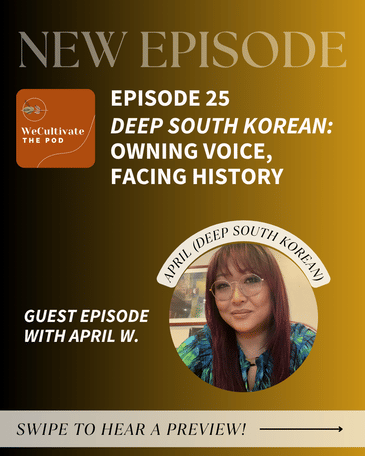



In this episode of WeCultivate: The Pod, we host our first conversation exploring the experiences of transracial adoptees —individuals adopted by parents of a different race.
Our guest, April, is a Korean transracial adoptee and the creator behind Deep South Korean. She shares her story of growing up in West Virginia, navigating her identity as an Asian woman in a predominantly white, rural environment, and how she’s now using her voice and online platforms to build community with other transracial adoptees and beyond.
Together, we unpack the nuances of cultural appropriation, the line between code-switching and inauthenticity, and the often-overlooked dark history of international adoption, such as falsified records and the commodification of children. April offers deeply personal reflections on facing racism, her family’s “colorblind” approach, and her ongoing process of transforming anger into advocacy—for herself and for others with shared experiences.
The discussion delves into the complexities of identity and self-definition for transracial adoptees, highlighting how cultural, familial, and societal forces shape the process of understanding who we are. It emphasizes the importance of listening, empathy, and creating space for transracial adoptees to claim their own narratives. April’s story is a reminder to us all, no matter our personal stories, that identity isn’t something we simply inherit, but something we continuously uncover and reclaim.
"My mission is to just kind of be loud enough that my people can find me and we can all find each other."
"My parents never talked to me about being Asian. They thought if they didn't see color, that the world wouldn't see color."
"For anyone listening who is a Korean adoptee, you are Asian, you're just a different type of Asian."
"With code switching, it's more about you're still saying what you would say, you're just choosing a different algorithm or pattern... Whereas being a different person, you're just changing what you would say period to fit whatever you think would make them happy."
"I cannot bury my head in the sand. I can't do it... I'll be walking around poking everybody else on the shoulder saying, you sure you want to do that? Just hear me out first though."
Main Topics Covered
Transracial Adoption: The episode discusses the complexities and challenges faced by transracial adoptees, including identity struggles and societal perceptions.
Identity and Belonging: The conversation touches on the importance of understanding and empathy in discussions about identity, as well as the personal journey of finding one's place in the world.
Systemic Issues in Adoption: April discusses the historical and ongoing issues within the adoption system, including falsified records and the impact on adoptees' lives.
Personal Experiences: April shares her personal journey, including her experiences with racism, the lack of support from her adoptive family, and her path to healing through therapy and community.
Actionable Advice
Embrace Authenticity in Communication:
April emphasizes the importance of being true to oneself while adapting communication styles to connect with diverse audiences. This involves maintaining the core message while adjusting the delivery to suit the listener's context.
Educate and Advocate:
The episode encourages listeners to educate themselves about the complexities of transracial adoption and cultural appropriation. Advocacy for understanding and empathy is crucial in bridging cultural gaps.
Seek Support and Healing:
April's journey underscores the value of therapy and support networks in navigating identity challenges and overcoming past traumas. Building a community of understanding can aid in personal growth and resilience.
Challenge Stereotypes and Assumptions:
Listeners are urged to question stereotypes and assumptions about race and identity, fostering a more inclusive and empathetic society.
Related Resources
Below, you'll find a few links tied to the topics we discuss in this episode. WeCultivate does not unequivocally endorse the material or its creators beyond a cursory review of the material presented. They have been shared here on behalf of our guest to encourage further exploration and independent learning. This is a dynamic list and subject to updates as time goes on. If any of the links become broken, or if you have a suggestion for the list, please let us know. Thanks!
Camptowns in South Korea
🎥 “How Korea’s Sex Trade Was Built For U.S. Soldiers” — a powerful look into camptown history https://youtu.be/J8U3VTH2YRY
📌 Explore Yuri Doolan’s work on Amerasian adoptees and camptown legacies: yuridoolan.com/work/transpacific-camptowns
📌 Read about the mistreatment of camptown workers in this Binghamton research project: http://digitalprojects.binghamton.edu/.../page/camppptownnn
📌 For book recommendations, interviews & articles on camptowns, check this resource collection: koreanquarterly.org/tag/camptowns/
Pods and Blogs
Empowered Adoptee: IG @the_empowered_adoptee_podcast
Color Shift: IG @color_shift_tra
Only Kads: https://feeds.buzzsprout.com/2542076.rss
Exploring with JennaLee Kim https://open.spotify.com/show/72n5Dck5jzMxsRHblS1h8L?si=3721d5468cb84cf0
Support Groups
The Empowered Adoptee Retreats: Connect with other adoptees while exploring culture and learning somatic therapy https://www.theempoweredadoptee.com/
Korean Adoptees https://www.facebook.com/share/g/19EA4UEe8k/
Korean American Adoptees https://www.facebook.com/share/g/1AHzDzfrL6/
Korean Adoptees searching for their birth families
https://www.facebook.com/share/g/1BRjU1ggYk/: These are facebook groups that allow other KADs to connect with one another
Additional Resources
G.O.A.'L. (Global Overseas Adoptees Link) https://goal.or.kr/
Global Overseas Adoptees' Link was founded in 1998 by overseas Korean adoptees who returned to Korea. It soon became and remains the only adoptee-led non-profit and NGO in Korea.
EARS (Emergency Action for Records Storage) https://earsonncrc.org/
EARS consists of adoptees and allies, each with their own area of expertise. They strive to hold the NCRC and the South Korean government accountable to ensure a safe transfer of all adoption records from the adoption agencies to the NCRC.
KAAN Korean Adoptee Adoptive Network https://www.wearekaan.org/
Founded in 1998, KAAN is an all-volunteer organization that is a special project under The Foundation for Enhancing Communities, fiscal sponsor. Our mission is to improve the lives of Korean-born adoptees by connecting the community and providing opportunities for dialogue, education, and support.
IKAA International Korean Adoptee Associations
https://www.ikaa.org/
IKAA connects adoptees and their families by hosting regular gatherings, supports an international leadership network with the tools and resources to build their local capacity, and advocates for the well-being of the global adoptee community through key policy positions and partnerships.
Mosaic Tours
https://meandkorea.org/apply
The Mosaic Tour is for post-college age Korean adoptees focused on learning about their roots, experiencing Korean culture, and exploring their past. Applicants must be able to communicate in English. Application Deadline: December 20, 2025
On April's Reading LIst
Putting Down my Stethoscope By Dr. Byung Kuk Cho
She Is Mine By Stephanie Fast
Before We Were Yours By Lisa Wingate
Disrupting Kinship: Transracial Politics of Korean Adoption in the United States (Asian American Experience) By Kimberly D. McKee
Video version of the conversation here:
Full Transcript
This is an auto-generated transcript. There may be mistakes and typos. For the best results, please navigate to the transcripts generated alongside the episode on Spotify, Apple Podcasts or Substack.
Michelle (intro) :
Welcome back to WeCultivate the Pod, where we explore the intersections of language and communication, culture and identity. Today's episode begins with an opening question, where do transracial adoptees find themselves in this space for clarity? When we say transracial adoptees, we mean somebody who was adopted by parents of a different race. This often means across different cultural and linguistic lines. This means growing up in a family. Of course, this can be broadened and adapted in many different situations, but predominantly a family where your appearance, ancestry, and sometimes even first language. Although that wasn't the case for our guest today, don't align with those around you Today. I am joined by April. She is the creator behind Deep South Korean, and she's a Korean adoptee who grew up in West Virginia. If you don't know where West Virginia is, open up Google Maps and you can find it. It's one of the states of the us and through this entire conversation, she shares her personal experience and what it means to have navigated this space, including what it's been like to carry multiple identities also as a female inside of spaces that don't always make room for them. And I want to be really clear about one thing. This episode, like many of the guest conversations that I have is not about meet perfectly boxed in answers. It's about listening, questioning, always expanding our sense of what belonging means as you listen to the stories of others. So without further ado, here is my conversation with April.
Michelle:
I not only listened to the first two episodes, the second episode of yours, I listened to twice because kind of in preparation for this episode, I wanted to really make sure the information was sticking. And I don't know your plans so far, but I love what you're doing. It's like genuine love. It's not just like I support you and I actually love how natural and honest, and I am actually asking myself, oh my, oh my God, I feel like you're really, really brave for talking about certain things. And I've always felt this about your online presence.
April:
Oh, thank you. Honestly, it's something that I question because there's obviously negative backlash. As a matter of fact, this week I got into a bad situation in a comment section on a read Cho post about appropriation. I believe it exists, and I do believe that it is something that we could do without, it's not necessary. And I think at the heart of the conversation, for me, it's just on one side of it, you have people saying, okay, it exists and we just kind of want you to not be an asshole. But on the other side, which is very fascinating to me, maybe fascinating, gives it too positive a take. But it is fascinating to me and a psychological sociological type of way that on the other side, there are these people who are just so defensive that it doesn't exist and it should just be fine and you should just shut up about it. And I think in the moment, and I've obviously, or admittedly 10 years ago, I would have received that way differently. And I did go a little bit just to kind of try and elaborate and explain that there are different viewpoints on this, and I think there's unique viewpoints based off of where you're from. And of course your experience because the entire globe is under this weird, well, it's different when it's me kind of mentality, which lacks empathy.
But if you're an American person who is not white, then you have a unique and genuine understanding of what appropriation is and means. It's not just like a costume on Halloween or somebody trying to show appreciation in a poor way. It's how people couldn't get jobs because their hair didn't suit a certain aesthetic. It was a people who were discriminated against or bullied in school because their food was different and then grew up into a world where it was trendy. The whole Fox eye trend was hilarious to me, by the way, as an Asian woman because I literally watched women pull their eyes back. It was bizarre to me. It was very strange. And then you have, and I'm just speaking for the Asian community because that's the community that I have the right to speak for. I can't speak for others, but especially as Korean adoptees, we hear this a lot. Well, it's not your culture. You're not Asian.
And for those of you, if you happen to put this in the podcast for anyone listening who is a Korean adoptee, you are Asian, you're just a different type of Asian. And I understand where a lot of those people who grew up under the Asian culture in an Asian country, I understand where they're coming from. They haven't experienced it the way that we have. We're over here on the front lines fighting up for everybody in the Asian community, and you get the benefit of seeing the appreciation because we've been putting in the work to make sure that people who started appropriating it, learned to appreciate it, so that now you can from over there, look over here and be like, oh, hey, they understand what Chinese New Year is now, or Sal, or they know what kimchi is. It wasn't that long ago that I think even on a Sharks episode, there was, I think it was a Canadian company that talked about Boba, and they made it sound like the original Boba was untrustworthy and dirty and wrong, and it's tapioca, it's full of carbs and usually marinated in sugar or some sort of syrup. So terrible for your health. Yes, but delicious and safe also. Yes. But anyhow, I say all that to just point out that my mission is to just kind of be loud enough that my people can find me and we can all find each other.
Michelle:
So we haven't technically, well, I think we've already started the podcast. I think the podcast started when we started talking about this. But I want to tell you that I'm sorry that you had to deal with all this because I think that I'm not sorry that different perspectives exist. I'm sorry that you had to spend time out of your life. You have work, you have other things going on where you also have to fight for something that I feel you shouldn't have to fight for it because if someone doesn't agree because they've never lived it, that's fine. You're not trying to lease their life experiences. So what's really strange to me is people who do spend that time to go, and this is honestly why I am taking very conscious and intentional steps with what I do with this podcast, with this platform, all this stuff, because I'm in no rush to grow at all, right?
Because I'm like, I need to really, really manage this well. I am also, I feel like, for instance, you coming on here, I have a responsibility to you to make sure that between the two of us, this is of course, I'll use the word safe space to talk and to exchange ideas, but we also go public. We go global is the idea. How do I make sure I manage this not only as a business owner who's been fine in her own thing, but now with this media side of it, how do I make sure that I do my due diligence to all of the guests that come on and all the stories that I feel like I am responsible for protecting to some degree, to be honest. And I suppose I want to just give a little bit of background as to first of all, how you and I connected, why I asked you, well, I don't remember. I probably asked you to be on here, but we were also talking about general content stuff. I remember the first time I saw one of your posts, and I think it's the one that went, maybe one of the first ones that went viral, the one where the girl was like, if there's an Asian with a different accent where a southern accent can someone show me or something, and you're like, oh, hey,
April:
That one. Yeah, that one went viral on TikTok. I mean, I guess it's weird saying viral. It's not like I'm this huge content creator, but it's had I think over 4 million views on TikTok. And it was weird. I didn't really feel like that was anything. But then when I started to create stuff on Instagram, I thought, well, I'll just introduce myself this way too. And I'd had a few posts, but I hadn't really done a lot on Instagram yet. And then, and I kind of connected, I think immediately almost after that and just started talking about different trains of thought. And we've had honestly some really nice conversations on Instagram about some things.
Michelle:
And I would venture to guess that the reason why posts go viral for many reasons, but I would also guess that it may have been someone's first time hearing or seeing that's, that's not a word we're going to call it. Your combination of your presented self. It was not my first time. It was clearly not, but it is rare for me to see, I think empowered identities out in the open. For instance, you did not try to hide it behind humor, which is what I think a lot of people do. Not to say you don't do funny content. My God, some of your stuff recently, I was like, what is going here?
April:
Oh my gosh. The most random things been, I dunno what that says about me and my FYP, but I'm like, and then I see the likes and I'm like, what am I doing wrong?
Michelle:
Yeah, so there's definitely a lot of humorous stuff on your page. And I'm not on TikTok, and this is only on Instagram that I'm seeing, so I can only imagine on TikTok what else is there. But for sure, when I see people talk about their, they're, let's call it the non-standard voice or accent as Asian Americans, I feel like I always see it's comedians. And not to say they can't be empowered, I do feel like that's one medium for it. But I don't see people out there just being like, Hey, this is me. This is who I am. This is how I became this way. It's kind of not a surprise. Right?
April:
Yeah. I think the closest thing I ever saw to it, I mean, obviously I'd seen videos of the people. I think it's the Chinese settlement that happened in the Mississippi Delta, so they have that very thick Louisiana draw kind of accent at Creole honey. But I think the closest thing I'd ever seen really was Aquafina, but even she exaggerates her accent a little bit, I think, not to call her out, I know she gets a lot of hate for her accent. I do think it's authentic, but I think that she kind of exaggerates it for a lot of her roles that she's in, which I can't say that I'm not guilty of sometimes. I know that in sales, I have definitely been guilty of laying it on thicker when I thought that it might make me feel more accessible or familiar to certain customers. There's a weird thing that happens in people's brains when they hear it and they see it and it softens them. Everything else kind of goes out the window for a second because now they just have to figure out how and why. And there's sometimes where I'll try to lighten it because I think it's harder for people to truly understand what I'm saying. But yeah, this is pretty much how I talk. Yeah,
Michelle:
Which what you're describing by the way, with sort of the code switching and turning it up or down or thicker or lighter, it's stuff we all do. It's just whether or not we're conscious of it. And the people who have never taken the time to really think about it are the ones that I feel are like, what are you talking about? I don't do that. I just talk. And it's like, okay, sure. Yeah, we're just talking. Apparently you can show up into every situation communicating in the same exact way. It's not exactly about accent for everyone, but it could be word choice, mannerisms, nonverbals, right? The way that you relate to someone else, you're going to say that you never change that based on who's in front of you, stranger or family member. It's the same.
April:
Yes,
Michelle:
Absolutely not.
April:
Yeah. You may not have as many levels as other people, but you definitely, yeah, absolutely. You have your work voice, your home voice. I've even seen people with different voices between the friends that they really like and trust and the friends that they just kind of keep on that superficial level. And especially if you work in the corporate world, you have to have so many different levels of communication, as I'm sure you can tell, because you are meeting so many different types of people. Where I have worked in sales and marketing, I have to be able to communicate with somebody from the backwoods of West Virginia as well as somebody from a high rise in New York City. I have to be able to meet them on their level because they won't always be able to meet me on mine. But I think that's probably why I've landed in those positions with work, because naturally in my life experience, I've just done that for so long.
Michelle:
And a lot of us who know that we sometimes have a phone voice also in work especially, oh my God, I know I had to train this. I had to voice record myself when I first started working because I was like, I can't be picking up the phone and being like, hi. So it's like I don't know who's going to be on the other side. A lot of times, and this is when I was working in a more serious position, a more serious office, but I had really had to train myself to have that voice and be like, sure, yeah, Barbara's not in at the moment, but I will get her as soon as she comes back from lunch. Can I take a message for her in the meantime? No. Okay. So we'll see you next Friday. Thanks so much. You train it. It's not like you do.
April:
It's always softer. It's Hello Branson, how can I help you?
Michelle:
Yeah, and the fact that I feel, I think it's two parts. It's like people don't want to be honest about it because a lot of people don't want to say that they've had to work on their voice even inside of business environments, which I find ridiculous. No one is born knowing how to give a good presentation or a TED talk or something. So why don't you be honest and say that? What are you hiding? What is this ego thing?
April:
Some people just really hate feeling deficient or feeling wrong. I was listening to a book recently, or maybe it was another podcast, it's all blurring together, but it was talking about the difference of being in a place of growth. And I think that's where a lot of it comes from, but absolutely. Yeah, everybody, you have to learn at some point,
Michelle:
Which I don't want to confuse code switching with being inauthentic, which I feel is oftentimes the counter argument. Well, for sure, we all have to code switch inside of what will consider. It's not only white. It's very, very, it's a certain, especially in the us, it's like the American corporate environment, and we do have to conform to that. And a lot of times people do have to be inauthentic. And I would agree that many times you, not many times. So it depends on where you work, depends on how toxic also, but I think only that for yourself, how far you have to depart from what feels like home to you and where you have to go. And I feel also why people get burned out really fast in these types of situations is because they're going to work for X number of hours a week needing to play this role, coming back, drained, exhausted, because they just can't do it anymore. That's when they quit everything moved to the countryside, start a chicken farm. I feel like that's the career path.
April:
Buy a cow and rescue 10 or 12 dogs.
Michelle:
Yeah, exactly. And then you see them on YouTube being like, so I left Wall Street for this. And you're like, wow, okay. Here's my
April:
Whale. Yeah, exactly.
Michelle:
I know, which I get that we're all on our own journeys, but I feel that it's like this, we forget that there's nuance and detail and gray area and descriptions that we need to be giving to fill the spaces between what is a concept and what is a person's lived experience in relation to that concept. And I'm so frustrated when I hear people on social media or see people talk about things like their binaries, because they're never binaries. Even between us, we won't have the exact same types of experiences. I mean, I'm just saying us because we fall under this larger category of Asian American, but our backgrounds are so different, our voices are different, how people treat us as different, how can we say that it's how it played out for you as opposed to be how it, for me, that's ridiculous, I feel.
April:
Yeah, absolutely. And I think that's something that, again, in America, it kind of happens that people who aren't educated enough to know the difference, that's when they just have this one representation. So, oh, that must be what you are, and then this is the box that you go in. So yeah, I think I'm not really sure how to kind of bridge that gap for people beyond patience and just trying to communicate that over and over. I think over time, eventually it does reach them. It touches them in a way because it affects them somehow. And just to kind of touch back on what I said earlier, is that weird? It's different when it's me. So it's almost like you have to make it happen to them for them to understand it. But as far as code switching versus being a different person too, I think with code switching, it's more about you're still saying what you would say, you're just choosing a different algorithm or pattern or whatever way to say it to communicate it. Whereas being a different person, you're just changing what you would say period to fit whatever you think would make them happy
To not rock the boat. And I think that's the difference for me is that I am still getting my same point across. It's I'm trying to do it in a way that you will hear it a little bit better,
Michelle:
Like the idea of using the, I want to say packaging, but it's more like the presentation of your words and message and extending it in spirit of connection in the spirit of bridge building and not needing to completely transform yourself into something else in order to deliver said message. I feel like I agree. That's my personal line as well, where if I'm not in agreement with what I'm saying, no matter how I package it, that is inauthentic. That is not honest. That's not me. That's not something I want to be putting out there. I do understand that people have to work, no, I can't say have to. People often feel that they have no choice but to work inside of certain environments like that. I do feel like there are certain industries or companies, organizations that really put that amount of pressure for you to conform in that way. And
That's where we see something that I think is very tough because the argument is constantly, but if I don't do this, I'm not going to be able to advance in my career. And I went to school for X number of years and I have all this debt and I have to work this job for X number of years in order to get out of it. So everyone has their exit plan. But I also noticed, and some of my friends who've had to work some of these very soul sucking, soul crushing jobs that a certain point, they no longer feel like them, which is why everyone's talking about going to a farm to which I'm like, you've never worked on a farm before. You wouldn't last a day. But they're all talking about buying a bunch of sheep
April:
And the countryside looks pretty, but it looks pretty.
Michelle:
I know it's a lot of work. I mean, I know it's different work, and I do think it could be restorative, right? It could be great to go do some manual work, but what's funny is when you know this world as well, and you're like, a lot of these people are like, what are you complaining about in your white collar world?
April:
Oh, I mean, that's an interesting aspect too, because when you say that, I just imagine me going back or sending someone who's lived in a big city in corporate America and then sending them back to where I grew up. And granted, there are people, they started doing this touristy thing, trail riding where people can bring their ATVs and their four wheelers and they can come camp and they can just ride up in the mountains and they call it the Hatfield of McCoy trails to touch back on history. They are not where the Hatfield and McCoys trailed, but they didn't technically trail at all, but they just fought each other over a pig, if I recall correctly, and amongst other things over time. But yeah, that was the history and that's what they named it after. But people ride trails and they come from California and Utah all across the country to West Virginia to do this because they don't get that deep in the woods kind of feeling just anywhere. And it's great to visit. But then what happens when you want to go to the grocery store somewhere other than Walmart or Kroger or you want to eat at an ethnic restaurant and any kind, there's a couple in my hometown, but there's not a lot to choose from. And you realize that there's a lot of things there that you kind of need to have to survive in today's world, first of all. So you almost have to regress a little bit in civilization in order to be comfortable there. That's how I feel. I ain't saying that it's wrong. There's plenty of people who still live there and love it. You'll also pay outstanding rates for your electric bill, but that's a completely different conversation. But to me, that's one of those things where it, it's nice in theory, but it's different in practice. The romanticized idea of going to the country, and I get it, it's a rat race. I've worked in corporate America for over half a decade now, so it's a lot, but I feel like you can still be yourself. I got my job with purple hair and a nose ring.
It's a manufacturing company. It's blue collar. It is the antithesis of what you think would hire me, to be quite honest. And I think sometimes I don't want to be insensitive to other, because everyone else has a different experience and what their own level of confidence is to do this, and I realize that, but sometimes you just have to believe that you really are good enough that it's not about what color your hair is. And now, again, I had some favors. Networking played a huge part in that for sure. But it was the networking. Then hearing about the work that I'd been doing that ultimately landed me the job. Never had anybody say anything to me about you change that every couple months. Oh, we're going to a trade show and now it's blue. It kind of became a thing. And even in the industry, I had other women come up to me and be like, my boss would never let me do that. So kudos to my boss for sure, for being open to it, because it's definitely not something that's common. I recognize that, but it is possible. It definitely is possible.
Michelle:
I do feel like, do you think the, well, I don't know if we can speak for all Asian American women, but I do feel like the pressure and the culture and also family judgments and also the lack of support socially that we have to all go through, it feels like a solo journey until you get to a certain point, which I do think thanks to social media, we're getting there faster. It's kind of new, actually. I'm not used to talking about, I know I started a podcast, but I'm still not used to talking about this with people. Even some of my closest friends. We have to be really, really close to be so honest about what this journey has looked like. Yeah. So I don't know if you feel like it's something that you see a larger pattern as well.
April:
I do. I think it goes back to that overlay that society likes to put on us as being submissive and quiet. And yes, there is this subsect of us who, like I said, have this obsession with Western culture. But then there are those of us who still remember and feel the pain of what happened on the west coast and with, there were women who were brought here just to be sex slaves, and the men were brought here to be mine slaves and the internment camps, while they weren't gassing people, people lost everything.
Michelle:
And not just in camp. There's the whole history on things. And I'm not trying to,
I think this is where we are so worried to talk about it because we are told constantly that there is no space for discussion or dialogue on this. We have to hide it inside of cultural events or remembrance, holidays, which I hate because for instance, it was just the 50, it's an anniversary. I hate calling it an anniversary, but it was the 50 year anniversary of the Cambodian genocide. So people are like, well, that happened in Cambodia. And I'm like, okay, where do I begin? You know what I mean? If you think we can talk about anything in this country without talking about something else in the other parts of the world really, and 50 years is not that long ago, and you realize that your friend that you went to school with or your neighbor, they are here in this country because their families were all killed during the genocide. I mean, the same way I feel about the revolution in China and a lot of other things, it's like the fact that things didn't happen on American soil does not mean that that didn't play a role in how people arrived here. And therefore, the fabric of what is history in this country is also formed by history that played out across the world. So I mean, how the hell are we going to just, oh, world War ii. It drives me insane sometimes, like the hyper focusing on Europe.
April:
And it's not to detract from anybody else's experience. No one's trying to compare. No, we're just trying to say, Hey, it still happened though. And again, this isn't me trying to take anybody's seat at the table. This is just to say, I think we've just accepted for the longest time that it wasn't our turn yet, and now there are enough of us who are old enough, who are tired enough and loud enough and who are finding one another to combine forces, and I guess try to just get that message out there a little bit better. I've noticed that a lot too with Korean adoptees, because that's another one. The entire concept of Korean adoptees in America, all of that happened because there were so many children in Korea who were the products of American soldiers and Korean women who were left behind by those American soldiers. And the Korean government said, well, they're not Korean enough, so let's ship. And then Holt was someone who went over there and decided he was going to bring those American children back home, great, taking responsibility for your people. Cool. But then greed entered the chat, and I think the four B movement was their karma for that.
Their lack of population is most definitely a direct karma for getting rid of so many. There were so many of us who were full-blooded Korean born, that were just part of the prophet, especially during the eighties. I can reason with and understand the children who were products of the American soldiers and the Korean women, because they wouldn't have accepted as people in that culture at all because their fathers were not Korean. But it's all of those things that contribute to it all. And even on that subject, people will still comment and be like, oh gosh, you were given a better chance at life and you're actually going to complain about it. Which wouldn't it be nice if adoption was the fairytale that we all thought that it was even domestic adoption, but it's not. It really isn't. And my case isn't even the worst. But there are children, and most of us Korean adoptees were female, but there were children who were essentially sold to pedophiles. There's no nice way to say that. And I don't think it should be said in a sugarcoated way, but they were essentially sold to pedophiles. And you cannot tell me that you would dare look at any of those people because there are multiple of them
And say, well, you should still be grateful because you were given a better chance at life. That is not the case. But again, I think now there's a lot of us who are old enough and we're wanting to talk about it, and we can. So we do.
Michelle:
Yeah. Can you describe just for, because I'm thinking this podcast could be people who are familiar with the terms that we're using, but then also I feel like there are people who didn't realize they probably defaulted into the adoption is always positive, always wonderful, always a gift. And they don't know this really dark world, and you just said it's like there are, which I think is not only very fair. I feel like it's coming from that standpoint of recognizing that there are nuances, there are shades to what adoption means, and in some cases, people probably got lucky and got great families on both. I don't know. You know what I mean? I think we have to hold the totality of different experiences. But I also know on the other side of the extreme, and it's not an exception, it's like the number of cases, and especially for Korean adoptees, which by the way, for anyone listening who's not familiar with what that means, it means that these were children originally born in Korea, as April was saying, from many of them involvement, which is a convenient fact that is always overlooked, but also under other parts of the world.
But when you say Korean adoptee, it's not like people who are then going back to Korea or being funded or, you know what I mean? I know that people are like, oh, yeah, I get it, adoption. And then they're like, okay. And then they go to school with people. They become, again, neighbors friends, but no one really asks, and no one really understands that there was a whole history and journey before, before you even arrived. There was a whole history behind this. There was a whole history that started with you coming to this country. But then I think your brother also, right? You said
April:
He was the domestic adoption.
Michelle:
Okay. Yeah. But then there's this whole other type of storyline that comes out, but it's like you don't just cut off that part. I'm making a gesture to indicate before you got here. I'm like, oh God. Yeah, audio. But I am wondering, do you mind giving us the highlights of that as well, and a little bit of, and if you're comfortable, of course, talking about what the challenges were in terms of your family dynamic, how you were treated in school, and I just feel like there are people who don't, they think of adoption as being so good and think of it as being lifesaving that they can't imagine that you could have struggled through it all.
April:
Right. I think the picture that was painted for a lot of us who were adopted from Korea is that we were all saved from dishes. And if you've ever seen the show on Netflix, oh gosh, I can't think of her name, who's in it? Alyssa Milanos in it. It's a buddy queen who kills people. She loses a bunch of weight. Oh my gosh.
Michelle:
I know what you're talking about. Oh, I don't know.
April:
Okay. But there's a Chinese adoptee girl on there, and her mom
Michelle:
Remember the name? Yeah. Okay.
April:
And her name is Dixie, I think. And she talks me and her big story on there is like, oh God, my mommy saved me from a ditch. And then she raised me here in America. And then come to find out, her mom actually stole her from a hospital, and her family was American and lived nearby, and she was able to reunite with them. But ironically, that is not far off from the story of a lot of Korean adoptees.
So it started, I think in the sixties and seventies, for sure, the seventies, and then really took off in the eighties. Like I said, it initiated with the US and Korean children who were being adopted out by Holt because he saw that they were kind of being left. And the Korean government, I think the president at the time, he was just like, yeah, we don't want 'em. Get 'em out of here, basically. And after they got all of the American Korean kids out, then it was like, well, there's still some kids here, and there's money to be made because there's all of these families. And the US, I believe was the country with the largest amount of adoptees to be received. But I mean, we've landed in Europe, Australia, I can't say if I've heard of anyone in an African country or a South American country, but I'm sure that wouldn't be completely out of the realm of possibilities. It kind of touches into that white savior thing, because regardless of the country that they were going to, a lot of these receiving homes were white people who couldn't have children of their own. And some of them just also adopted because they could. And there was no education on culture. And a lot of these parents, it was left up to them to build that and educate the child. And mine for sure, I know that the adoption agency provided resources. My parents just didn't use them.
And there wasn't any kind of background check to find out if these parents were sound. I mean, realistically speaking, at least in America, a lot of these families adopted because they couldn't get an American child. It was just either going to take too long or they would have to take a child with disabilities or a child that was older, but you could get an Asian baby like that,
Michelle:
Which somehow we don't see as being human trafficking.
April:
Oh, yeah. It really is. There's a discussion right now. There's a lot of discussions around it. So we'll see if there's
Anything that comes of it. But there's a lot of, because it has come out that a lot of paperwork has been falsified. Children were just straight up stolen from their families. Some were marked as orphan because one thing that I think a lot of Americans don't realize is that in other countries, at least from what I understand about in Korea at that time, it was not uncalled for you to drop your kid off at an orphanage for a set period of time until you could get your shit together and then come back for 'em. And that orphanage would take care of your child and you could go work and you could make your money, or you could live hard that you couldn't do with two kids or a baby or whatever, and then come back once you got on your feet. And what would happen is some of these children who were not surrendered but just meant to be there for a little while, were just given up for adoption.
Some children were stolen off the street. There's a story I saw not too long ago of a woman who actively went to adoption agencies in Korea looking for her son because it was such a big, it had become such an epidemic that the women in Korea knew to look for their children at orphanages because they were afraid that they were going to be adopted out. And they were like, no, we don't have him. We don't have him. Well, of course, he was adopted out, and years later, he got his paperwork and he found her. And I mean, it was so sad to see her entire life she'd spent looking for him and to know that it didn't have to be, or children who were healthy, that they would lie to the parents and say, well, they have some sort of, we'll say heart disease, and it's really expensive here. You can't afford it. But if you surrender your child to this adoption agency and the halt, they'll have the surgery and pay for it so that they can make the baby adoptable and then send them overseas, but you won't get your baby. So yeah, it is going to be interesting to see what becomes of that conversation.
Michelle:
Yeah, I really feel there's such a double standard that's placed on any time that it's, I feel like anytime it's Asia, anytime it has to do with Asian people. But I would say that I've commiserated on this topic also with some of my African friends who are tired of this crap also. They're like, literally, when you see things happening, I mean, on the one hand, not okay to always see these areas of the world as lesser. So that's a whole struggle and challenge. But on the other hand, when you see that there are children who are just there and you're basically, you don't even see them as human because you go there, there's this one creator, I really, really love her stuff. She's so funny. She does these parody videos of what people think is Africa. She'll be like, oh, yeah, because we don't have phones.
We go to this tree and we knock on it five times, and then we do a dance to the heavens, and then we have to go and move our talk to the giraffe or whatever, send it to you afterwards. But that's funny. It's exactly that, right? That people, and there are people in the comment section being like, oh, really? And you're just like, oh my God, I can't, how can you not understand this as humor? But I like her stuff a lot about how there are white people who go to African countries, go with their phones, just go and take pictures of all the kids. Oh, these poor starving children. Oh, these poor, oh, this mother who's like a normal, just because it doesn't look like a western country, a developed western country. They're like, oh, you must be in such extreme poverty. It's not just like, that's literally the architecture of the village or something.
And I do feel similarly for certain, I mean, Asia has developed a lot, but there's no shortage of areas that are quite remote and impoverished still. And when people go there, it's always some humanitarian thing that I know it's good. I know that I'm supposed to support humanitarian work, but I find it so frustrating when I hear, and I do think adoption falls in this category, save the poor Asian babies that came, and it's just save the other, the African baby, save, save these poor children who didn't stand a chance in these other areas of the cup of coffee. Oh my God, I know for less than the price of a cup of coffee a day, you can make a difference in this child's life.
My first question, I think when I was a kid and I saw one of those commercials, I was like, how do you know that the money's going to the kid? I think everyone's like, because a kid, how are you asking this type of question? I'm like, yeah, how do you know that this is the kid that's receiving it? And it's like, well, because the organization blah, blah, blah. I'm like, no, but this money should be going to the kid. You're using the kid. There's something very wrong about that. Yeah. Okay. Sorry. Back to your story, your background. That's what we were talking about,
April:
But yes. Yeah. And then in the eighties, like I said, greed kind of got in the way, and then it was just selling babies left and, and that's when a lot of the fraud kind of happened. But as far as growing up, I kind of feel the same way. How you said it was a trend. It was just a thing that people did. It was almost like they grouped the women together in the community because there were four or five households in my county who adopted Asian babies around the same time, or we were all Korean. And it was interesting because growing up, everybody kind of expected you to know each other because you were all Korean adoptees and even boys would, that was weird too. Compare us to each other as I was built differently than the other two. I was taller and bigger, and they were kind of like the shorter, petite framed Korean girls. But I was always just a big girl. I'm five eight, which every time I tell people that, they're like, oh, that's tall for an Asian. It's like, yes, I know.
Michelle:
I'm so jealous. I am not five eight. I've always wanted to be tall. People say I have a tall person personality, but I'm like, I take up space. But now I'm five two. I'm five two. Really? Really? People have no idea. I know it doesn't seem like it, right? See, I feel
April:
Like I'm short, but then I meet other Asians and they're like, no, you're tall. Even have people tell me that not. But other Asian people, even Korean people say, you got to be one of those mixed ones. I'm like, what? And they're like, oh, you would've been one of those white army daddy babies. That's what you were, but I'm not. She's 99% East Asian. So yeah, that was always weird growing up was not fitting the expectation of what they thought Asian was supposed to be. But my parents never talked to me about being Asian. They thought if they didn't see color, that the world wouldn't see color.
And so I guess to that one guy's statement, I was raised to be a little white girl, and he's not wrong about that. My parents didn't know how else to raise me, but using the word raise is given a lot of credit.
They didn't do a whole lot of raising either, but there was never any conversations of, there may be people who look at you a certain way or may say things to you a certain way. So the first time when I got out of grade school and I was in middle school was the first time that it really happened. Because when you're in grade school, you're kind of in a bubble. You're with that same group of kids before you even know how to be an asshole. So you all kind of know each other. And if you are going to be an asshole to each other, it's usually for something that is really personal. I saw you pick your nose, but I think there was only one kid that ever pulled his eyes back at me, and the teacher saw it and put an end to it. But I was pushed down the hallway at the end of school by this guy that was calling me a chink. And I don't even think I knew what that word was at the time. And then I just knew that I was scared. I didn't know what was happening, and I didn't know why. All I knew was that I was scared. And that is why I know that racism is real, because you can be raised to not know that exists and then have it happen to you and still not know what's happening, but know that you are in danger.
And so I came home, I cried about it. I didn't even know how to tell my parents about it because again, they weren't necessarily big hands-on parents. We talked about it, and they said, okay. And then that was the end of it. Now, later on when I was older, I think I asked, did you guys ever do anything about that? And supposedly my dad went to the school and blew a gasket. Nothing ever happened again. But because they never came back to me and said, this is what we did, this is what happened. Are you okay? I felt completely alone in that struggle. So it made me very angry. It made me very reactive, and I made the choice at a very young age. I think I may have been in sixth grade when I was like, all right, well, we're going to either learn to fight or we're going to make them run. So I started to cuss a lot and yell back. I never had to fight. Because the truth of the matter is most of those people are cowards, and they're more afraid of you than you are of them, even though it may not feel like it in the moment. But imagine how terrified you have to be of a person just existing to go out of your way and outside of yourself, just to try and make them scared before they can beat you to the punch.
And it took me a long time to get to that point. As within the last five years, it has taken me to get to that point of acceptance and understanding, because my teens, my twenties, living in Logan, I hated people. And then when my best friend died in a car accident, I really hated people. I went from, I hate y'all to, I will burn this motherfucker down. And I meant it. I probably should have been put in the grippy socks at that age, but my did not believe in that. So I had to learn to figure that out on my own. Until a former psychology professor of mine, I don't even know how I found out, but he offered counseling and he helped me. He gave me the tools that I needed to figure out my mental health journey and to navigate it to where I am now. It's taken a lot of therapists. It's taken an, honestly, therapy has been a huge key in helping me understand and come to terms with a lot of the microaggressions and the racism that I experienced. Because when you're in it, and when you're surrounded by people who all have that same mindset, they'll tell you, you're overreacting,
Or it was just a joke, or they didn't mean it that way, or it's different when it's you, but it's still racist,
Michelle:
My favorite that I've heard recently, by the way, it's just misogyny. It's not racism.
April:
Oh, what? That's a thing Now, who said that?
Michelle:
Oh, that's a thing. And especially internationally, it's been fun to fight that one.
April:
Ew.
Michelle:
Yep. I was like, did you ever think it could be both?
April:
Also, how is that better? I know. I know. Also, misogyny is just racism without, except it's gender specific instead of being racially specific. So yeah, same thing. Different font, babe. I know. Ew.
Michelle:
Yeah.
April:
I hate people.
Michelle:
I know. I swear. We need to find safe spaces or else we're all going to, I have a lot of, truthfully, I have a lot of rage inside of me because a lot of us do. We need to find healthy ways to express it, I feel, or else this is, I see the path that this leads down. For a lot of us,
April:
It's going to be terrible. I mean, it's a pressure cooker. I feel like there's a lot of people who, it's a mixture of people who have just said, you know what? I'm piecing out. I'm taking some rest and taking care of me because none of it matters anyway. And then you have people who are just ready to boil over because they can't take it anymore. If one more thing happens, I battle that balance in between, because I have to keep myself in check, but I will not watch the news for days at a time because I know that if there for a while, I was like, okay, this isn't real. This is fake news. Like making, wait, what? Wait, this is actually from a news station. Oh, wait a second. Okay, I'll Google it. I'll just see if it's like, okay, so there's three reputable articles. Okay, that's real. That's real. Well, that's enough for today. We'll check in next week. Yeah, I totally get it. I'm thankful that I'm further into my healing journey than I was. I don't know that I would be handling any of this very well, honestly. And maybe I'm being a little bit dramatic, but I have never been more aware of my immigrant status than I am right now.
Michelle:
No, I don't think you're, you're being dramatic. I think that's exactly what everyone is being told right now. Literally directly. This is no longer coded in the subtext. It is literal. It's happening every single day.
April:
Yeah. I remember a few months ago talking to my mom about it, and she was just like, oh, but you're not, not you. And I'm like, but I'm an immigrant. Well, no, you're not. Yes, yes, I am. I was not born here. I am a naturalized citizen, and while it is much different than if I had done it at this age, I've got a green card. The certificate is green. That's why they call it a green card mom. And well, it's just, it's not going to happen to you. And it starts with the Korean adoptees who weren't naturalized because some of them had parents that didn't do all the paperwork, and I can't imagine literally just swept up. And then some of them have actually been sent back to Korea. And then I hear about other people looking into their FOIA paperwork because between some of the records being falsified and then the adoption paperwork from, I think it was sometimes the state we were received in or landed in via airplane versus the state where our parents took us back to might have been different. So that has messed with some people's FOIA information. So now they're trying to figure out can they even vote anymore? We all have five different names in our history. If you are a Korean adopted female who has been married at least once, then you have at least three name changes. That's the only reason why I did not change my name back after I got married was because I didn't want to have to do the paperwork. And my degree is also in my married name, but I didn't want to have to do the paperwork of all that. Side note, ladies, when you get your degree, always get it and your maiden name. I don't care how much you love that motherfucker.
Michelle:
I agree. I agree.
April:
Yeah, I wish that I hadn't. I think honestly, the only reason why I was up for it at the time was because I was no contact with my adopted family at the time. And I was like, you know what? I would like to get rid of that last name. So yeah, at the time I was like, yeah, because even people have asked if you changed it back. I was like, I don't know what I'd change it back to, because I don't know that I would want to change it back to that. So yeah, I just keep it. But yes, if you are a Korean adoptee who is female and you've been married and you've changed your name and all, you have a Korean name that was on your actual birth certificate, and then depending on when they changed it, if you have your American birth certificate, it's crazy. I don't think people think about all of that stuff because I have friends that probably think that I was being overreacting and being alarmist, but it ain't going to be long until I'm next.
Michelle:
So when I moved out of the states, that's what gave me clarity on exactly how different it is. When you say that you live outside the US and I'm a US citizen and I'm born, there is no ambiguity there. Right? I'm not trying to say I have it great. I'm trying to say I am theoretically supposed to be locked in. Totally fine, because that's what citizenship normally gives you at customs. When I come from another country and where all the people come from, probably trips, tourism, whatever. If I say, oh, I was in Europe, Spain, France, Italy. Oh, I had a great time. Oh my God. The sun. Yeah. Oh. So if I do that, totally fine. Welcome back. We're through. If I say, oh, I live there and I'm here to see my family in the DC area, why do you live there? Who do you know?
How long have you been there? How did you arrive in the country in the first place? What year did you go there? And this is the US citizens line. And there was one time I was so sick of it, I just went like this for them to give me my passport back because I was like, it's enough. I am so tired of this crap. But that to me is that's even before all this mess. I moved out of the states for the first time in an official way for work in 2016. So why do I feel like I have my years wrong? I could be wrong. It could have been some other year. I was already in Malaysia when I saw that he was, when he won the election, I tracked the election from No, because he was voted in. No, I moved before. So it was before he was in office, meaning it wasn't related to him. So this is standard operating procedure for the United States of America. When someone leaves the country who is a citizen, takes up residence elsewhere and comes back just to see her family. So now we add in all the mess that is this administration.
That's what I mean by you're not being dramatic, me explaining that this was normal before people would be like, oh, wow, that's so weird, but I don't get it. Why would they question you more? I have been hunted down in the middle of the Baltimore airport to be like, do you have money on? You do have, it was like an Asian guy who asked me too. He was like, are you carrying cash larger than 5,000 USD or something? And I was like, no. It was where you finish security, you get your luggage, and then you're like the one-way mirrors where they're still monitoring you. And literally out of nowhere, out of one of these mirrors, this guy jumps out to try to get me. And I'm like, I'm literally so broke right now. I just spent all my money to come back here. Do you know what I mean? This is the type of stuff which it's mild when I'm sharing. Now, there are other things that have happened to me in other international airports, but this is my country. But we're not all treated the same. So there is already the social factor, and then we have the administrative factor and the status thing. And absolutely, I feel like you have every right to be concerned at this moment, which is very, very scary because it's the unpredictability of the situation.
April:
This is where we say that it is a privilege for some people because they aren't thinking about these things.
They don't have to think about these little things that seem minute and might not interrupt your everyday life, but could be the difference between, because okay, scenario, let's say I'm flying and I don't have my driver's license isn't my maiden name. I think I have a federal license though, so that should cover it. But I don't have a passport on me. Whatever. This person decides to be problematic. I am who I am. And I'm like, no, we're not doing that. And they decide to throw their weight around. Who's to say it at least could not cause me a few hours to a few days of major inconvenience.
At the very least, that is lost on me. I mean, there've been people who have been lost deeper in the system and even gone out of this country so far. And they didn't have grounds to do that either, but it happened. So yeah, those are the things that I think people don't think about when even with the transracial adoptee thing, it's not all sunshine and rainbows. There's a lot of things that are complicated and that people don't think about or consider and just to say, don't worry about it. Doesn't really fix it. But that is, I think, what has called me the most to do. A lot of the content creation that I've done is to be the voice and to kind of start the conversation. A lot of people don't like to have the conversations that I'm trying to start. I recognize that because uncomfortable and nobody wants to rock the boat, and they're worried about somebody going too far off the rails, and I want to believe that we can. I want to believe that if we can communicate boundaries upfront and we can find a mutual respect for people, that we can start to have these conversations and educate one another and create empathy, and then that group will grow and the conversation will grow. But I see a lot of avoidance in a lot of safe spaces, and I get it. They want to keep it safe,
But even in some of the Korean adoptee groups, they weren't too keen. One of them wouldn't even let me post that question because they see it as drama and I get it, but at the same time, I cannot bury my head in the sand. I can't do it. I just can't do it. I will be the one not only refusing to bury my head in the sand, but I'll be walking around poking everybody else on the shoulder saying, you sure you want to do that? Just hear me out first though. Yeah, so that's one of the reasons why I was very excited to meet you because I feel like you and I have very similar mindsets, even if we have different perspectives and different experiences and can even provide different minds of thought or schools of thought to things, it's just been very nice to be able to have those conversations with you.
Michelle (outro):
I hope you enjoyed this episode of WeCultivate the Pod. Make sure to subscribe here and wherever you get your podcasts so you can catch new episodes as they become available. I also share after the mic reflections on Substack, the place where I dive into the themes that stay with me long after recording beginning in 2026. You can also find additional bonus content from guests and other, WeCultivate extras. Subscribe for free to the communication shift on substack. The link is in the show notes and in this description. Thank you so much for joining us this time, and I will see you in the next episode.