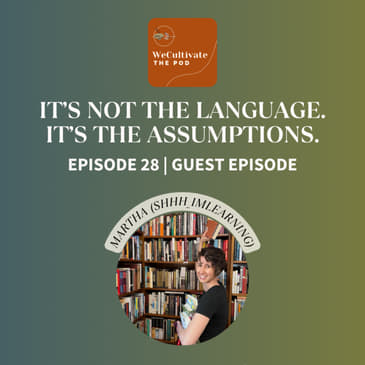



This episode looks at assumptions in language learning and how they influence confidence, belonging, and the way people are judged before they even speak.
It’s Not the Language. It’s the Assumptions.
In this conversation, Martha and I explore how assumptions in language learning, judgments, and personality dynamics shape the language journey far more than grammar or vocabulary ever could. From growing up between North Carolina dialects to navigating Spanish as a lifelong learner, Martha shares how people often decide who “belongs” in a language long before you speak a word.
We also look at why language spaces tend to reward extroversion, what this means for quieter learners, and how introversion can actually support deeper, more reflective learning. This episode challenges the idea that fluency is the main barrier, and instead turns our attention to the environments, expectations, and biases that influence how we show up in a language.
A grounded, honest look at the emotional and social layers of learning, speaking, and being understood.
“This one lady told me, she was like, oh, you speak Spanish. I thought you were just another white girl. And sometimes it's easier to just be another white girl.”
“The language classroom especially, is very extrovert oriented... It's like, come and talk, come and chat... You don't know who's going to be there. You don't know what you're going to talk about... These extroverted ways are great. They are fantastic for extroverted people, but some of us aren't that way.”
“I quickly realized that the way that you sound affects how people treat you.”
🌍 Main Topics Covered
⭐Assumptions and Judgments in Language Learning
How people decide who “should” sound a certain way — and how those assumptions shape confidence, belonging, and opportunity.
⭐Dialect, Accent, and the Social Weight of How We Speak
Growing up between multiple North Carolina dialects, navigating bias, and understanding how voice influences perception.
⭐The Hidden Strengths of Introverted Language Learners
Why language spaces often reward extroversion, and how quieter learners bring depth, processing, and precision that go overlooked.
⭐Navigating Spanish (or any language) in Environments Not Built for You
The emotional toll of being misread before speaking, and the difference between language skill and social acceptance.
⭐Rethinking Monolingual vs. Multilingual Narratives
Why empathy isn’t guaranteed by language ability. And how environment, safety, and exposure shape every language journey.
💡 Actionable Insights & Takeaways
For Language Learners
Honor your learning style. If you’re introverted or need processing time, you don’t have to match extroverted learning methods to make progress.
Separate your ability from people’s assumptions. Their reactions don’t reflect your skill — they reflect their expectations and biases.
Choose environments that feel safe. It’s valid to switch languages or avoid certain interactions if judgment becomes the norm.Let exposure match experience. You don’t need to know every vocabulary word if you’ve never encountered that context in the language.
For Educators & Facilitators
Create space for quieter learners. Build in thinking time, smaller groups, and activities that don’t require instant responses.
Recognize linguistic diversity. Accent, dialect, and heritage variations are assets — not errors to be corrected.Teach multiple varieties when possible. Even simple exposure helps students understand that no language has a single “correct” version.
Use mistakes as teaching moments, not judgments. Support confidence before correction.
For Community Builders / Program Leaders
Be intentional about who feels welcome. Many spaces feel unintentionally closed due to safety concerns, stigma, or insiders-only culture.
Promote events clearly and accessibly. Transparency supports learners who don’t yet feel confident stepping into a new linguistic environment.
Related Resources
Below, you'll find a few links tied to the topics we discuss in this episode. WeCultivate does not unequivocally endorse the material or its creators beyond a cursory review of the material presented. They have been shared here on behalf of our guest to encourage further exploration and independent learning. This is a dynamic list and subject to updates as time goes on. If any of the links become broken, or if you have a suggestion for the list, please let us know. Thanks!
Highly Recommended by Martha: Trapped in the Anglosphere: compassion for native-English speakers - Laura-Jane Baxter | PGO 2022
Podcast episodes
Fact or Fiction: Three Common Bilingualism Myths
This episode focuses on very common myths about bilingualism, including the myth that you have to be perfect in both languages, or at least perfectly balanced, in order to call yourself bilingual. The host, Kayla, doesn’t do the podcast anymore, but she runs such a cool school for kids learning Spanish that I highly recommend for anyone (direct ties to Spanish or not) with kids to check out.
Languages in North Carolina (we’re SUCH a linguistically diverse state!!!) and abroad
Language and Life Project: This project run out of NC State (go pack :D) creates documentaries about different language communities. They focus a lot on North Carolina languages and dialects, but also do work in other parts of the country. One of their key values is always giving back to the community they get interviews and time from. Many of their documentaries can be viewed on their YouTube channel
Books
No me gusta como hablas (o más bien, no me gustas tú) - María del Carmen Méndez Santos: This incredible book goes over how linguistic discrimination takes place in our everyday lives. María takes examples from all over the world and includes QR codes for a more interactive reading experience. Book available only in Spanish. For those not in Spain it can be bought on Amazon, or on Buscalibre for those preferring to not buy from Amazon. I also recommend following María on Instagram for those who use it.
Says Who? A Kinder, Funner Usage Guide for Everyone Who Cares About Words - Anne Curzan: This book celebrates the joy of languages and reminds us all to be a little less intense about what’s “right” and “wrong.”
Algospeak: How Social Media is Transforming the Future of Language: Language is constantly evolving and affected by everything around us. Social media is one of those influences, and in this book Adam Aleksic (Etymology Nerd on social media) goes over how our language is being changed by our time online.
In Other Words - Jhumpa Lahiri: This book stuck out to be because it covers topics such as learning a language as an adult with several responsibilities, falling in love with a language, feeling like you’ll never “get there” (wherever “there” is supposed to be) in a language, and having it always pointed out that you “don’t look like” you should speak a certain language. Also available in Italian (this is the first book she wrote in Italian, so I recommend reading it in the original for those who can).
People
Mamen Horno is an autistic linguist who writes fascinating thoughts about language and the ways our brains process language. She has a book coming out at some point regarding her autistic experience in language or autism and language. She’s also a good person to follow on Instagram. Mamen provides invaluable insights on autism and language use and acquisition. Her materials are available in Spanish.
Vera Gheno is an Italian sociolinguist and author known for her engaging work on inclusive language, digital communication, and how words shape social identity. She has a podcast, Amare Parole, and several books. She’s also quite active on Instagram. Her materials are available in Italian.
Bront’e Singleton: A neurospicy language learner and coach who creates inclusive spaces for fellow neurospicy language learners. She’s also introverted and is continuously creating resources to support language learners who don’t find what they need in a louder language learning environment. (Bront'e was also a guest on WeCultivate: The Pod – see her episode here!)
YouTube Channels
RobWords: For anyone interested in nerding out about the English language, this channel is a must. In each video, Rob delves into topics like the history of English, English’s quirks (like its spelling) and rules that are silly and we shouldn’t follow.
Otherwords: This series from PBS includes videos on all types of practical sociolinguistic issues.
Magazine
Translator Mag: This new initiative includes translated journalism from around the world, sharing stories and perspectives you might not get to hear otherwise in the Anglosphere.
Video version of the conversation here:
Full Transcript
This is an auto-generated transcript. There may be mistakes and typos. For the best results, please navigate to the transcripts generated alongside the episode on Spotify, Apple Podcasts or Substack.
Michelle (intro):
Welcome back to We Cultivate the Pod, where we explore the intersections of language and communication, culture and identity. Today's episode is with Martha, and in this episode she explains what it's been like to navigate language learning as a shy and introverted person. No shyness and introversion are not the same thing, so if you've been using them as the same, please stop. And in this episode, Martha shares about how she found her way into speaking Spanish, making it a part of her life and the unfortunate kinds of judgments that she's had to face along the way, especially as her profile does not match who is generally and stereotypically thought of when it comes to learning this language in the us. And I will remind everyone that with all the guest conversations I've had here, the US is an incredibly large place. It it's an incredibly large country, and if you've never had this experience, that's your experience and that's your life.
But this is Martha's, and I really want to make sure that we understand how many different variations of life exist inside of the same country. And it's come up a few times now, just being from the same country doesn't mean you have the same experience of what it's like to be a person in an everyday society, even if you're from the same state, even if you're from the same city. Until very recently, Martha hosted her own podcast, which she has taken a step back from, but hopefully in the future I can convince her to allow me to spotlight some of her episodes. But you can also listen to everything she's released so far. It's called I'm Learning, and all of that information will be in the show notes as usual. Until then, here's my conversation with Martha.
Martha:
So yeah, my name is Martha, I am from North Carolina and I really love languages. I don't work in them currently, but they've always been a very important part of my life. And so that's part of why I started the podcast that I have. It's called I'm Learning, and I explain why it's called that in the first episode. And it's really just a way for quieter language learners, how I refer to it, to really feel more at home in languages because I always felt it was a very sort of loud space, a very competitive space, and I just wanted to bring a little bit more of slowness to that. And so in a nutshell, that is me. I can tell you more things if you want, but yeah,
Michelle:
Yeah, yeah. Well, your podcast and also one of your guests who also became one of my guests, Bronte, is how I got connected with you because she me that you had recommended her follow me, which I was like, wait, I don't even know you. Wait, this is great. So I completely hear that, by the way, the language space is really dominated by loud voices. I don't know if it's always extroverted people, but it seems to be a lot of talking, like a lot of going out and screaming. And I love that you provide that contrast because I think a lot of people need it.
Martha:
Yeah, I hope so. I hope they can get something out of it.
Michelle:
Yeah. Well, we are going to add in all your links and all the ways that people can connect with you. So you say you don't work in languages currently, but you did before.
Martha:
So the only time I've actually ever worked in languages was I got a start in clinical trials. There's a whole story about that, and I worked on the language side of that. So basically with clinical trials, since they're international, you need them, all the documents translated from English into the languages of the sites and from the languages of the science and English for record keeping. So I actually went to school, I got my master's in social linguistics. The idea was to teach English as a second language, but my dad was diagnosed with a terminal illness when I was in grad school. And basically the advice that I got was like if I wanted to work in this full time that I would need to go to Japan or Korea. And I was like, I don't want to move all the way across the world. And so I just got my job in clinical trials and that's where I've been ever since.
Michelle:
We've had a lot of really, really nice convos, mainly in dms because we were in different time zones, but around how it intersects language with culture and the perceptions of different people. So yeah, how was that in terms of personal life?
Martha:
There's so much that I can say about that. I'll start
Michelle:
First. We have time. We have at least 60 minutes. Okay.
Martha:
I'll start with just the English side of things first and then go into other languages. So basically I grew up between two North Carolina dialects. I absolutely love North Carolina because at least within North Carolina, social linguist tend to refer to the state as dialect heaven because we have five dialect regions. They're all perfectly mutually intelligible, but they're very different. And I don't know if it would be helpful for me to sort of explain the difference between dialect and an accent.
Michelle:
I was about to ask you to take us, well, I was going to wait for you to finish, and then I was like, maybe you might want, yeah, I'm always go with the policy of there is nothing too basic or too simple. So if you want to walk us through that and even go through the five dialects that you're talking about.
Martha:
So a difference between a dialect and an accent, A dialect encompasses accent. It's one of the things that makes up a dialect. So an accent, I usually explain to people who don't study linguistics that it's how you sound, how you pronounce words, and the collection of those different pronunciations that identifies you as part of a group.
Whereas a dialect encompasses accent, but it also encompasses vocabulary and grammar. And so I was always paying attention when I was growing up to the words that my mom's side of the family from Appalachia would use that my dad's side of the family from Eastern North Carolina wouldn't use and vice versa. And the grammar differences, one of my favorites to point out is a prefixing, which is a fancy term for putting literally just a in front of a Jaron, which is going where the ends in ING. But it's like you have to know how to use it because you would never say, I like a fishing. That's just, no, you would say he's gone a fishing or I'm going something like that. And so you have to know how to use it. But in Eastern North Carolina, I at least had never heard anyone use that. And so it's the vocabulary, the different words that you use, the different grammar structures that you use and the different way that you pronounce words, your accent, that all makes up a dialect.
And so I know that there are at least five dialect regions in North Carolina. I can look it up real fast if you want. I just know that there's the mountain. Then there is the coastal plains, you have the outer banks, then you have up north bordering Virginia. And then I forget, I don't know if the Piedmont counts where I'm at right now in Raleigh. I don't know if that counts as its own dialect region. But yeah, it's really cool the different ways that we talk. And so it's like when people say southern accent, I'm like, dude, first of all, there's no one southern accent. And second of all, there's so many different accents even within North Carolina. Come on.
Michelle:
Yeah, and to go one step further, again, no question or no answer to basic or simple. North Carolina is on the east coast of the US and it's not too far from my home state of Maryland. I always say I'm from the DC metro area because DC is like 20 minutes away, but most of us are not actually from the city of dc. Most of us are from one of the states that neighbor. But we basically just have Virginia between us, which is kind of a massive state by certain standards. It's not one of the largest states, but compared to Maryland, I'm always like, why is it not ending just going through Virginia, driving south? I'm like,
Martha:
Man,
Michelle:
It's still going. But then we hit North Carolina. And of course you would think that, and I think personally find this really interesting when people say the US accent or US English, and you're like, well, I get what you mean. But kind of there are so many different ways English is used here. I don't remember the number of dialects and accents that we have in the us. I know it's a large number for sure. I want to say it's like 20 something dialects minimum. But just in North Carolina alone, I'm like, yeah, naturally. Of course, even in Maryland, when you go to a different county, it just completely changes the way that people talk to each other. And as you're describing, I went to school in Baltimore, there's a Baltimore accent that is not what outside. So this is and accent and dialect I'm using kind of together here. I'm like, God, damnit. No, Michelle. Yeah, yeah,
Martha:
A lot of people do. Don't worry.
Michelle:
But also I think I do know that people, there are people who know the difference and then you're using 'em together because you're focusing on the fact that it's the accent that's the most salient part of it. But
Then thank you for clarifying. I think for everyone listening, I think that was a great kind of explanation and an introduction. And of course these are things that a lot of people can search online. I wish more people would just do a quick Google search sometimes before we're going with concepts. So then this is kind of your background of what you noticed in your family, and you were like, people are using things differently. Do you feel like that then kind of kickstarted this whole, okay, so then how do I talk or how do I produce speech?
Martha:
100%. Because where I was going with that is I quickly realized that the way that you sound affects how people treat you, because my dad had a very strong southern accent. And this is also part of where I love social linguistics. It goes more into the different parts of what makes you you, because there's oftentimes more pressure on women to sound a certain way. And so my mom, she had a much more muted southern accent perhaps, or because of the way she would talk, she would be considered. It is really annoying when people are like, oh, your accent's so cute. I'm like, no. And so it was much more socially acceptable and people would act like my dad was less intelligent just because of his accent. And so I was a little kid and realizing, I don't know when exactly I did this. I just know it was firmly in place by the time I was in high school. I was like, okay, my sister's the pretty one, so I have to be the smart one.
And if I want to be the smart one, I have to sound smart. And if I want to sound smart, I have to talk a certain way. And so I developed one way for talking when I was giving presentations or talking with people I didn't know, which is pretty much how I sound right now. And I would reserve my southern accent for when I felt safe, when I felt accepted, when it was a casual environment, because there is this general idea that southern accents, it's seen as at best, sometimes cute and innocent, but lots of times it's perceived as lack of intelligence, which is really annoying because especially growing up between these three dialects, it's like I can shift between these three. That's more intelligence. That's not less.
And so I think that had a profound impact on me and makes me very self-conscious for how I talk. And I think the good thing about that is it gave me a lot more empathy. It's like I know what it's like to be looked down on for how I talk, so I don't want to ever do that to anybody else. So it's a really frustrating thing. My sister, she ran into some issues with the career she wanted to have because of her accent, how she talks. And yeah, it is something that you see all the time that how people talk is a huge thing.
Michelle:
Yeah, I feel exactly what you're talking about. I've seen it represented more and more. I think it's just more conversations on the topic. And I don't necessarily fault humanity or society for falling into certain automatic behaviors. I think as long as you're open to examining how you are behaving and acting in society, so like, oh, I didn't realize I was doing that. I didn't realize I was falling into that because I was watching some standup the other day, and every single time somebody was trying to act out somebody who was less educated or less knowledgeable about something, it was always go into some stereotypical southern sounding accent. And I think that it's very important to recognize that, especially in the English language space where there's this whole battle sometimes and war, I don't know, it's been going on forever. It seems right between the British accent, which there's not one British accent, but just for argument's sake, it's like, oh, the Brits and the US people, the Australians and whatever.
And yeah, I feel like it's interesting to be in international spaces where we all speak English, but then all of us noticing these things as well, and then saying, have I been doing that? Wait, is that something I'm guilty of? Because for instance, I run this podcast now, is that something I actually want to keep in my behavior? Which I don't think I always defaulted to that, but I wouldn't be surprised if I did. And I think that's part of learning and growing. You also talk about empathy, which I don't think everybody who has to navigate this, they get to that conclusion. I think actually it becomes one of those generational cycles. So I think it's one of the good ones, you know what I mean? When it comes to which side of this, which side of history, because we always have that choice. We can choose to recognize these types of behaviors and say, alright, it's influenced me, but I'm going to show up better and show up different for other people. Instead of being like, well, how come you do this to me? I'm going to do it to all of you. This is what's probably causing the eternal presence of division amongst humans, even in the same society. It's probably always going back to this. So you mentioned introversion as part of a big part of your, let's say, your podcast and your online presence. I'm going to assume that it's because it's also you and how you feel and what you wanted to see in this space.
Martha:
Definitely. It's one of the things that you had asked me pet peeves about the industry in general. And one of the things that I felt for the longest time, and I never realized what it was until I started doing my training for teaching English as a second language, was when teachers would actually implement activities or tell us of activities that we could do to give more introverted students more time to think and process. Because the language classroom especially, is very extrovert oriented, and it's even these polyglot spaces. It's like, come and talk, come and chat. And it's like this space where you're going to talk with people. You don't know who's going to be there. You don't know what you're going to talk about. It's not easy for everybody. And the advice I got was always like, well just talk. You just need to practice more.
And I was like, no. And no was supposedly my first word, and I seem to be pretty good at saying it. And I also read an article by this Scottish guy who is an English teacher in Madrid. I have not found him anywhere except for this one guest blog post that he did. And he was talking about when he started teaching and he noticed some of his students acting differently or whatever, and he was like, what's going on? And then he started thinking about it and he started realizing that he was not providing a space that was conducive to more introverted or even possibly ambiverted language learning. He was like, I'm an introvert. How did I not realize this? And so the article is really great. It talks about how even the physical setup of a classroom is really important to give introverted students this space to think and to give them more time to think and changing how you do group work.
Because a lot of the times, not only do you learn just the standard, which nobody speaks in the language classroom, but you also, the way that you have students interact with each other is just so unnatural. And especially for more quieter students, more introverted students is just like, I'm literally never going to do this. Why are you making me do this? And so it was just like torture. And I like to say that when COVID happened and I had what I call my ear of introspection, I came to accept a lot more my introverted side. And so I just really wanted to share a bunch of information with people because I was like, these extroverted ways are great. They are fantastic for extroverted people, but some of us aren't that way.
Michelle:
Yeah. Yeah. And I think it's important to make the distinction also between introversion and just shyness, which could be sort of just a more acute thing, right? It's situational or whatnot. I had someone else on who talked about something that was overlooked in her early life language learning experiences where her teachers thought that she was bad at the language, when in fact she was just shy, but also because she didn't have that sort of environment to speak at home. And I think that's another kind of variable to throw in, which is even for people who are not personality type or I always struggle, it's just a psych degree, me struggles to have the best words for this. Like, oh my God, it's so much going on. I say it's so complicated. But for people who would, let's say, self-defined as introverts, I feel that even shyer students could benefit from a little bit of a change in that classroom setting. I just remember being in Spanish class, not, I wasn't exactly shy, but in Spanish class I was shy because I wasn't used to the sounds coming out of my mouth that it's foreign for that reason. And I didn't have that type of personality to go and just chat with people. And I failed every oral exam as a result. You had to do it in front of the class, which I was like, no, I can't even do this by myself. Right. So
Yeah. Do you have things that you would recommend that teachers incorporate if let's say there's language instructors listening to this episode right now, things that they might think about putting in their classroom?
Martha:
The one thing I would highly suggest is there is a, I don't even know what she calls herself anymore. She still calls herself a language coach, poetry therapy coach, something. I interviewed her for my podcast, Maria Ortega Garcia. She talks a lot about, for example, how your attachment style is going to influence how you learn languages and a lot more of the and integral holistic side of language learning. And so I think she, at least in the past, has offered workshops for teachers. I think she's a very good resource, very good person to go to. And I think in general, of course, it's important to recognize that at least if these are language educators working in the school system in the us, obviously they're probably overworked and underpaid, and so seriously just do what you can. But I think things like, for example, you saying the heritage speakers in your classroom, recognizing what they have to contribute, first of all, not telling them, because I've seen so much where it's like, first of all, and there's so much that I can say about the language landscape in the us, but it's like not only are these kids coming from language background that's stigmatized, but then they're told that they're wrong. The way their family talks is wrong in the classroom.
And the kid who just reads the word from the textbook is like, oh, yeah, you're right. You got it. And it's like, okay. I was taught growing up that the teachers were always never say, or when you want to order food, then what do I do? I grow up and everyone is using or, and I'm just like, guys. So it's use that have some sort of empathy, and when students make mistakes or whatever, use those as teaching moments. And really just trying to educate yourself as much as you can on different learning styles. I mean, because we have so much going on. We have type, we have gender, we have sexual orientation, we have background, language, background, racial, ethnic background. We have so many different factors, and it's impossible for every language educator to know everything, but at least try to know something, try to consider. And when you see something that's different, think about why and try to learn from that.
Michelle:
The point on using heritage speakers, that is such a, oh my God, just taking me back to high school and just ninth grade Spanish. When Ra Anderson, which is clearly Senior Anderson, was a 21-year-old, 22-year-old white girl. I mean, all due respect to her and her efforts, but she was there telling all of the heritage speakers that they were wrong. They weren't doing the things that she was teaching in the book. And I think that really opened my eyes because I kind of looked around and I was like, but they're fluent. They're not even fluent. It's their family's language. It's also,
That really opened my eyes also to how many different versions of Spanish we had even in that classroom. And I think she improved. I saw her again in 11th grade. I think she had made some progress in those two years. But I think that type of, whoa, what's going on here? Which one is actually correct? Kind of experience. There is the book, and then there's the evidence here, or Oh my God, sorry for my accent. It's been a while since I've spoken in Spanish. But literally, yes, every single time you're like, no, no, no. Do not use this. It's a bad habit. And then you're like, okay, but everyone's using it, so I'm going to use it. Right,
Martha:
Exactly. Seriously. And then I mean, it's like language variety. I think there is more attention being made to that in the language classroom. It's a genuine concern. You don't want to expose your students to too much because it's overwhelming, but to let them know that it's there. And also in the us our dialects of Spanish are different. They're different. The first time I remember I heard TE to be like, I'll call you back. I was like, Ugh. It's jarring, but it makes sense. And if all language is a group of people having agreed that this makes sense, so if this community has agreed, this makes sense.
Michelle:
Oh my God, I love that. Yeah,
Martha:
It's a thing.
Michelle:
It's a thing.
Yeah. The difference, Spanish, by the way, the Spanish is that comes out even if you don't have the Spanish language in your family history or heritage or culture, because for instance, my husband and I, he's French, right? I'm Asian American, so he learned a version of Spanish. I mean, I don't know how this came up. I talk about languages every single day. So I assume one day over while I'm cooking, we're like, blah, blah, blah. And I'm like, what did you just say? Trying to correct me on something. I'm trying to correct him on something. And we're both like, wait, no. First of all, we're not in a position to correct anyone. Never stop. Neither of us really, really speaks the language. But second of all, we're like, oh, that's right. You learned. Oh, you both. So true people. I was just like, oh my God, you learned Spain, Spanish. That's why. Because I'm from the us. And of course, there are so many different versions here. It blew his mind truthfully.
Martha:
And that's one of the fun things in my marriage, because my husband, he's from Mexico, and so he calls a pen. I called it ero, and we just live in peace. I'm like, ero, he gives me a pen. He says, dma, and I give him the pen. We're fine.
Michelle:
Yeah, it's really not that big a deal. So there are multiple words, things like, okay, we move on.
Martha:
Yes. I mean, it's like, what do you call, I wish I had one, but the thing that you put on your head when it's cold, and it's kind of usually kind of like crocheted ish or knitted, and sometimes it has a little poof on top. What do you call that? Call it a hat. You just call it a hat.
Michelle:
Yeah. There's a different word for, there are different words in French if I'm talking about it. But yeah, I just call that a hat. What do you call that? So you don't call it like a beanie? Yeah.
Martha:
Well, I call it a bogan.
Michelle:
Oh, okay.
Martha:
A bogan or a toboggan. And people think that's funny, especially people who come from snowy place, because if a bogans a sled, we don't have snow here, so let us call it a bogan in peace. It's a bogan.
Michelle:
Let us live with this word. The idea of, yeah, no, I call it a beanie sometimes. I think it depends. I just, if I am, they have the ones where your ponytail can come out or there's all these fancier versions. So I just call things I think probably hat, and then if I know it's mine, I'll be like, okay, my beanie. But yeah, I don't actually care too much, but I have been corrected now that I think about it, people have corrected me when I say hat, and they're like, you mean a beanie? And I'm like, no. I mean, yeah, it's more precise. It's a
Martha:
Hat. It's a hat. It goes on your head. It's like I call everything you put on your foot besides a sock, like a shoe.
Michelle:
And
Martha:
People correct me for that. They're like, it's not shoe, it's a sandal. It's a flip flop. But I'm like, that's a shoe.
Michelle:
It's a shoe. Is this a multilingual thing, like a multilingual person thing? I think that's also where it goes in my head. It's like, why would it be? It's not wrong. You can say there's a more precise word shirt. I mean your example of bogan as in the end of toboggan, right? Okay. Yes. But I mean, I'll accept that. And also if I move to let's say a community that uses that word, I'm not going to be the weird one being like, no, it's a beanie. I'm going to go with what everyone else is doing.
Martha:
Right, exactly. It shows the creativity of the human mind. And to me, it's just really fascinating to be like, what do you call this? What is this for you? And how do you pronounce this word? How do you pronounce pecan? Everyone has an argument over that.
Michelle:
Oh, man. Salmon. Salmon. Oh, salmon. Yeah.
Martha:
My dad would pronounce it with an L.
Michelle:
It
Martha:
Would drive me crazy.
Michelle:
Oh, caramel and caramel. Oh my god, there's so many. Or
Martha:
Syrup.
Michelle:
Yeah. Okay.
Martha:
Yeah. My best friend and I growing up would argue over how you pronounce syrup and caramel.
Michelle:
Yeah. Wait, so you say caramel.
Martha:
I say caramel and syrup, and she would say syrup and caramel.
Michelle:
Yeah. See I say caramel. It just like something in between.
Martha:
Caramel is so
Michelle:
Elegant.
Martha:
Yeah,
Michelle:
It is elegant. Thank you. No, I'm kidding. Oh god, this is so funny because also because I feel like we are exemplifying the whole point over and over. It's like you're, again, regionally speaking, not too far away, but even inside of the states, inside of the communities, people use things differently. And I think that's one of the funniest things, funny in an ironic way about being online and seeing all of the, I call them fake wars that people have on language, and it's more than just grammar police. It's like, no, it can't possibly be that. And it's like, but it already is. It's not like this is not up for debate. There
Martha:
Is, right?
Michelle:
Yeah.
Martha:
Let's just let everyone live in peace.
Michelle:
Yeah. Yeah. Can you walk us through your Spanish? I don't remember if you grew up bilingual or I just the Spanish part. So
Martha:
I always tell people I feel sometimes learning Spanish was the biggest mistake of my life. It opened up so many doors for me, but it made things really awkward. But do you want me to talk just about the Spanish part about languages in general?
Michelle:
If you want to use Spanish as a lens to talk about languages in general, that might be
Martha:
Great. So I did not grow up bilingual. I come from a multi dialectical family, but English was pretty much the only language that I grew up with in my family, and I grew up in a very homogenous environment. And it was a very religious environment too. I always tell people also, it's like if you want to understand, a lot of the US look at evangelical Christianity, and that's what I grew up in. And this is not to throw shade at my parents or anything at all. I truly believe in the importance of everyone doing what works best for them. But what turned out to be autism that I didn't know that I was autistic until I was 33 or so. My autism and evangelical Christianity did not blend very well because I would always ask why.
I was like, why is this true? Why do we do this? How do you know? God said that, but when did he say that? What mood was he in? Could he have changed his mind? What happened? And everything was double forbidden. I was a girl. There's always going to be that double standard there. And I was like, but why? I want to know. And so I had to start learning Spanish when I was seven. I did not have a choice. It was part of the school curriculum. We had to learn it all through 12th grade, and by the time we were in high school, we had to teach K four through first grade, or maybe it went up to second, third grade, I don't remember. And so I had to learn that language. There was no opting out. There was no other languages, nothing. Our teachers in rural North Carolina in an evangelical Christian environment were like, you guys need to learn Spanish. There's more and more people who are coming to North Carolina who are learning Spanish. It's going to be very important. I feel like that's the side of the story that most people don't mention, but that's what I was told. And so it was in part, Spanish is the only language I did not choose to learn.
And so I think that's part of why I take things personally sometimes. But evangelical Christianity played a huge role in motivating me to learn languages because I realized from a young age that I could read whatever, I could listen to whatever, and my parents would have no idea what I was listening to, but I was reading, and we had to go to church at least three times a week, so I had all these Bible stories mentioned. So if my parents were like, oh, what are you reading? I could literally just recite any Bible story and they believe me, it would be fine.
And so I intentionally immersed myself in Spanish. Anything I could get my hands on. I mean, this was way back in the late nineties, early two thousands, so there wasn't that whole much, but everything I could get my hands on, I did. And it was really funny because when I started to check out books in Spanish from the library, the librarian asked me, she was like, you realize this book is in Spanish? And years later, I was like, why did I not say, you realize I'm literate, right? I am pretty sure I'd be able to tell
Michelle:
This
Martha:
Book is not in English, right?
Michelle:
No. You just accidentally checked out five books consecutively in the wrong language.
Martha:
And so I would read people in Espanola, I would watch TV shows, everything, absolutely everything. And so I grew up with a lot of these same cultural references. So people from Spanish speaking households grew up with. I didn't grow up with that culture. I didn't grow up in that family. And so it put me in a really weird middle space that has caused me to ask a lot of questions and to really try and figure things out. Because in the US we never really talk about how weird it is in terms of being a place for languages.
And so it's like once I got to the point where I would try to talk to people, I would get all these really weird questions, all these really weird comments, and it made me so uncomfortable that I was like, I'm just going to stop speaking Spanish. And even when I met my husband, I naively thought things were going to be better. And I still had people be like, oh, say that. They assumed I didn't speak Spanish because my eye color, because of my skin color, because their wife is white. She doesn't speak Spanish. They assumed I wouldn't either. And there was one time my husband took me to this event and he introduced me in Spanish to six people. And so he would introduce me to the person and I'd be like, whatever. And their response to that, every single person was,
And I was just like, okay. By the sixth person, I just reached around and grabbed some wine and just was chugging it and things like that. Or there was this time I was talking with this girl and my husband in Spanish and mid conversation, she changed into English and I kept going in Spanish, and she was like, oh, you speak Spanish? I was like, I've been speaking in Spanish. She was like, oh, but you're American, right? I was like, yeah. And she was like, okay, bye has all of these experiences that I'm like, I'm already fully aware of how different I look. And so when that is called out, it makes me feel really weird. And I have the face that people assume I'm always wanting to practice a language, and I'm like, in a certain sense, yes, because for example, I went to the dentist in Mexico and I learned the word for root canal.
I've never needed to know the word for root canal in Spanish ever, because your knowledge of a language is based on your experiences in that language. So many people freak out. They're like, I have no idea how to say this and that. Have you had that experience in the language? No. And so it's in a certain sense, yes, but also I want to use this language that has been a part of my life for the past 30 years. That's all I want. And so I would ask people, I was like, am I doing something wrong? Am I being rude? I'm just trying to talk with people and I keep getting all these weird comments and all these weird questions. And for the longest time people would just be like, oh, that's just how people are. I was like, I don't think so. This is weird. And so I've really made the decision to not use Spanish with people I don't know in the US
Because sometimes it's easier. This one lady told me, she was like, oh, you speak Spanish. I thought you were just another white girl. And sometimes it's easier to just be another white girl. It's like, if this is going to get me through the conversation without a weird comment, without a weird question, I'm trying to be respectful. I'm trying to show respect by using your language. I'm trying to connect, but if that's not going to happen, I need to protect myself too. And I used to think, oh, you're holding yourself back. And I'm like, no. If every single time this conversation's awkward, I can't control how other people act. I can't control how other people perceive me. I'm not the problem. And the common piece of wisdom is if something keeps happening and you're the common denominator, you're the problem. Sometimes yes, but sometimes no.
And so it's like, if it's better for my mental health to just use English, I'm just going to use English. And I think that's something that is really stressful that in terms of using and practicing other languages in the us, it can be really stressful because also I think maybe in New York and LA and Miami, it's a different story, but especially in places here, I even told my husband one time, I was like, there are so many events, so many places that people could go to and immersed themselves in Spanish, especially once you get to that lower intermediate level and you really need to talk with people, right?
Michelle:
Yeah.
Martha:
There's so many events. I was like, why are these events not more publicized? Or the language always sort of indicates it's like, I don't know how to word it, like insiders only.
And he mentioned the fact that it's like a lot of it has to do with undocumented people. Here. It's like this desire to protect the community. It's like you never know who is going to show up. That's not going to be a safe person to have there. And so that's something that it's really a huge struggle for me because also you look at language violence, language discrimination in the us, you look at how stigmatized Spanish can be, and that's a very real reality, and those are boundaries that need to be respected and honored. But we keep going in the same loop of Americans don't speak Spanish. Well, first of all, what do you mean?
Michelle:
Or other languages, by the way.
Martha:
That's the thing. Who are you talking about when you're saying American? Are you talking about white Americans? Are you talking about all Americans? Who are you talking about? But it's also, we don't have the chance to go and practice. I've been very fortunate to be in other situations, but a lot of people, I see so many people who speak Spanish who want to use it, but it's like how and when and where. And so it's a really tough reality to navigate through, I think.
Michelle:
Yeah. I appreciate you sharing honestly about your experiences. I do think sometimes we don't talk often enough about how, yeah, great idea, Duolingo, Rosetta Stone, whatever you want to buy, fantastic. Go for it. Growth, personal development, fantastic. Shoot for the stars, but that your own goals and ambitions will not change the environment that you're in. So if you're not in an environment that supports your new language, use new initially, but then you progress. And for you for sure, it's been essentially your whole life, right? It's been like it's a very long time, or not your whole life, but definitely long enough with the language that you're like, yeah, I'm not the problem. It's literally I can't change the people around me. All you can change is your behavior and reaction to it or in response to it. And I want to say also that you're reminding me that oftentimes people like to refer to the us and it doesn't really matter what term you use, we'll touch on this later, but the US Usan or Americans, it doesn't really matter to be honest.
If you're talking about the country and you're talking about it, well, all of you don't speak another language. I'm like, well, I speak, I grew up bilingual. What and how many other people I know like me, but not just that your experience. I know a lot of people who were required or for some reason had to expose themselves to other languages. And it's not only not true that us and Zura Americans are monolingual, it's not true. First of all, we don't talk enough about how different your experience can be in the country. For instance, in my local area, when I walk into a, I'm just going to call it any sort of government office for people of different immigration statuses, there's often a, because it could be really general, but there's often a group, you might see different types of groups broken up into language. They assume I speak Spanish, I have an Asian face, and they assume I speak Spanish because they have learned how many people in this area speak Spanish. And so it's weird to have that, the reverse experience of you, which is not, it doesn't mean one is more valid, it just means it literally depends on where you live so much does. Yeah.
Martha:
Yeah.
Michelle:
And so what you were saying, and I think Bronte and I talked on this also, she was like, yeah, oh my God, it was so great. I was growing up in all these people in all these different languages and the linguistic environment, multi linguistic environment around me that supports and facilitates someone's sort of goals as they progress as well. And for you, I feel like it's very, very sad what you've had to go through in a way because you've put all this work into it for whatever reason, like evangelical Christianity, not withstanding, which by the way, you and I, that is something we should talk about at a different time. But that is also part of my backstory into understanding language, culture, identity and all that. But yeah, it's something that is very, very tough because it's not this very rosy happy, oh, great, so you speak Spanish, so then your life is better. It can only be good that we learn languages, right? It's like,
Yeah, maybe for the person it can be enriching, but if societies don't change their behavior intentionally to help facilitate that, then no, it's going to suck. For the people who I feel that way about French, I don't like listening to having French in my head and being able to understand some of the things that French people say, let's say in the country, vis-a-vis other French accents. I was on the plane and had to listen to these two guys complain about the Canadian French accent. It was an Air Canada flight the whole time and making fun of the staff and saying all sorts of really, really nasty things. I'm like, I wish I didn't understand this language.
Martha:
That's one of the things sort of related to that that I wish people had prepared me for is listening to people talking about your group of people, however, to define it in this language, especially because they assume that someone like you is not going to be in that space. It's really weird. It's really awkward. I wanted to touch on something though, because I think it's really important to highlight the fact that monolingual is often thrown around as kind of an insult,
Which really frustrates me because I'm like, there's nothing wrong with being monolingual. It's like as long as you are using the language that you need to communicate with people, you're doing a great job. And also one of the biggest disappointments for me and learning languages, so basically, again, I didn't realize I was autistic for the longest time. Once I did, it made so much sense because I live and breathe languages basically all the time. I'm learning a language, I'm learning, I'm reading about linguistics something. And so I think that's also part of why it hurts when people see me as just another white girl or something. I literally spend my entire existence doing language. So it's like people see monolingual as a bad thing and multilingual is a good thing. And I was really disappointed because I just assumed, okay, this whole I love languages.
I assumed that everyone who learned languages and who was multilingual would be like me and just love languages and be super excited to learn about other people. No, I think there is a certain amount of truth to the fact that if you learn more languages, you might be more prone to being more open, but it definitely does not automatically make you a more open person. I have met so many monolingual people who are very open-minded and so many multilingual people who are very close-minded. And also there is an amazing talk, I don't know if you've seen it or not, I think it's called Trapped in the Anglosphere, sort of talking about how hard it is to learn and use other languages as a native English speaker. It's like also the side we don't talk about. It's not to say, oh, look at us, poor us. No. It's to help understand the other side of the story that never gets talked about.
Michelle:
Yeah, you're touching on so many great points. I want to just also piggyback off the monolingual thing. I actually put this on threads just as a fun kind of poll, and I'm like, and that wasn't a poll. I don't know how I worded it, but basically responses came flooding in. I don't have that many people following me, and I don't have very popular social media. I too like the minimum. I'm like, Hey, new podcast episode. All right, bye for another two weeks. So I'm there. And a lot of people came in to say, all right, yeah, multilingualism, of course, it can help you develop compassion and empathy because especially if you have gone through it as an adult and you know how difficult it is because you're confronted to so many different things and you're like, oh my God, I feel like a baby again, it's horrible for my brain, but it doesn't mean it will guarantee that you develop empathy in this area first. Secondly, monolingualism is not the cause of rude behavior or assumptions or biases or stereotypes. Monolingualism is not to blame for that. You can be a monolingual and be an open-minded kind person, a compassionate person, and you can be a monolingual and be a jerk,
A sort of asshole. Total scum of the other type person is something that is specific to the individual. Sure, we might see a pattern sometimes, and I think what I say bothers me the most is when monolingualism is also together with native speaker superiority. I think that's where it starts to become a problem, like you going around expecting the whole world cater to you because you are the king. It's your language. That's a whole separate piece of it though. And it's not oh, down with the monolinguals because it's not the root issue. I do think it's sometimes, again, it's helpful. It could be great. It could be a good exercise, but it doesn't guarantee an effect,
Martha:
Definitely not.
Michelle:
I think that sometimes we just need to have a little lot more compassion in this world. We need to just set aside our biases, which is easier said than done, and probably will never be done completely uniformly by everyone. But I feel why it's important to push conversations like these is really to break any assumptions around why is it that it's this way for one person and that way for another, well, they're different people. They had different life experiences and histories. Was it similar for you, or can you kind of walk us through the other languages that you have a bunch listed in your bio?
Martha:
It was totally different. It was totally different. So my favorite story is with Portuguese, and it is funny. I used to think I had a complicated relationship with Portuguese because I would start it, stop it, start it, stop it. No, it's just because I didn't need it.
And so I went to Brazil when I was 15. I was told a lie that I would be able to eat cake for breakfast every day. Never happened. That's the whole reason why I went, to be honest, I was 15, so those were my priorities, and I loved it though. I was like, I can understand so much with the foundation of Spanish that I had, I could understand so much. And so I came back, and again, this was 2005. We didn't have all this stuff still we have today, but we did have Live Mocha. Live Mocha is a website where the idea was, I don't know if you ever used it,
Michelle:
Probably not. No.
Martha:
The idea was you were supposed to leave voice messages, a view, practicing the language.
Native speakers were supposed to give you constructive feedback. What constructive feedback did I get on my Brazilian Portuguese? Nothing. The comments were like, you have an accent, and this is Portuguese, not Spanish. I was like, I am perfectly aware of those things, but can you give me some constructive feedback? And so it was because of that, and I didn't need to learn it that I stopped learning it for the longest time. And to be honest, and I've even tried to see why this is the huge difference between me speaking Spanish to someone and me speaking Portuguese to someone like anymore. When I speak Portuguese with Brazilians, they're so excited, they're so happy, and it makes me feel so good, and it makes me want to talk more. We even have a Brazilian restaurant here, and they just started talking to us in Portuguese. I was like, man, this never happens, but okay, so I was talking to them in Portuguese and the waitress was like, I love your accent. Where are you from? And I was just like, you have no idea how much good you did just right now. And so it is so different again from how it is in Spanish and how it is in Portuguese, and of course the context is completely different, but it's so nice. It's so nice. So that was the second language, and then I studied modern Middle Eastern history in college, and so I started learning specifically, I studied Palestine, Israel, Jordan, Lebanon, and so I started learning Hebrew and Arabic
In part because let's be honest, I had to read about 200 pages a week. If I could read through the names really fast, that would make things faster. So that was part of it. But also I really wanted to be able to better understand the people. I wanted to be able to better understand the culture, their region. I didn't want to just learn the history through this English only lens. And so it set up this awkward dynamic. I feel lots of times I have to pick between Hebrew and Arabic, and I'm like, no, both are part of my story. If someone's not comfortable with that, I respect that, but they're both part of my story. And it's really interesting because the Hebrew that I learned is the Hebrew that you can go to Tel Aviv and just talk with people. I did that and just chat with people. The Arabic was not, so, the Arabic that you learn in school is probably going to be modern standard Arabic, which you can't just go talk to people. And at the time, Egyptian Arabic was the only dialect offered in a classroom setting. And every single Lebanese or Palestinian person I met in person who was like, oh, I'll teach you this dialect of Arabic. They would teach me for 30 minutes and then moved to somewhere else, and I was just like another city, another state.
So I was like, all right, this is not going to be a thing. But then the same year I went to Tel Aviv, I went to Lebanon, and yeah, I couldn't talk with anybody. Most people spoke French in addition to Arabic, but not really English. And I had this one girl, she was like, why don't you speak French? And I was just like, I've never needed French. And so I came back and I learned French at a community college for a year and a half, so I know enough to get me in trouble, but I didn't speak it. And then in grad school, my best friend was from Pakistan and she had this mad love affair with Persian or Farsi, and so I started learning it with Chaan conversation, who I have to recommend, especially because again, as a native English speaker who has had English as a heritage language for forever, I don't know what the struggle is like, but they really are very familiar with the heritage speaker struggle. And so they're very sensitive to people born in the US who have Farsi as their family language.
And so you see a lot of people who I feel really left out sometimes most people are either learning Farsi because of their partner or because of their family, and I'm like, I just love the language. But you see a lot of heritage speakers there because it is a very welcoming environment for them as well. So that was really cool. Then I dabbled a lot of language and a lot of languages on Duolingo. So again, learning nothing for a while. Then currently I'm rotating. Oh, I started learning Italian when I was on a break from Portuguese, and then I'm currently rotating between Japanese and Irish and Welsh.
Michelle:
That's very cool. I, so yeah, I keep Duolingo around because I just think it's cute and I think it's something to do when you're just on public, and I don't think that they actually make these claims that you will become fluent only with the app. I've never seen them say that. So God forbid I be the one voice in Defense of the Owl, but I feel like, well, it's a really well-designed app from the tech perspective. I'm like, well, they thought about everything and I feel like it's good for practice. Why would that be a bad thing? But yeah, I'm not a Duolingo ambassador or anything. I'm not trying to just give them any, yeah, I just think we have to use tools as we need, but a lot of people seem to not understand that, at least not yet. In the interest of time, we have to sort of wrap up, but I want to say you're very welcome to come back and we can talk more about so many things. I hope to have a recurring guests. Yeah, thanks for having me. It's been great.
Michelle (outro):
I hope you enjoyed this episode of We Cultivate the Pod. Make sure to subscribe here and wherever you get your podcasts so you can catch new episodes as they become available. I also share after the mic reflections on Substack, the place where I dive into the themes that stay with me long after recording beginning in 2026. You can also find additional bonus content from guests and other, we cultivate extras. Subscribe for free to the communication shift on substack. The link is in the show notes and in this description. Thank you so much for joining us this time, and I will see you in the next episode.