



Video version here:
MAIN TOPICS
Shame as a Hidden Barrier in Language Learning
How early schooling, exams, and correction-focused teaching embed shame that follows learners into adulthood.Compassion as a Foundation for Sustainable Practice
Why consistency only works when it’s guilt-free, flexible, and humane.Fluency vs. Perfection in Real-World Communication
How communicative success is often misunderstood as grammatical perfection.Generalism, Curiosity, and Diverse Learning Paths
How having many interests (languages, music, disciplines) challenges narrow definitions of “success.”Systems, Exams, and the Limits of Evaluation
How exams and assessment systems distort confidence, identity, and learning priorities.
Recurring Themes (Within the Episode)
Balance over binaries
Navigating structure vs. freedom, perfection vs. communication, and technology vs. self-reliance without treating them as opposing forces.Self-compassion as a learning foundation
Reframing mistakes as natural and recognizing shame-free environments as essential for sustainable learning.Cultural adaptation and identity shift
Living abroad as a permanent transformation, captured through the idea of becoming a “triangle” rather than fully belonging to one system or another.
Wider Shifts (Beyond the Episode)
AI and edtech in language learning
Growing influence of AI-driven tools alongside ethical, pedagogical, and expertise-related concerns.A pushback against burnout culture
Increasing recognition that intensity and productivity-first models are unsustainable, leading to gentler, more human approaches to learning.Communication as a life skill
A broader shift toward understanding communication as relational, psychological, and contextual — not just linguistic accuracy.Actionable Advice
Build consistency without punishment
Focus on habits that are guilt-free and sustainable, not intensity or perfection.Start small and lower the stakes
Use brief, low-pressure practice to reduce avoidance and build momentum.Prioritize communication over correctness
Treat mistakes as functional, not failures, and separate fluency from grammatical perfection.Design a rhythm that fits you
Practice in safe environments and shape learning around your life, energy, and needs — with self-compassion at the center.
List of References Mentioned in the Episode
French in Action
A 52-part university-level French immersion video series designed to cover the courses of French 101, 102, 201, and 202. After the introductory episodes, the course follows a 10-minute story of an American man visiting Paris and having conversations with local people followed by 20 minutes of a professor reviewing and explaining the vocabulary and grammar to a class of university students learning French.
Ernest Hemingway’s A Moveable Feast
A memoir about his time living in Paris in the 1920s.
Pimsleur audio language series
The language-learning series designed by Dr. Paul Pimsleur integrates graduated memory recall and short dialogues that are systematically taught and recalled to improve memory and pronunciation. Because the dialogues are the same in every language, the series can be used to accelerate learning multiple languages with familiar content.
TESOL Exam
The Test of English as a Foreign Language is designed to assess the language skills of students around the world who wish to apply to and enroll in English-speaking university programs.
Jonathan’s 30-Day Speaking Challenge
Since 2017, this challenge has been designed to encourage language learners to practice speaking and making daily recordings to document their progress over time.
I am a Triangle.
According to the founder, when circles live among squares or squares live among circles, they end up becoming triangles regardless if they live abroad permanently or move back home. The experience shapes who they become.
French Education grade levels and names
Working at 31 rue Cambon, Chanel
This the first shop that Coco Chanel had since 1910. It expanded over the years to contain her apartment and main offices.
The Devil Wears Prada (2006)
Around the same time while I was teaching English for clients at Chanel, I could relate to the main character in the movie who was a fashion outsider.
AirFrance
Teaching English to groups of flight attendants and ground staff for Air France at Roissy and Orly airports.
Full Transcript
This is an auto-generated transcript. There may be mistakes and typos. For the best results, please navigate to the transcripts generated alongside the episode on Spotify, Apple Podcasts or Substack.
Michelle (intro):
Welcome back to We Cultivate the Pod, where we explore the intersections of language and communication, culture and identity. Today's episode is with Jonathan. Our conversation spans his journey in and out of different spaces and what he's seen in the language learning industry. Along the way, we dive into his experiences as an English teacher in different countries. We also talk about the patterns and barriers that we've both seen that often show up early through schooling and exams, but the heart of the episode actually touches on something broader, at least it does to me. And something that's really stuck with me since we recorded is this aspect of consistency in a way that feels right to you. See, Jonathan runs a speaking challenge where he speaks six languages or so a day, but he's quick to emphasize that that's his rhythm about what works for him. And that's something that I know I and others continue to emphasize in the language learning space and really learning anything, not just languages, that it's not just about finding what you like, but something that works for you, something that's not a punishment, which we all often too quickly associate with learning.
And maybe that is from school, maybe that is from early life experiences. And Jonathan and I also talk about how we've helped people get past those things, whether as students, learners, trainees, or clients, things that many people carry from childhood into adulthood that are often the true blocks to learning. So this conversation is about systemic challenges, personal strategies, and the personal experiences that tie all these things together. Here is my conversation with Jonathan.
Michelle:
Welcome, then. Welcome to this podcast, which is taking a lot of time out of my life to produce. But how are you today?
Jonathan:
Great, great. Thanks for the invitation. Yeah, pleasure to be here.
Michelle:
Great. I'll just let you go ahead and introduce yourself for our listeners.
Jonathan:
So my name is Jonathan Huggins, and I have been an English teacher for a little over 25 years now. I'm originally from Southern California, but I've been living outside of the United States for about 23 years now, 22, 23. So I lived in Paris, France for six years. I studied there and started teaching a lot of business English. And from there, after about six years, I moved to Mexico City and I've been in Mexico for the past 16 years from Mexico City, and then more recently [???]
Michelle:
Which direction should we go first is kind of what I'm asking myself. I mean, I guess we can kind of talk a little bit about what made you start your life abroad.
Jonathan:
I think I felt a bit limited in Southern California. I guess I could have gone upstate to San Francisco, but I decided to go across the Atlantic. I think what probably motivated me was in my last year of high school, my French teacher had some kind of exchange between schools. So there were students from France or Switzerland that came over on their Halloween All Saints Day break in the French system that there's a week there. They came to visit, they came to visit California for a week, and then on our spring break we went to visit them for a week and see their school and have a host family and become pen pals. And from there also another week in Paris without those families, but just two experiences, like a home stay for a week. And that was my first experience in Europe. And I was like, wow, I like it here. There's the languages, there's just, everything's different. And so that caught my curiosity and that encouraged me to accelerate my university studies so that I could eventually go to Paris. And then, yeah, that's what I wanted to do. That was the promise I made to myself. I'm going to come back and either study here or live here. And I fulfilled that promise to myself. Yeah,
Michelle:
Yeah. Was it everything you wanted
Jonathan:
In my delusional dreams at the time where it was like, I was watching a lot of this really old video series called French in Action,
And I think every student in that generation who was watching French in Action, it's an eighties series from Yale, I think, and it created the story of an American in Paris and meets somebody. And it's all these little conversational, these dialogues, which for the purpose of teaching French, but it creates this little dream of, hey, it is a cliche and an American in Paris. It is a very cliche thing. And when I was living in Paris, I did come across Hemingway's movable feast and to say, if somebody lives in Paris in their early twenties, they carry that with them the rest of their life. In calling that experience in Paris and France, a movable feast, I thought like, wow, that is true. It has been true. When I was there, I was like, how could I live anywhere else in the world? I mean, it's a living museum, it's the architecture, just, yeah, there was a dream. And I felt very much, very much immersed in that. I loved it. Yeah.
Michelle:
Yeah. So you studied there also before you started working. Okay. Was it for English teaching?
Jonathan:
The studying was French literature at theBone. So
Michelle:
You went on it all in?
Jonathan:
Yeah, I was very much out of my depth. I had professors in the, I didn't know they were famous, but they were famous. They had books and stuff, and they were in these lecture halls. My French was street French, it was conversational French, even though I had a bachelor's in French, I was not in the American system in a bachelor's French, it was not French in France at the university. So I was taking notes and I would get the first part of the first sentence, the middle part of the middle, the second sentence, and then the last part of the third sentence, I'd look at my notes and nothing made sense. So after a year I was not doing great in the literature studies, I changed and switched to musicology. So I equally had a bachelor's in French and music. So I had taken a break from the music to look at French literature. And then French literature was just way out of my depth. And they said, okay, lemme try music. And then I was able to get a diploma, the ance in musicology.
Michelle:
But
Jonathan:
It was challenging. It was challenging.
Michelle:
Yeah. Very, very cool. I mean, I did know that you, well, I see it sometimes on your socials that you play piano and guitar, right? That's what I've seen so far. Other instruments, or not to say that's not enough, but it's just musicology is great.
Jonathan:
Over the years, I think I started with trombone, then piano, then alto saxophone, tenor saxophone, baritone saxophone, guitar, then electric bass. And then about 13 years ago, I decided to pick up the violin and the violin then that like, oh, there's a cello. Let me try that. So as just
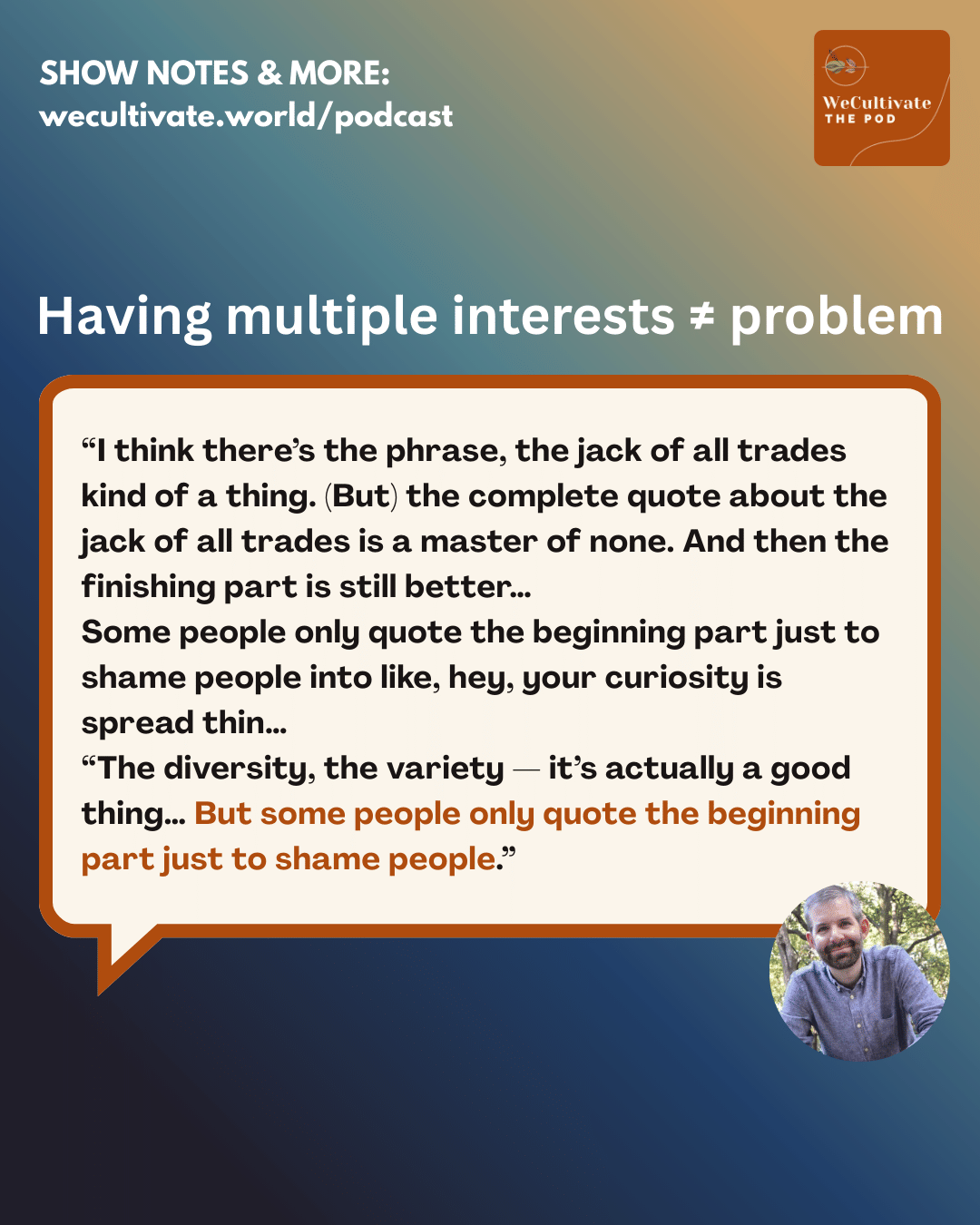
Candy at the cash register, like, oh, there's a cello, lemme get that. I think mainly now I do stick to piano and guitar. Those are probably the two I enjoy the most, and they have different possibilities with that. I'd say the switching between the instruments or picking the instruments up, and also the different languages as well. It's probably, I've learned this now as much older in life, but probably some undiagnosed A DHD. So when something got challenging and I would have to actually put the effort into get good at it, I would jump ship and just let's start something new. Unfortunately, fortunately I got good at that. So I think there's the phrase, the jack of all trades kind of a thing. I think the complete quote about the jack of all trades is a master of none. And then the finishing
Michelle:
Part is still better than a
Jonathan:
Yeah,
Michelle:
Exactly.
Jonathan:
You're still better than a master of one or something, some when they,
Michelle:
That's
Jonathan:
What it is.
Michelle:
Yes.
Jonathan:
So when people do actually add the last part, you're diversity variety. It's actually a good thing. But some people only quote the beginning part just to shame people into like, Hey, your curiosity is spread thin. And I'm like, no, I like doing a variety of things.
Michelle:
Yeah, I don't think there is anything wrong with wanting to have a more generalist existence. And I do kind of always remind people Industrial revolution was a lot for why certain countries decided to make you specialize. I mean, during the time of Da Vinci where it was anyone like, oh, how dare you do science and art and philosophy and all this, come on. So I do think that we have to take a step back and just be like, it's a more modern thing for everyone to be so into one thing and maybe we need to ease up on that. I'm not saying that we don't all have jobs. I'm saying more, let's remember, we're still whole humans. You can have a multitude of interests and Id she notwithstanding, I just think it's a human thing. If you're curious about something, you can go towards it. Why not? But that's just me. That's just how I feel. Also, kind of like that you speak a lot of languages also, so let's chat about those.
Jonathan:
Sure. Yeah, definitely. I think I was probably monolingual until I was 14. So then it was just a high school requirement at the beginning, two years of a language.
Oh, I love that. I enjoyed it. And in my family, in terms of my parents and my brother sister of what they had also studied in high school, I just thought it might be cool to be able to practice Spanish with one or two of them and maybe practice French with another one of 'em. So I decided, I opted in for another language, French one when I was in Spanish three. So I had those two going on at the same time. And I didn't realize that the Spanish studies directly accelerated the French ones. So when I was about to go into French two, the teacher said, you know what? Skip French two. Let's just put you in French three. And I'm like, really? And there's like, here's the French two book. Look at it over the summer, it'll probably make sense based on stuff you've already done in French one and also from the Spanish. And then I was in my last year of high school, I was in Spanish four ap, which is an advanced placement that gets potentially college credit if you'd take an exam and French three. And that wasn't enough. I was curious to pick up conversational German at a community college at night. And then I was starting to ask questions to one of the English teachers who still remembered learning Latin when they were in school. So I was like, okay, teach me Latin since I am starting to get interested in Spanish or French. And so they would give me just a few little things on Latin,
And I was like, oh, this sounds familiar, based on the Spanish or French. And then from there I just ransacked the local public library and just started taking books and audio cassettes before CDs and amputees and video series, and I got the language bug and I was just giving you everything.
Michelle:
Yeah. Well, I imagine you at that time just wanting to absorb anything and everything, because I do think that there is something really magical that happens when this doorway to this other world opens and you're just like, but this could happen with any language. It could just be so many more worlds that I get to see.
Jonathan:
Definitely. Yeah, I think there was this, yeah, definitely opening doors and just like, oh, I could talk to people from around the world. And my dad was a language enthusiast as well. He dabbles, he and he would pick up these audio series and books and things. So he had a pretty extensive bookshelf at home. And I would just start, Hey, can I borrow that pimsler Spanish? And then, oh, hey, can I borrow that Pimsler French? And then the German, and they tell me and Russian, they eventually thought I was really crazy because of the music, all the music stuff I was doing, I had access to a bunch of audio cassette players and recorders. So I would intentionally put on three or four, possibly five, maybe cassettes of each different language. So I'd have Pimsler one in Spanish, and then another one, another lesson in French, another one in German. And it would just be this bombardment, constant bombardment of, do you remember how to tell the woman, I don't know what time it is, or ask her, would you like to eat? And what time is it? So I'd have those just bouncing back and forth in Spanish, French, German, Italian. They would open the door and just like, this is kind of crazy, close it.
So it's given me a lot of neuroplasticity. I thought it was just fun, a challenge to keep my mind just active and curious. Years later, it still helps. I still practice six languages on a daily basis,
Michelle:
And I am reading them in your bio. So basically we have English, Spanish, French, German, Italian, and Russian on a daily basis. And this is also related to the speaking challenge that you do, right? Yeah,
Jonathan:
That's a program. It's inspired through my work with exam preparation like TOEFL, where students have to get comfortable making recordings with the microphone and those exam conditions. They really just have like 45, 60 seconds to look at a question, think of what they're going to say and speak and confidently. I decided to take some inspiration from that and open it to all languages and not put a timer aspect in there. And also not put a limited time for the prompt. So I end up giving people maybe a week that they can look at a prompt and think, okay, a week from now we're going to be talking about this. That gives you some time to review some vocabulary, review some grammar, maybe write some speaking notes down. And then when it comes time to practicing it, then just record yourself speaking, improvise it or read some notes. It's very flexible. And that's a program I've been organizing for eight years now.
And I also try to participate in it as well to say it is possible to do something for five minutes or 10 minutes or 20 minutes, have a recording, just hit record, start practicing. It can be embarrassing. There can be mistakes, but you get tougher skin, it gets easier, you gain more fluency, confidence, you activate grammar, you activate passive vocabulary, make it active vocabulary. And when you're in conversations with people, you don't always have access to the phone or the computer or it's just going to interrupt a conversation if you're looking stuff up. So it is a good idea to just get comfortable with, I don't know how to say that. Okay, how do I express that idea? Or, oh, it's not perfect, but here's the gist of what I'm trying to say. So that becomes a habit. And as of right now, I'm very close to getting a five year streak of the six languages every day for five, 10 minutes. And it really helps for the fluency and practice and the habits and the mindset.
Michelle:
I think people underestimate, and this came up in another podcast episode, essentially the idea that it doesn't mean consistency doesn't mean that we need to be practicing, let's say two hours each day and then just go hardcore and just concentrate on one language or just drill grammar over and over. Sometimes consistency is just building the habit. And it doesn't even have to be, I mean yours is every day, but that's, that's the rhythm. It could be every other day, it could be once a week, whatever it is. That helps you maintain the habit of practice. Because I feel like when people do something and they might be really committed to it, and then they, it's like going to the gym, right? You're like, I'm going to go, I'm going to go. And then one day you miss it and you're like, oh, crap. And you're like, oh, I'm going to go next week. And you never really get back on. I feel like that's really what keeps coming back. As in it is a little easier to build, I think, than some people think. It's hard to maintain. And that's why it's good to have community challenges, people to motivate you. Because even Duolingo can be very, very, I mean, they gamify it, but if you're just doing it alone, I mean, especially if you're an adult, you're like, I have things to do. Why am I this stupid? Bird's not going to tell me what to do with my time. I'm going to make sure that I get my life done and you can very quickly drop off. So I like that you encourage people to stay motivated.
Jonathan:
Yeah, I think what is a really fundamental part of that, when you mentioned the gym and exercise and also the Duolingo owl, what comes to mind is making sure that for consistency, that it's guilt free. You don't shame yourself if you do get tired or you do forget or you do skip a day. A lot of people make an immediate association of like, oh, I'm stupid, or, oh, what's wrong with me? And I would just taken me a while to get up to a consistent thing that I could say is five years. It went maybe from a couple months to 90 days and then six months, and then I would drop off and then question, how do I do this? And then once you interrupt it, yeah, there is the shame, the guilt, or just, and that doesn't help, that just makes it harder to just get back on the wagon kind of a thing. But I think the self-compassion and just, lemme try again. Tomorrow's a new day or next month is a new month. It doesn't have to be January 1st any day could be January 1st. If you're just willing to like, okay, I'm going to try something. And some other people who study habits and motivation, they say, okay, just make it the easiest minimalist thing you could do. So can I do one pushup?
And then when you do one, you're okay, I could do more.
And it's just easing your way into something or, okay, I'm going to record myself for 10 seconds, I can do that. And then 10 could easily become 30 and you're like, oh. And now I've been speaking for five minutes. So if you just ease that first thing to get back into it without the shame, without the guilt, and just enjoy it and keep making positive associations with it, it leads to better results. But a lot of people, we're human, everybody makes mistakes and just realize that the default is at some point something is going to feel unsustainable, some unpredictable thing is going to happen during the day, and that could derail your plan or your goal. So I think having multiple options, I can do something in the morning, I can do something in the middle of the day, I can do something evening. So speaking of recording, it's a little bit more flexible compared to going for a walk that might be dependent on the weather outside or your energy level. So there's some other variables, factors that couldn't get in the way. And then so if things get hard, get simpler. If you're like, I don't have two hours, no, do two minutes and just keep the ball rolling. That's a better way to approach consistency.
Michelle:
Yeah. Yeah. This is reminding me that I think I'm just starting to learn how many people are naturally very hard on themselves. I'm also very hard on myself. I've heard also many of the people around me say things like, yeah, we all need to practice more compassion and understanding. Sometimes it can feel like we're lowering our standards and it's not the same thing. And I think that sometimes something as simple as a language speaking practice can be a good way to practice a general life skill and a new habit in something that is relatively low stakes. It's like,
I'm going to rework. It's so deep. It's like my personal relationship with self-critique and self-compassion. I'm going to work on this in this safe space in a way that I've created for my speaking practice. And through that, I will also learn maybe how to be kinder with myself in other ways. We think of these as isolated containers of different subjects and topics, but I also feel like at some point, everything is psychology in some way at some point. It's all behaviors, it's all thoughts and all the little loops that we get caught up inside every single waking moment. And it feels like that can be a good way to kind of show, I mean, we talked about different worlds, but it's also a different version maybe of what we could be in life. We can be a little bit kinder. We don't have to be so hard. We're in a new generation also of all this, I think not gone, it still exists, but more people are speaking up and saying, we don't always have to go hard. Yeah, 30 days go, right? This has now thankfully died off a little bit more.
Jonathan:
Yeah, there is definitely this constant productivity always on never off. And there is some real burnout and some backlash that the body can only handle so much intensity or it can go short term, but as a long-term approach for the consistency, I think the self-compassion and things can be different. And those are definitely part of building that habit and the system as well, the system to create the habit.
Michelle:
Yeah, absolutely. I think also another point is many people are embarrassed to speak in front of other people. And so what you're doing is something also very powerful, which is, and I tell people this all the time, it's like you might not want to talk to people, but eventually language is used as a tool for communication. So you're going to have to interact in real life and better that you get comfortable in, again, a safe space, a closed setting, a relatively gentle environment, versus what's the alternative in the moment out in the real world where there's no safety, there's no padded landing, you're going to have to just figure it out. And you're right that even though we have translators and we have apps and everything, we're not, there's something very unnatural about speaking to someone and saying, oh, wait, hold on. I got to translate this in my, let me get out my phone and just search this word and hold on. Please wait for me as I do this initially. Sure. But as time goes on, you want to develop that rapport and that consistency also in the conversation, right?
Jonathan:
Yeah, it definitely becomes a crutch. And I kind of look also at some of these adventure movies where they clearly try to give us two characters. One is a tech file where they have all the advanced technology and suddenly the adventure movie, they're in a plane crash and all the characters survive, but the devices and all that stuff breaks and there's no wifi, there's no electricity, battery duties run out. The screen is cracked.
And then there's this experienced wilderness expert who kind of just, you know what? I don't need any of those gadgets. I have what I need up here. And then the story drifts towards that's the hero and the person who's dependent on the tech, just to learn to develop some self-sufficiency and inner confidence and just rely on their, just whatever they know that's enough to get by. And I think in a language environment where, no, I need my translator, I need my dictionary, I need Google, I need, I need all those things to supplement these things for me, those don't actually, they kind of replace things, but they don't actually develop the necessary skills when the screen is cracked, when the battery breaks, when I know the wifi is turned off. Those things,
Michelle:
I feel like those who were lucky enough to see the world under pre new tech, pre-digital age and can appreciate the transition and understand how to do things both ways, I feel like that's the most useful. Because I don't know, I'm always paranoid things are going to, the power went out for five minutes the other day and I was just like, I'll be fine. Right? Because yeah, I remember the power going out before. I also remember a time where internet was like, so this is totally livable. I mean, it's not my preferred world, but I will not be totally lost versus those who, I just don't like having dependence on things. So if you're totally dependent on something, anything from an app to smart home automated systems, I do feel like, yeah, it's a little bit of a crutch. That's definitely the word I would use
Jonathan:
Where I live, I mean, not to call it out, but there is a bit of a wheel of fortune that we might spin once a week where it's like, okay, what's going to be out this week? Could it be the water supply? Could it be electricity going to be power outage? Is it going to be the gas? Is it going to be something? So there is a bit of anything could happen. It's not great for working online. But I remember watching some of the news recently where Spain and Portugal had a complete countrywide blackout.
Michelle:
It's crazy.
Jonathan:
And the news was really like, how are you surviving? It almost sound like it was earthquake survivors and tsunami survivors. And I'm like, it's a power outage. I mean, yes, it's countrywide, but just the way, I mean things could escalate in a way where it could get social chaos, but just the reporting made it sound way out of report.
Michelle:
Where were we? Tech problems? We just had one. So yeah, no, I mean I think that that also kind of shows the
Jonathan:
Resilience maybe or
Michelle:
Adaptability
Of a person. Yes. I mean, I can't speak for media, and I do think it's like we have to scale it to culture as well. It's not only about, I think the wealth status. I think it really depends on how different countries handled it. So yeah, I did hear stories about that. I did hear how it was for a lot of people, and I'm not saying that obviously it was in a hospital situation, if traffic lights went out, and this is a major road, obviously that's a concern. But also if you were just a person in an apartment, the water being out is for me, a more serious problem than the power.
Jonathan:
It is a major inconvenience. And I think some people realized some dependencies on, okay, a just in time sense of, okay, I got cash for today. I need to go to the ATM. Oh, but the at TM is out and I'm going to need to go to the supermarket to buy food. Well, but they need electricity to accept my card. Okay, no, they're not accepting that nobody has cash.
So a cashless system can be vulnerable. But fortunately the situation in most the things that I heard in the news went back to normal. But it does give some cause for reflection on like, okay, how dependent are we on everything and how self-sufficient are we on many things?
Michelle:
I will say I think it's funny, I mean I do it too, but sometimes in these moments where it may not be for you a life-threatening thing, but sometimes you're like, I appreciate the presence and it might be dependence, but people become more gracious and more, they recognize more that normally in life we function with all these different invisible systems. And it's not until that goes away. I mean, COVID literally pandemic. Everyone was like, I'm so grateful to have all the things now I can't go out.
Jonathan:
And then the transition after of kind of rediscovering things, socializing these things. Yeah. So yeah, those moments, a little moment of power outage, partially short. But yes, the pandemic and very life-changing for many people around the world, yes, there is the gravity gravitas of the situation in the longer scheme of the earth and humans on the earth, I think there's a moment to reflect and go like, okay, what is our impact here? And how do we just live with the world, not against it or dependent on it.
Michelle:
Yeah. Can I ask you about the social integration side of things? As a person who's lived in a couple different countries and places now, if you want to just walk us through or you want to compare contrast, I'll leave it up to you, but
Jonathan:
I think one of the first memories I have, going back to that school exchange with a host family and getting a pen pal set up, I remember writing the first letter to introduce myself. And to this day, I'm still a bit embarrassed how much of a consumer and how materialistic my introduction was. I was introducing myself based on the things I owned because I dunno, it was an open-ended self-introduction, but I was very aware writing this in French and realizing I was introducing myself not as a person. I was introducing myself as I have this, I have this, I have this. And I was like, why am I doing that? And then I rewrote it. But I think I threw away that first draft and go, I don't say anything about myself. I only am talking about my possessions. And I'm like, okay, there's something on something going on here in American society of just consumerism and materialism. And when I did go visit Europe and I was like, okay, there's a different way of living. There's a different way of seeing things and opinions on things. So I did start to romanticize a little bit of European life or European differences probably to a bit of an extreme. But when I did get there and start to adapt,
I did have experiences of culture shock. So that's a natural process where we start judging. Initially something is different, but we immediately place a value on that. If something is better or worse,
We don't immediately think of it as just tolerating differences or even embracing differences or valuing diversity in differences of thought patterns or ways of seeing things. Eventually to the point I did start to really embrace more European things to the detriment of, Hey, you're letting go of some American things. I think over the years I have learned of a concept which is these kind of triangles. I am not inventing this concept, but there was some community that was called triangles. And the premise was that no matter where you are in the world, if your home country is a circle and another country you go to is a square, when you are in, if a circle in a square country, you eventually become a triangle. And if you try to go home, you're no longer a circle. If you stay in that country that's full of as a concept squares, you're still a triangle. You're not going to become a square. If a square goes to a country that's with circles, the square will become a triangle. They will still be surrounded by circles, and if they try to go back to the country where there are squares, they will be a triangle. So the idea was fellow triangles should create their own space where they can feel understood. And I think I identify with this concept, and it's not to call out any countries that are like, oh, that country's a circles country.
Michelle:
Oh yeah, you're not saying a circle is better than a square or vice versa.
Jonathan:
No, it's just their differences and just you assimilate, you adapt. So in theory, I've gone through those processes and I suppose on the culture shock spectrum, I am still concerned about the reverse culture shock transition. So I've never really gone through it. I've just gone through tiny bits of it on vacation, and the vacation has been enough to say, I think I am okay living abroad for 23 years and not actually moving home. And then the reverse aspect where I think the longer it is, it gets harder in a way to, okay, I visualize home as it's two trains on two parallel tracks that at some point the tracks split and really start going different ways. And I can never go backwards on that because the hall I grew up in, I mean the culture home that I grew up in the eighties and nineties, no longer exists anywhere in the world are all way beyond that. But the memories of that still exist. So in some cases, I probably romanticize some things of, or a childhood in a culture versus an adulthood outside of the country. So I don't necessarily have adult experiences in my home country. So that creates a huge gap in terms of if my friends back home talk about, Hey, this thing A, do you not know that? That's a basic thing of adult life here. And I'm like, oh, sorry. I've lived my entire adult life outside of that. So there's just things I know that not everybody has those unique experiences and it gets harder the older I get in a way.
Michelle:
Yeah. Well actually, you're touching on something I think a lot of people miss when we talk about what life is like when you move abroad or even temporarily, I mean, feel. So my first experience of it, it was not meant to be permanent in any way. Even though I had a permanent work contract, it was like, let's see where this goes. Let's see what happens. But then I also think in that whole conversation, and many times people focus on the countries as if they're static, as if societies don't change, as if it's just like, we are here. Well, so you started here, then you go there, and then it's like, okay, well what's it? And on both sides, I feel you have conversations in let's say country and country B. So you have instances of people asking you, but then over time, it's not only the longer you stay out of your home country or make a new country, your home, I think it's also what you mentioned, the country that you left was in a certain time period that no longer exists anymore. This is also true for wherever you are. And I mean, you've also moved multiple times. So every time that you move, it's kind of like your memories. I dunno if I can speak for you and tell me if you don't agree, but I feel like the memories are kind of frozen in that time.
Then when you go retrieve them, I think sometimes people forget to say it's not, for instance, if you're talking about the us, I appreciate that you're adding in like, well, it's the US in the eighties and nineties, which doesn't exist anymore in the us. It completely in the way that you experienced it then. And also it's the experience of a child versus that of an adult. I think especially when people go to different countries, first school, let's say,
They forget that's the experience of a student. If you didn't live and work there, it's going to be different. So then people are like, well, I heard from my friend that this thing is like this. And it's like, well, that's why we all have different experiences. That's why sometimes you can get two people together who have technically lived. You've lived in France, I've lived in France, not the same city first of all. Second of all, not the same time period, also not the same conditions. So of course we're going to say kind of different things. We might overlap, we might find commonality, but we're not going to say a hundred percent the same story.
Jonathan:
Yeah. What has been, for example, for France,
Michelle:
I think I got to decrease my cognitive load before entering the country, meaning I already understood the layout of the city. I knew it really, really well. I didn't speak the language yet, but before I moved, I geographically could pinpoint it. I also got a sense for the culture, for the people, for how things worked. I feel like people oftentimes, because you move and that's your first introduction to everything, it's thrown at you. It's so much more intense for me, I think I got to ease into it that way. Do you mind if we talk a little bit about your teaching experience in Paris?
Jonathan:
Oh yeah, definitely. Yeah. I think initially with easing into that student life of, I was actually there on vacation, and then I happened to enter in the academic calendar where you could just be a random stranger walk in their office, admissions office and say, Hey, could I study here? And they might say, yes, you can start in October. And I'm like, I was initially thinking about joining in January, and they're like, no, you can start in October. We don't do half semesters. You have to start in October. And then I was still there on vacation. I was like, okay, I need to get a student visa. So I did have to go back to LA to get a visa for being able to study.
And I also needed a little bit of help from my parents, like a monthly stipend to just before I could get any student work. And then eventually the dollar euro just, it became kind of just unsustainable. And my parents were like, yeah, you need to be completely independent here. So that's when I was going into a lot of just doing anything. And the first thing that I could really easily do was teaching English, like cafes and odds and ends as a student. And then from there, get into teaching in elementary school. So I was teaching one or two elementary schools with third grade, fourth grade, fifth grade in the American system. And the French system, it was like CMS. Yeah, about that age. The kids were like 89, let's
Michelle:
Not bring up the insanity. That is the, I mean, I've had to
Jonathan:
Learn this also, the numbers
Michelle:
Names. Yeah, the numbers have reverse and then go back and then go into a new, oh my God, I'm sorry.
Jonathan:
Yeah, I have kids and I have to, what is the name of this school year? It does not go
Michelle:
1, 2, 3, 4. It doesn't just ascend. Nope. It's not that easy
Jonathan:
To change his letters and things. But yeah, so I was teaching in elementary schools, and that was an interesting experience because because I was a university student in the afternoon and teaching elementary school students in morning, I also got a huge cultural insight where definitely between the education systems for United States and France, the United States, there was this way of think outside the box, think for yourself, be an independent thinker. And everything seemed to be the opposite when I was in the print system where I would start writing vocabulary words on the whiteboard and instantly the children, I mean, they had been taught, okay, what the title, date, underline, the title I learned as a university student. So the formats and the content, they were equally important. And I was a complete mess as an American student where it's think outside of the box and just who cares about the form?
It's the content that matters. And when I was in that system, it was like just 8-year-old, nine year olds and 10 year olds going like, Mr, do we underline it? Does it in red? Do we put the date? Where do we put the date? Do we put the date on the left, the top, the right? And I was like, I wanted to say I don't care. But I was being at the same time chaperoned by the home teacher who was teaching the children. Yes, you put a title and you put the date and you put this very pretty notebook entry. And I was just like, okay. And then I would go back into the city and go to my university classes, and I would be in an amphitheater and there'd be university professor at the front of the room, and the professor would write something on the whiteboard and then underline it. And I would hear this ripple effect in the entire room because everybody would open their pencil cases, pull out a ruler, pull out the pen, take off the pen cap. Then you'd hear this and you'd hear a hundred times in the room. I'd be like, oh my gosh,
It's real. You indoctrinate them when they're eight years old, old and nine years old and 10 years old, and then you see them when they're 20 and 21. I'm like, where are the independent thinkers? And nobody would answer questions. I mean, again, I don't want to really say, but it was just, I don't know anybody else who had that exact same experience of the morning. You're getting bombarded by these questions from the kids of what's the way you set it up is very important. And I'm just the content, get it on the page. I don't care about the form. And then go straight to the university and it's doing the exact same thing that they had just done in elementary school and middle school and high school. And it was like, okay. And I was just like, okay, this is not for me. But it did teach me discipline. It did teach me a value for design, and it's a struggle I still have, or it's appreciation and the struggle I still have, but this constant back and forth between content design and which one is they go together. But I'm not a designer. I teach and I enjoy the content, but I have to wear many hats as a content creator online now, which I prefer to just do content and have a designer do that.
Michelle:
Yeah. Well, so I think a couple of different things to echo there. I was a gymnast for a long time, but then I was a modern dancer. And inside of the world of modern dance, I don't know if it's kind of like modern art. Also, people I think are surprised. This is related. I promise people are surprised because when we start talking about modern or contemporary techniques, it's kind of like, well, anything goes a freedom of expression. That's the idea. But I feel like people don't understand how many years of technical training you need to have as an artist or a dancer, a performer of any sort. You need to have a good foundation. And so I think what you're talking about when you're talking about form versus content, and I'm thinking, yeah, I mean to me, the form where you put things on a page that's very much like the fact that I had to do ballet even though I was a modern dancer.
You do need to have certain fundamentals. It doesn't mean that you can't go and still also be independent in thought and expression though. So that's why I feel like this kind of fake war that always exists between, no, but if you don't do it this way, it's not, Americans are so whatever about their systems and their structures and they're just, yeah, freethinking is good, but it's not good because it's like a mess. But then also here, I feel like, and I absolutely sense that as well, just not, I look at it from looking at the kids and also up through adults, what is happening. I'm not used to this level of uniformity and to no small degree conformity because as you say, everyone's doing the same thing at the same time. That is so strange to me because I'm from this world, and again, it's like circle square, and yes, people are triangles, sure, but also I think there's oftentimes this false binary going on. And that's why I want to say the dance thing is related, because I'm like, you can still find your own way through it. I do think that there is appreciation that we can get for cultivating autonomous people in a way, independent thinking people, and at the same time appreciate that a little bit of structure in discipline is good.
Yeah,
Jonathan:
Both. Yeah, it is not like one versus the other. There's a
Balance in a way. And later then I transitioned into teaching just adults one-on-one and business contacts and going to the offices. And there I enjoyed it quite a lot. And I was gaining access to just different clients, client offices, international companies, multinational companies, and I dunno name dropping some companies, but Air France, Chanel, Chanel was cool because I did get to Coco Chanel's, her apartment office that still exists. And the student I had at the time was responsible for loaning the dresses, these really handmade dresses. And I was like, do people rent these? And they're like, no, no, no, no. It's an honor for them to wear this dress. And we select only a few people. And she's like, okay, well, and she showed me the dresses and I was like, you're showing me these dresses and I'm, I'm just like here in touch. I'm like, no, I can't.
I dare not to.
I felt like I was in a scene from the devil Wears pr. I know. So those were some access things through teaching and through meeting students at different places or all kinds of stories from staff at Air France of the flight attendants, ground staff, just you hear all these kinds of things. So there's a lot of fascinating students and all different levels from beginning to advanced and all different hierarchical levels of assistants and receptionists to supervisors, managers, directors. It was just everything and people saying, Hey, I need help you with the translation of this and can you help with that? And I need to prepare for this meeting. So it kept me very much on my toes. And that really developed a lot of fluency between English and French and all the skill sets and really helping people with their confidence and speaking. And there's two students I do talk about oftentimes when I'm giving presentations and some conferences about language learning. And one particular student, one of my first ones in the business environment was very anxious, nervous, a bit of a perfectionist
With trying to finish the sentence, but interrupting the sentence before getting to the end of it and needing this kind of validation of was that the right tense? Was that correct? Did I say that right? Was the pronunciation correct? So we had to kind of just pause and I said, okay, this is a couple of stuff we need to just address to just the mistakes are not a problem. This is okay. And eventually we did get the student to feel a bit more comfortable, just not afraid of the mistakes and just start enjoying it. And that gave me a sense of as working with adults, some, I mean, I don't have the proper training for this, but helping people overcome some traumas from learning in elementary schools or other schools or maybe bullied from a teacher, bullied by other classmates. And so that's something I have incorporated into teaching.
And just this self-compassion, the mindset, you're in a safe space. The second student that I refer to was one of the first ones I met when I moved immediately to Mexico City. And this was a director in a company. And every day I was going and taking my notes, handing in it a report of, but I would come back and the next day that stuff would be at the bottom of a pile and the notes were not really being reviewed and the mistakes were being repeated. So I was getting just a little like, what am I doing Is my job just like error correction, a grammar checker. And one day I was waiting there in the office and he's calling from a car phone and saying, Hey, I need to cancel. I've got a conference call with Houston, Chicago in five minutes, my assistant can give you the money and I'll see you tomorrow.
And as he was coming up, I was just like, oh, I've got a conference call with Houston in Chicago. That stuck in my mind. I was like, so I was taking my time, putting my stuff away, and when he did come in, he was in a hurry. He didn't really have time to argue with me, but I was like, Hey, can I stay and just listen? I won't open my mouth. I won't say anything. I'm just curious. And so when I was listening to this conference call, he was very fluent. He kept making the same mistakes that I always kept correcting. But what was very fascinating was listening to the reaction from the people from Houston, Chicago. They didn't care. They absolutely did not care about his English mistakes.
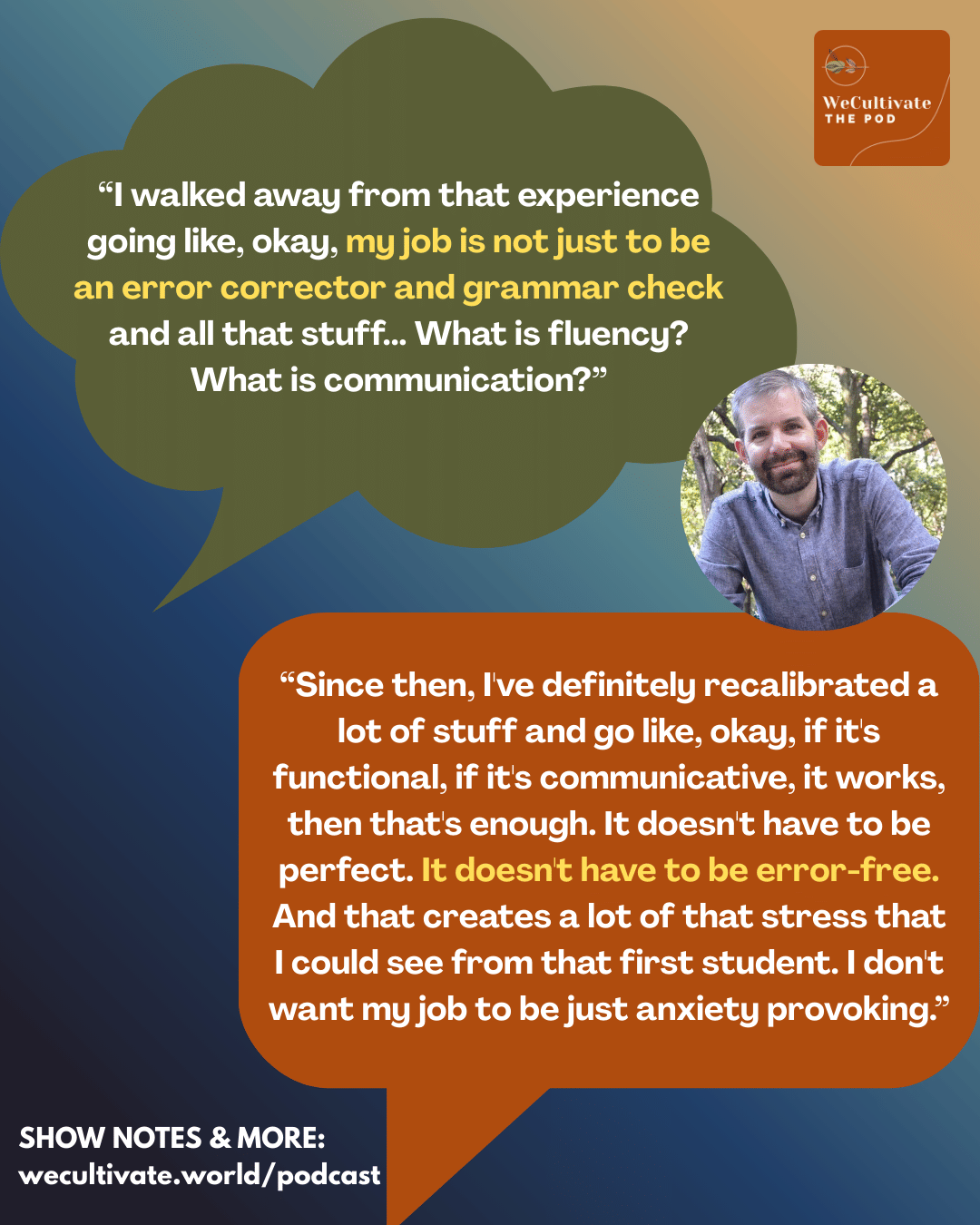
They were just focused on the content of what he was saying. He's an expert in some thing, I'm not going to say, but he was an expert in that field, and they were there to talk to him about his expertise, not give him an English lesson or correct his pronunciation or his grammar or the vocabulary. So I walked away from that experience going like, okay, my job is not just to be an error corrector and grammar check and all that stuff of what is fluency? What is communication? So since then, I've definitely recalibrated a lot of stuff and go like, okay, if it's functional, if it's communicative, it works, then that's enough. It doesn't have to be perfect. It doesn't have to be error-free. And that creates a lot of that stress that I could see from that first student. I don't want my job to be just anxiety provoking. I want to make people feel comfortable and confident in a safe space and in control of the situation and that they're making a human connection from one person to another. So those experiences have really changed my teaching philosophy over the
Michelle:
Years. Well, I work in this capacity, so we're on the same page. But I think what surprises people, because especially if you've been in such a rigid academic system, this is where I do think that culturally speaking, I can't speak for all the US because again, if you didn't know, we all have, education is done by state and county and basically county and also we have private options. So that means every single person was educated very differently. I mean, even people in the same county are educated differently depending on which school you go to. But there is something cultural, I think in society where we are, it doesn't mean that we're not perfect when it comes to grammar, but I think the US as a whole have so many different types of languages already spoken, so many different types of people. We kind of take it for granted that you don't need to be perfect in order to communicate.
I think we see it every single day. You don't even need to see it in your hometown. You can see it on tv, you can see it, you can understand people. I think the difficult part is when many people who were taught in school that perfection equals success. So language and grammatical perfection equals communicative success. I mean, that's not an appropriate jump to make. I feel like that is something that is, unfortunately, it could work towards your success, especially if you're using it well and you know how to harness those abilities. I just do feel like, unfortunately, this is where I personally see that in many, what we would consider advanced language level people, there are so many communication gaps and skills gaps because they just never learn to embrace both. And it often, again, it's another fake war that I feel like doesn't need to be fought.
It's like, no, but I know that if I say it like this, that sentence should mean this. It's like, yes, but also you need to scale it to the context that you're speaking. It's not how you speak to each person is going to be different. And I mean, oh my God, it just sounds like just hearing my other solo podcast, the one I do on just training, but I mean, it is exactly that. I think we'll get farther if we don't fight these unnecessary wars, especially online, especially when I see so many people say things like, oh, well, Americans just don't care. Because again, it's like the English speakers just say whatever, and they don't even know their own language. It's like, well, all the people of every single type of society, country language, they use language in a multitude of ways. I do feel like sometimes if you're working with someone who hasn't realized that about their own language, there is this additional hurdle to overcome where they don't know their code switching. They don't know that they have, they've never done that. And then when you ask them to do it, it's like, I mean, it's like mind blowing for some of them. Bug. Yeah. Yeah. Well, I mean, yes, they bug first and then after that it's like epiphany, hopefully. And hopefully it's like, yeah, this other stuff, this personal development stuff that you're touching on that will help them also see other aspects of their lives.
Jonathan:
Yeah, I think what you're mentioning about the communication as well, and these being perfectionist, I do see that pop up in exam preparation work as well where the speaking and communicating at a high level does have its placements. Because in those contexts where I do want to somebody have a human contact and a connection and say, okay, represent yourself or your ideas, but not have all that pressure of it has to be perfect. I do have to switch and put on different hats when it's an exam and say, unfortunately, I do have to hold you to certain standards that whether you like it or not, you are going to be assessed and judged based on this criteria. And then also when it goes into job interviews, it's very unfortunate to see how if we start to notice somebody's language mistakes because maybe they're nervous or they're anxious in that interview and they start making a few little minor mistakes in all language, it's very unfortunate with human consciousness of, or the psychology of just like, oh, well, if you don't know the English well enough, how do I know that you're an expert in what you claim to be an expert in?
And It's not fair at all. We don't give credit to say, okay, this person speaks 90% of the language. They might have 10% they can work on, but we fixate too much on those 10%. Oh, glass is basically empty because it's missing that 10%. And so we're very quick to judge on the language part and start equating it to, oh, well, this person doesn't know what, they don't know what they are talking about, so I'm not going to hire them. And it's really unfortunate, especially with the exams as well, where it's a snapshot of any given day. It's unfortunate that it can be a very stressful moment, and it can be expensive, and it could be lots of people that have an impact on somebody's performance, but it's just a snapshot and we're judging people based on those criteria. If I could, I would redesign an exam experience where you don't realize you're being tested, you don't realize it. It's kind of some kind of a 360 situation, and you don't realize it's happening, but it's happening in the background kind of a thing. Or a job interview where it's happening in the background. You don't realize you're in an interview or something.
Michelle:
Right. Anytime you want to do that, I'm down. I don't know how who will back us, but yeah, I mean we know this also from psych research, from all research, actually, but anytime we, I mean, what we're talking about is a couple of things, but the first being evaluation systems, assessment systems exist for a reason. That's just the truth. I feel like that's just the fact of life, but also there are other ways to look at it. That's why a company started doing 360 also because of this fact that it's that snapshot, and that's all we have. We probably need something a little bit more holistic, but I do think that many people don't know, and maybe you can kind of touch on how you can preach both things. How can you say that on the one hand, it doesn't matter because language and communication are related, but separate and communication doesn't have to rely on language. Perfection. On the other hand, you're like, oh, but you do need it for the exam. This is another fake war. Can you address this?
Jonathan:
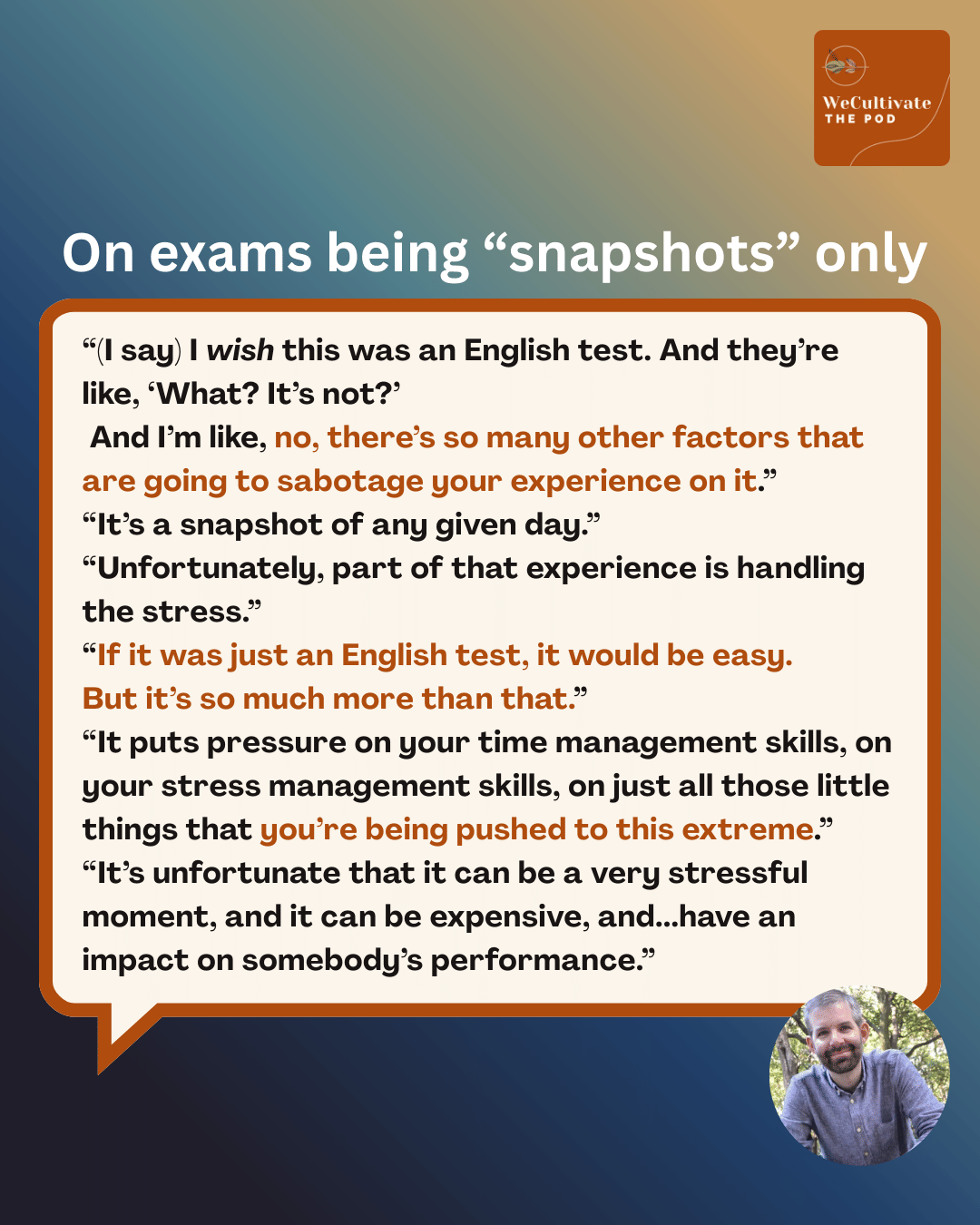
Yeah. I would say you'd sometimes have to jump through the hoops, play the game, somebody's rules if you want to get their prize, which is, I dunno, the job, the university application or the licensing or something like that. It's like, okay, don't shoot the messenger. I am there to facilitate and really just kind of like, okay, help you get through that process so that you can get back to the other stuff, which is the, we're humans on that one day Yes, it's stressful and unfortunately part of that experience is handling the stress. So I do have to tell a lot of people, I wish this was an English test. And they're like, what? It's not. And I'm like, no, there's so many other factors that are going to sabotage your experience on it. If it was just an English test, it would be easy.
But it's so much more than that. It puts pressure on your time management skills, on your stress management skills, on just all those little things that you're being pushed to this extreme. Those things are being tested. I wish it was only the English part. And then when we do go to just a conversation, we take some of that stuff out of the thing. It's like, okay, it's a conversation. I'm not putting a timer and saying, here's a piece of paper and write down what did you do on the weekend? I'm not expecting that. So I can take some of that time pressure away in a conversation with a friend or I'm like, whatever you say, I'm going to decide if I want to be your friend or not. I'm like, no, that's not, that's not
Michelle:
Like how many verbs did you use and how did you conjugate them? Well, or how many advanced vocabulary terms did you insert in a naturalistic way? Yeah, you're not looking at that.
Jonathan:
No. Yeah. So I'm like, okay, no, it happens here. It's a bit more of these other stuff. The language element, it's a small part ends up being, but in the other things it's like, okay, just tell me about your week. And I'm so surprised at how many times when I start a class and it's like, how's the week going? And people really look at me like the deer in the headlights of, what do I say?
But It is almost like I'm asking a really strange question because I'm like, wait, people don't ask you how you're doing in your daily life. And it's just, they're like, we don't care anymore. So sometimes there seems to be a disconnect the longer I teach where especially I can see with our attention spans getting shorter and shorter, and the value of education seems to be commodified in a way of just which teacher is willing to do this at the cheapest rate as a reverse auction. And so that gets a little challenging to connect, stay relevant with students.
Michelle:
Yeah. I think there's also another one of those big paradigm shifting moments for somebody who has never learned that even for a formal examination when they were a student, they were always taught maybe that this was the way to evaluate their performance. And maybe especially for people, this is my personal experience, who put a lot of their identity of their weight, how they value themselves in their academic performance. For someone to say, well, formal examination is really just a closed environment, and it is a system, sure, but it's also just based on how you do, it's a snapshot. And so basically you just work inside of that. I feel like there is this dissonance that happens for a lot of people and they don't realize that it's okay. We're not undoing all of your accomplishments of the past. We're not breaking it. You have to know that if you want to go forward in life, for instance, tofu or whatever it is, you'll do this. But then eventually you'll also need to survive the real working world environment. If you speak to everyone like you do for a TOEFL exam, no one's going to be your friend. No one's going to want to collaborate with you. You sound really rigid and robotic.
Jonathan:
Some students can get some advice that's out there.
I don't have control over this under, but where they get an idea like, oh, I have to speak a certain way for the exam and all this. I'm like, kind of, you need to loosen up a little bit. And they're like, no, but I need to be impressive. I need to add these work. Other words, these academic words, I have to say this. I'm like, you're just making it harder. And that is, it's going to backfire. And unfortunately, there is a lot of advice that's out there that I compete with in some of that stuff. And once some of those seeds are planted for some wheats, it's harder to pull those out once they're there. So that gets harder with the online teaching space because anybody is an expert now. Yeah,
Michelle:
Right. I will ask you if you can, to talk a little bit about some of the things that you find challenging about the industry, the way things are, maybe good things also, but any thoughts on this?
Jonathan:
So the industry in general, I have a lot of friends. I know a lot of people, but let me start with a positive thing. So without calling myself out, but there are a lot of smaller profiles that are experts that they do know. They do have a lot of experience in things. And so it is important to find those individuals who have the experience. They might be smaller accounts, they might not be fancy marketers. They might not have all the gadgets and bells and whistles on what they're doing, but they're doing a lot of great stuff and they're helping a lot of students. And that said, they're, there is a proliferation of a lot of startups and apps and things that right now there are a lot of 'em embracing ai. And I'm not really convinced that they're hiring language consultants or experts or specialists for their input on these apps. I think they are quickly developing and quickly distributing, and there is a market of students, potential students who don't know what the basics are. And that makes them a potential target for, I don't want to say specifically scams, but ace inferior product that is very quickly deployed
And that can give the impression that it's helping, but in the long run, it might not really be a helpful tool and it can be very quickly gamified and monetized. It is very easy to find those, and they're all over the place now. And even before ai, there are also other apps that have been out there that are developed in such a way that they are marketed. They might have unrealistic claims to say, these guarantees, these promises that are not realistic and that can speak to a certain part of the learning market that is receptive to those messages to say, this is going to be easy and you don't have to make an effort and it'll be overnight. And that is just not realistic. But I think those concepts touch upon so many other things around daily life now where it does get into other things where that without specifically stating it and getting into that, but it can even go into political discussions where people might be receptive to fake information, fake news, conspiracy things.
So that kind of potential student can be receptive to those messages, not only in their newsfeed, what can be in their social media feed, but they can also have some beliefs about what it's like to learn a language. And they can be easily immersed in a series of apps. And if you have a guide, if you have somebody who knows what they're doing and teaching and provides that value, then yes, things can accelerate, things can be developed in a certain way that you can have an immersive experience where you can make some progress. It does exist. It's just not necessarily one size fits all for everybody. So things should be tailored. I would love to see technology develop in a certain way where we do get ai, we do get some tech, and we do get a language expert that can go in and like this 360 thing where you could have a very personalized, immersive experience that is only for you and not one size fits all for everybody. And you are a easy target. I would love to see AI in the next iteration where you could have your digital footprint turned into learning content. It is a thing that I've tried to offer to a few test subjects to say, okay, show me your digital footprint
And let me turn that into some learning content for you. And it would be highly personalized. Like, okay, you're talking about that in your Facebook feed. You're talking about that in your Instagram post. You're talking about that on your blog, you're talking about that in this, or here's a couple emails, here's a couple access to a couple chat messages. I mean, if I do that as a person, it's just limited, a limited approach. But AI could definitely get its hand everywhere in there and turn that into a whole language corpus of information that could be translated. It could be turned into audio, it could be turned into translation exercises. So with a lot of creativity, some of those tools could have a lot of potential if we put it in the hands of language teacher as an expert, instead of, let's make a lot of money very quickly and give it to people who don't know what they're doing and they don't know what they want and they're going to easily be tricked. So that's what I see the potential of, but the reality is money.
Michelle:
Yeah. Well, I mean, there's a way to make money also with even you can still make a good product. This is my UX designer talking. Yeah. So essentially I feel like what you're talking about is this. Yeah. And I love the forward thinking mindset on this because we are talking a lot about how AI will cripple us, but this is a way that it can actually work to our greater good in a way. I just want to say before we go, if there is something that you could tell, I don't know who, but maybe some advice you would give to people who are listening who are for whatever reason, I just always imagine in my head, it's like you're literally just being pushed from product to product to person to person lost in this whole consumer market. What advice would you give them?
Jonathan:
I think something along the lines of thyself, just this kind of introspection and reflect on things
And embrace that in the language learning. So I do enjoy making the things that you're doing with your speaking and your writing meaningful, so personalized and meaningful. So you could talk about your favorite color, but you could also say, Hey, what's my definition of happiness? And explore that in and another language, and that is a filter that does force you to highlight some of these things that rise to the surface when you're thinking about that stuff. So I really love that mix of language learning for personal self-development. And in terms of anybody who's out there, just start today, start small, be kind to yourself, be patient with yourself, and just start now, there's some quotes I've heard of. The best time to plant a tree was like 20 years ago. The next best time is today or yesterday. So you might as well just start today. Yeah. You'll look back from the future as your future self and go like, okay, how can I make my future self proud of myself by doing things today? I'll wrap up with that.
Michelle:
Yeah. Okay. Well, thank you. I totally agree, and thank you so much for taking some time out of your week. I know I saw your post on how busy your calendar is, so it seems
Jonathan:
It comes and goes, but
Michelle:
Yeah,
Jonathan:
It fluctuates. But yeah, I love enjoying getting a chance to talk with other teachers, other people in the teaching space and coaching space consulting, and I love what you're doing with the podcast, and there's been a lot of enjoyable conversations I've heard with other guests. Thanks for being Thank
Michelle:
You. Yeah, thank you for being a guest.
Michelle (outro):
I hope you enjoy this episode of We Cultivate the Pod. Make sure to subscribe here and wherever you get your podcasts so you can catch new episodes as they become available. I also share after the mic reflections on Substack, the place where I dive into the themes that stay with me long after recording beginning in 2026. You can also find additional bonus content from guests and other, we cultivate extras, subscribe for free to the communication shift on substack. The link is in the show notes and in this description, thank you so much for joining us this time, and I will see you in the next episode.