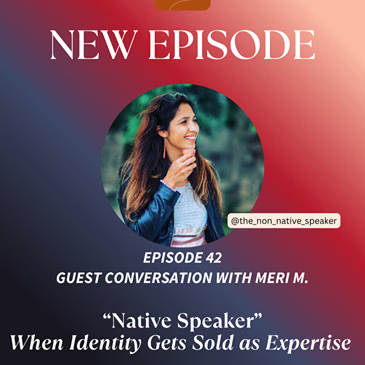



What does being a native speaker actually tell us about someone’s ability to communicate, teach, or use a language?
In this episode, Michelle sits down with English language teacher and educator Meri M. to unpack native speakerism, accent bias, and the assumptions that turn language background into perceived expertise. Drawing from Meri’s multilingual upbringing and experiences within English language teaching, they explore how ideas about “native” and “non-native” speakers shape hiring, education, language assessment, and whose voices are treated as credible.
The conversation also examines the pressure to conform to standardized forms of language, the difference between correctness and effective communication, and why understanding should be a shared responsibility. Together, Michelle and Meri challenge listeners to look more closely at the language hierarchies we inherit, and the everyday choices that can either reinforce or disrupt them.
✨ SPECIAL LISTENER FREEBIE! Click to download Meri's Free Guide detailing all you need to know about Native Speakerism in ELT.
Related Resources
A curated list to help you go deeper after listening. Graciously provided by our guest.
Start here
Two pieces that explain what native speakerism actually is, in plain terms.
Adrian Holliday, "Native-speakerism" (ELT Journal)
https://academic.oup.com/eltj/article/60/4/385/499514
The article that named the problem in 2006. Short, readable, and still the reference point for everything written since. Holliday defines native speakerism as an ideology, not just a hiring preference.TEFL Equity Advocates, "Eight Reasons Why We Still Need to Talk About Native Speakerism"
https://teflequityadvocates.com/2019/07/17/eight-reasons-why-we-still-need-to-talk-about-native-speakerism/
The plain-language version of the same argument, written for teachers rather than academics. A good first read for anyone who has never questioned why job ads say what they say.
Organisations doing the work
Places to follow, join, or point a colleague towards.
TEFL Equity Advocates and Academy
https://teflequityadvocates.com/about/
The longest-running campaign against discriminatory hiring in English language teaching. Their archive of job-ad analysis is the clearest evidence that this is structural rather than anecdotal.Association for International Educators and Leaders of Color (AIELOC)
https://aieloc.org/
Works across international education on race and equity, well beyond language teaching. Their annual conference is one of the few spaces where these conversations happen at scale.Women of Color in ELT
https://womenofcolorinelt.wordpress.com/
A community and blog centring the experiences of women of colour in English language teaching, where native speakerism intersects with racism and sexism.AIELOC and Women of Color in ELT joint conference
https://aieloc.org/aieloc-and-women-of-color-in-elt/
The two organisations run a joint event. Recordings and reflections from past conferences are a good way in if you cannot attend.Research worth the effort
For listeners who want the evidence base rather than the summary.Natalia Wright, “I’m a skilled English teacher, and I do not need to be labelled” (International Studies in Sociology of Education, 2026)
https://doi.org/10.1080/09620214.2026.2718065
Wright surveyed 149 teachers on how the "non-native" label and its supposedly gentler replacements actually land. Her argument goes further than most: that the question worth asking is not what we should call teachers but whether we should label them at all, since even well-meant alternatives rebuild the same hierarchy. She draws on Spivak to argue that teachers should claim the centre rather than accept a softer name for the margin.Vijay A. Ramjattan, "Workable Accents"
https://www.vijay-ramjattan.com/publications.html
On how international teaching assistants are made to modify their voices to be considered employable. It reframes accent discrimination as a labour issue, which is a genuinely different lens from most ELT writing.Adrian Holliday, "Native-Speakerism" (Encyclopedia of English Language Teaching)
https://adrianholliday.com/wp-content/uploads/2014/01/nism-encyc16plain-submitted.pdf
A later and fuller treatment than the 2006 article, freely available as a PDF. Useful if the first piece leaves you wanting the fuller argument."Disinventing Native Speakerism in English Language Teaching"
https://files.eric.ed.gov/fulltext/EJ1318184.pdf
Open access, and asks the harder question: what would the field look like if the native and non-native distinction were abandoned altogether rather than balanced?"Native-speakerism and the complexity of personal experience: A duoethnographic study"
https://www.tandfonline.com/doi/full/10.1080/2331186X.2016.1264171
Two teachers, one categorised as native and one as non-native, examining their own careers side by side. The most human of the academic pieces here.
Practitioners and creators
People making this visible to teachers and learners every day, several of whom Meri has worked with directly.
Canguro English (Christian Saunders)
https://www.youtube.com/canguroenglish
A teacher with a large audience who consistently challenges the native speaker myth rather than selling it. Worth watching for how he handles the commercial pressure to do the opposite.Bridge, "Native Speakerism: Discriminatory Practice or Response to Market Demands?"
https://bridge.edu/tefl/blog/native-speakerism-discriminatory-practice-or-response-to-market-demands/
Notable because it comes from inside the industry rather than from campaigners, and takes the "but clients ask for it" defence seriously enough to dismantle it.TEFL Equity Advocates, “You don’t look like a ‘native speaker’: Racism in ELT”
https://teflequityadvocates.com/2020/03/18/you-dont-look-like-a-native-speaker-racism-in-elt/
Names directly what is often left implied: that the "native speaker" preference is frequently a preference about appearance.“Native Speakerism: Hiding Behind Privilege” (E L Gazette)
https://www.elgazette.com/native-speakerism-hiding-behind-privilege/
Independently published piece, authored by Meri. On how governments themselves entrench native speakerism. Italy’s Ministry of Education defines mother tongue by where you went to secondary school rather than what you have studied or achieved, which sits badly against Article 21 of the EU Charter of Fundamental Rights. The same pattern runs through South Korea’s language assistant scheme, Spain’s exclusion of its own passport holders, Japan’s JET programme, and the British Council’s English Assistants, where an A-level and the right passport outrank a DELTA.
This is an auto-generated transcript. Typos may be prevalent.
Michelle (00:00:00):
Welcome back to WeCultivate the Pod. I'm your host, Michelle, and I apologize profusely for not being here for a couple months, for a little bit longer than I originally planned. We have just been incredibly busy this year. Those who know us personally, Yann and I had some major life changes unexpectedly, and so we have just been navigating all of that. But I am here and I am so excited to bring you this episode. Today, our guests will talk about one of probably the biggest sticking points that exists inside of not only the language industry, but how we conceptualize speakers of any type of language. We talk a lot about English in this episode, particularly because English as of this current time period plays a unique sort of role in the global landscape on language. However, do not be mistaken, the concepts that we address here as it pertains to native or non-native or the so-called supposed binary and supposed evaluation approach is not limited only to English.
(00:01:18):
So I heavily, strongly encourage you, after this episode, go to wecultivate.world/podcast, look at the related resources and other materials provided by our guest. This is, by the way, for every single episode, we have an entire page dedicated to show notes, to our guest bio, to special listener extras that you can access courtesy of our guests and take a look at the different links that have been provided to support understanding on what may be kind of new information. For those who want to connect with our guests more, you can also find their social media profiles if they have them, websites if they have them, also at wecultivate.world. This year and going on, I will actually be filing in different formats of the podcast. So as that happens, we're now in the second year of doing this, so I really, really would love to hear from you what your thoughts are.
(00:02:24):
If there's something you learned from an episode or something that you want to share, some personal experiences maybe that resonate with the subject matter that we discussed, please, please, please get in touch. There's a contact page on the site and conveniently enough, my Instagram handle is wecultivate.world. So let's get right into the episode. Mary and I talk quite a lot on this, so settle in and enjoy this conversation.
Meri (00:02:52):
Okay, so my name is Meri Maroutian. I could actually go on forever with the intro. I'll try to keep it short. I'm an English language teacher. I'm Armenian originally, have become an Italian citizen just recently. And yeah, I've had the privilege of traveling the world when I was very young. My parents decided that for me. And so I became a multilingual child very early. And this also makes sense as to what we're going to discuss in a bit. And we traveled with my family a lot. So I've lived in Yerevan, which is the city where I was born in. And then we traveled to Moscow, Buenos Aires, Kualumpur, Malaysia, Bangkok, Thailand, the States in San Diego and Rome. And finally we settled in Italy and I'm now based in the north part of Italy. So I became an English language teacher in the north of Italy.
(00:03:46):
By chance, I got a call from a language school who wanted to hire me. I had put an announcement there saying that I was available to tutor children for homework, and that ended up becoming my career just because of how I sounded. And so it was like, "You speak English so well, would you care to come and teach for us?" And I kept saying, "But I am not an English language teacher." But they said, "We don't mind." So that's how I entered the field. But then subsequently, obviously I sought formal training and I got myself and my Delta. I had a bachelor's degree in communication studies and then an MA. And yeah, for the injustices that I witnessed within the field of English language teaching, I started the page on Instagram where we met very formally and informally we can say, and that's called the non-native speaker.
(00:04:38):
And here we are now discussing about accentism and whatnot.
Michelle (00:04:43):
I know. Let's get all into it. I think actually before we jump into all the industry stuff, which I'm just so excited for, but I'm just going to hold myself back, maybe you can kind of brief our listeners on what your early life linguistic environment was like, because it sounds like there were many different influences. You mentioned moving a lot and traveling a lot before settling in the North of Italy. So what did that look like for you?
Meri (00:05:11):
Well, it looked like a lot of survival kind of issues with me because I grew up with two languages, Armenian and Russian. I never attended school. I think I did a month of Armenian schooling. And so I'm an illiterate Armenian. It should be my mother tongue. I should be the best at as what the field is perpetuating that your first language and your mother tongue have to be the one that you're most proficient in, but that's not my case. And Russian, I just acquired through cartoons. I never used it personally. So it remained a passive skill. I still can read, understand. I'm very slow at reading, but I'm more literate in Russian, but I never use it. Instead, I use Armenian to speak to my family. And then when we moved to Buenos Aires, there was another language added to the mix, which was Spanish.
(00:06:00):
This was when I was about seven years old, and I went to a school which was half in Armenian, half in Spanish. Don't ask, I don't even know how this was even possible. But we got into this bilingual kind of schooling, which was about nine months really. And then moving to Malaysia, I began to learn English from scratch. My family did not speak English while my sister and I both attended an international school under Cambridge in Malaysia. So that was where my first exposure was to the English language. And it was a very international mix of sounds that I've heard because there were students from all over the world studying there. And so I had my first English language teacher I think was Indian, which is a native speaker, even though people don't attribute that to Indian people. But yeah, it was quite a mix.
(00:06:52):
And even now that I remember when I went to the States, I studied there for another nine months and I think my teacher there was Korean. And so I've had this mixture of nationalities and everything, but everywhere I went, so I changed about 17 houses and I had to learn languages from scratch many times. And the last one was with Italian when I was already 13, 14, which was obviously becoming harder and harder because you have to have different skill set to face education and studying all the subjects. What we would call clear today was what I had to go through just naturally switching from country to country, from city to city and from language to language. So I was always like the foreigner. I was always the newcomer. I was always reinventing and rediscovering my identity. And so that played, I think, a very big role in me just understanding when people come from a variety of cultures or having different influences and having different languages in the mix.
(00:07:55):
I just tend to sympathize and empathize with people who might just sound like they don't know, but they're actually very skilled and it's just a language thing that might need a little bit of assistance and then they're good to go. But yeah, it was hard for me. I remember specifically in Malaysia when I began hearing a sound, a language that I never heard, which was English, I remember I started crying because I literally did not understand a single word and that feeling just stuck with me. It was so uncomfortable,
(00:08:34):
Not knowing what people were asking you to do or not even knowing ball, dollar sit here. Okay.
Michelle (00:08:42):
Yeah. And all these foreign sounds and smells and people and just all these influences, the confluence. And it can be extremely overwhelming. I think no matter if you're a really small kid or even if you're an adult, it can be overwhelming. Sensorally, is that a word? Yes, sensory-wise, I think it's absolutely. It's something that I think people understand when they travel because already there's a massive, we'll call it a cognitive load of sorts. When you travel, you're in a new environment. But I think it's different and why so many people talk about, and I attest to this as well, the challenge of settling into a new place and integrating is not just learning customs and culture, and also how do you learn that? Even if you try to prepare every day, things are moving in real time, you have to process it in real time.
(00:09:33):
And especially for you coming from all these different places and then going into this environment and being like, "All right, this is new home, new home, new home 17 times, even houses." What you describe is something that is actually quite common. I think that people just don't take the time to listen to others and what they've experienced. I really think formative experiences, no matter where we come from, they help shape our perspective of the world.
Meri (00:10:01):
Definitely. And I want to add something that I was just thinking about when you were saying this. I call it survival instincts because it was survival for me. Languages were survival because it was also a thing that my family wasn't able to communicate. And so it wasn't like looking towards to an adult, looking up to them and saying, "They'll do this
(00:10:23):
Education thing for me because they know or they know better." We were really, my sister and I were both in the position where we had to be mediators, translators, the ones learning it as fast as we could so we could then tell our parents what was happening around them to be kind. So it's not like as an educator, as an English language teacher, I often get the parent who already speaks English and it's like, "Oh, I won't speak in English to my child because I'm afraid they'll catch my accent by mistake and I make so many mistakes." But they don't realize what a resourceful entity they are for their own children because they kind of censor themselves. They don't see themselves as able or apt. And I know what it feels like to be unable to communicate, not to know any single word. And we try as parents, we're very protective of what our children go through, but this is not survival mode.
(00:11:15):
I keep telling them when you change a house and you're within the same city, that's not. Yes, I get the challenge. I get that you are straying away from your habits and what you're used to, but it's just not the same when you are catapulted to an environment which is entirely new and you don't have a friend to call and you don't have family members there and it's just you're in the deep end and you must speak this language that you know nothing about.
Michelle (00:11:46):
Right, right. Yeah, exactly. And I echo that with my own experiences. And so I have this kind of personal history that runs through the states, but then also when I moved to different places as an adult, you have to figure it out. And oftentimes if you're. I moved the first time for a job, which was very different than moving just as a human because I didn't have anything lined up. And so essentially dropping yourself, even if it's voluntary, dropping yourself into a new environment is very, very, very intense. It's a very overwhelming experience. How you handle it though, I think is basically what shows, dare I say your true character? Not to say that it's success all the time. I just think it's how you choose to navigate and migrate yourself through different spaces. It really shows how you make those choices. I think especially what people don't know, especially those who probably haven't experienced this, is the burden on children. It's not like you had adults who knew the language already and could provide this kind of framework for you. You were part of let's all figure it out together.
Meri (00:12:55):
Yeah. I think that now we know so much about how we can be intentional with minority languages, with marginalized communities, with all these things that are in the mix. There's so many resources that we can access. However, not that we're ancient. I know, I don't feel ancient at least, but it was a different time. We had to hand write the lyrics to the songs they were listening to, and so it was a different kind of world, whereas our kids are growing up in a different era altogether. So I don't know if they will ever experience that kind of discomfort with having access on their mobile phones on… Translator or something that simultaneously can do everything that we just had to go around with dictionaries and books and things like manually kind of find art. And I'm not saying it's a bad thing. I'm saying such a lucky time to be and to progress through this kind of obstacles that life can throw at you. But yeah, you have all these resources and you can be absolutely intentional with understanding how you can, if you have kids and if you are an idea, to just find the resources as to how you can approach this and go through. I always say that there are far more non-native English language speakers than there are native English speakers. And that just accounts for the fact that the world is a multilingual place. So to be an educator and not understand that and not put yourself through what you need to know in order to assist or help a student, you're already at a disadvantage because they linguistically are superior than a monolingual teacher who just knows how to do that one thing because they can't assist. I don't think they can begin to comprehend unless they already speak two languages.
Michelle (00:14:52):
Yeah. Let's get into, first of all, let's cover the terms that we know can be very tricky. And I did one post on this so far. I mean, every time I try to make a post, I mean, you're really fast on social media. A lot of people are. I feel like you guys are so great with the content. I'm like, well, I do this podcast. I'm already tired and I'm already trying to produce all this. I feel like there's just a massive amount of, I don't know what it is. Is it misinformation? Is it a lack of training? I don't know what to call it, but I just feel like I'm always coming up against this wall of outdated thinking. Native speakers are the gold standard and non-native speakers just will suck forever until we become a native speaker. And so let's actually just define, could you define native and non-native for those who might not be familiar with this?
Meri (00:15:45):
Yes.
Michelle (00:15:45):
Kind of false binary, to be honest, imperfect binary.
Meri (00:15:48):
Yes. I'll try to explain it as easily as possible. Native speakerism and being a native speaker is really an ideology because it really doesn't. There's no superiority or inferiority. It's just what people have attributed and what has been perpetuated with colonialism for so long that in order to speak a language well, you need to learn it from someone who was born in the country that is English speaking in this case. And so times have changed, obviously. English has become a global language, but still people think that a native speaker is the best model they can find for a teacher. They're seeking native speakers in teachers. So they're not looking to hire, and we see this in job ads where constantly the messaging is we're looking for native speakers. Our teachers are mother tongue speakers of English, yada, yada, yada. And it's a global phenomenon. People say it's outdated, yes, because research has shown that because you are a native speaker, it does not mean you are at a very high level or you have to sit a proficiency test that will attest to your level, that will certify what level you are.
(00:17:00):
But native speakers are often not required to sit these tests. And so non-native English speakers and teachers, even when they're qualified to be teachers, they have to sit through proficiency tests, pay for them, go through an extensive kind of a model and sit four hour long exams to show that they are actually good at the language that they speak. And so there's this constant comparison and a lot of people justify so many different things. I address this when I speak internationally on the topic, what do non-native speakers think? What do native speakers think? And how do they justify this? And some people talk about it's the market preference. So if a student wants to study with a native speaker, then it's their choice. But then under these kind of choices, there's a lot of discriminatory practice and some preferences are not real preferences. This word hides a lot of discriminatory practice.
(00:18:00):
And so non-native teachers, they have this imposter syndrome from within because while we do study well, we do go through formal school training most of the time when we don't have the privilege of sounding like a native speaker not be perceived as white, not be perceived as. Because it's a lot of. I use the word perception a lot because even if you are born in so-and-so country, which by the way, native speakers need to be born in either the US, the UK, Canada, Australia, New Zealand, sometimes we can put South Africa and Ireland in the mix, but not always. That's not even enough as a status. And some countries like the Italian government defines it as someone who has completed their secondary education in an English-speaking country. But then again, which countries do they actually accept as English speaking? That's another thing. We know that even the United States does not have English as their first language, but for many people, it just attests to people being very good at English when they come from the States.
(00:19:07):
And so there's a really weird kind of misunderstanding, but then the industry has played a lot on these dynamics because they are associated with obviously power, dominance and whatnot. I just want to say that a lot of people have benefited a lot from the privilege and they still want to benefit from it. And so there are people and there are institutions that still want to uphold this idea because it serves them and it doesn't serve non-native obviously speakers and teachers because the industry profits from them economically more than once. We are first, we go into learning mode and we pay for all the certifications that attest to the fact that we are actually growing in our ability to speak the language. And then when we do become English language teachers even, then we have to sit again other proficiency tests that attest. So it's just like a never-ending circle of having to prove that you are capable in a language.
(00:20:10):
But as you were saying before, almost laughingly, that how do you become a native speaker? Well, you just can't. It's not something that you can do through academia. It's not something that you can. It's just how do people perceive you? And often accentism comes into play as well as to how you sound and then could you be one of us or are you one of them?
Michelle (00:20:33):
Yeah. I had written a piece and it's posted on the website, it's posted in many places on basically how the industry as it stands right now, we could say English probably is a little more visible than some other languages, mainly because it's become the international language. But I do think that it's a problem, no matter the language, this whole native speaker superiority and this whole false idea that there is one unified type of native speaker. So something I ask a lot of people when they tell me like, "Oh, I want to be a native speaker," I'm like, "Paint me a picture of what that looks like. Who are you describing?" Because I will just add my personal anecdote to our dialogue here. When people are listening to me, of course, I'm born and raised in the US. I was educated here. I did all of my schooling in the States, so I basically, of course, I came out speaking this way.
(00:21:28):
However, I've had a few choice moments in life, not my choice, other people's choice, where they look at my face and because I'm Asian American, they do not consider me to fall under the profile of native speaker. And you would think that, for instance, if I were applying for jobs inside of East Asian countries, because that's where a part of my family is from, that essentially I might have a better chance also being a Mandarin speaker, heritage speaker, you would think that it would only help. I'm not complaining at all in terms of my career choices. It's more I just wanted to talk about what I've personally been through. I have literally been told, it was for a job posting in Japan. I was told, "I'm sorry, but it's because you're Asian, you can't take this English teaching post," which is actually a very low level post compared to my qualifications.
(00:22:19):
And so I was really surprised because it was the first time that I think. I mean, I had encountered this before and obviously I knew it existed, but I was like, "Okay, you had no problem just telling me that directly, did you? You thought that was just a matter of fact thing." So what I think surprises a lot of people is that when you listen to me and you also look at my resume, you look at my background, you look at my experience, you would think, well, you wouldn't run into these things because for instance, what you talk about, I think a lot of people might be like, "Oh, well, that makes sense because you know what? The world works this way. You weren't born in the US. Oh no, it sucks, but whatever." It's everywhere because what we're touching on, and I think you just said, the word native speaker is actually a placeholder for so much more prejudice than I think we all want to admit.
(00:23:06):
And I really, really appreciate your page so much. I appreciate your fortitude and your energy, your constant resilience battling this because I see some of the comments that you get that are beyond ignorant. I have no words sometimes, and they're on LinkedIn. They're like, "Oh, I have X number of years of teaching experience verified by the fact that I was born as a white male in the UK. What?"
Meri (00:23:33):
Yeah, I know. But one thing I can say that a lot of people, they think that the way they sound somehow is the only way people should sound. We all think that the accent. And by the way, you're not born with an accent. You're influenced so much by everything, by so many external factors. People think that if they do an hour of English with a non-native teacher, they're going to catch their accent accidentally when they can't understand that it's like 52 hours. In 52 hours, people can't even intentionally learn a different accent with an accent coach if they want to be actors, whatnot. So it's just so absurd that we talk a lot about critical thinking, whether it's in education, whether it's. But we don't use our critical thinking when it comes to it because I think it's because, and I continue to say this for years, that the noise out there is so loud. There's so much noise around this topic, and those who are speaking about it do not deserve to be heard or to be like, "A lot of people need to just dismantle all this argument." Instead, what happens is like, "Oh, I'm not going to go into that because I'm far better." No, it's not about that.
(00:24:55):
It's not, "I'm going to take the high road and not address it because the more you refuse to address it because it makes you uncomfortable because it really would take five minutes to dismantle this whole argument, people just don't take a clear sense. And I want to argue that this is because it's very personal. I think with languages and with how people sound and with accents, we see it as a part of. It touches our identities deeply. And so you can't talk about language without putting yourself into the mix. And I don't think many people, just like many people, are not ready to put themselves on camera and speak about native speakerism, even though they might agree with X, Y, Z and much more than I could ever imagine they would agree on, they will still not put themselves out there, stick their necks out and say," I am in favor because they're afraid, because they're afraid of their colleagues, of the judgment of other people, because they might lose a job, maybe a recruiter will not.
(00:26:04):
So there are many reasons why people should not talk about it, but I think there are many more people should. And that's why I'm trying to give voice to the people who. Or give them that extra thing of build a community around this because it's okay to talk about uncomfortable things as long as we see our own prejudice because we are biases. You can't defeat this systemic bias of conceiving native speakers and non-native speakers without having this uncomfortable conversation and also admitting to yourself because if I'm talking about English language teachers, if you've gotten into the training and the formation courses, you are perpetuating native speakers if you don't take a closer look at what it is you're actually doing. Because what we are taught is to conform to a standard and then we go out and teach that standard even though that standard is not our own.
(00:27:00):
And so there is an imbalance. There is something. And those who really think about it for a second, they quickly grasp on the thing of, okay, something might be wrong here. I don't feel like this is representing me as much as it should. And I think that's when most people start thinking, okay, I need to look deeper into this, investigate more, and that's when they become vocal about it. Like I say, awareness is the first step. It's not the end. It's not, oh, I'm aware of this, and so everything is right with the world now. It's not how it works. We need to change the culture around this subject and make it a conversational topic that's really easy. It's really easy when it's like a muscle. If you get used to speaking about it more, you won't shut up about it because it's literally everywhere.
(00:27:54):
I don't go looking. Sometimes I'm at dinner parties or someone is from my friends or a colleague of another language, they'll say something. And my husband already, he looks at me like, "Oh." He hears it as well now because he's used to me talking about it. And then I just wait, I let them finish, and then I ask a couple of questions and then it's done. It's very easy when you are used to educating people around you about it.
Michelle (00:28:22):
Yeah, I would completely agree. And I think that a lot of it's unconscious. So a lot of people don't know that this is what maybe they were taught. Taught in what way? Taught in the classroom, taught by society, taught by your family, taught by friends, peers, whatever. A lot of this is unconscious. We're coming up on a lot of these unconscious prejudices, biases, assumptions that we have, I think, in the world. And a lot of people are uncomfortable looking at those biases because we all have them. We're all products of whatever society we are raised in. No one's saying that you are a horrible human and all the tragedies of the species is on you. No one is saying that you are absolutely to blame for all of this and go just. I want to say something really extreme, but I don't want it on the record, but basically we're going to keep it as PG as possible.
Meri (00:29:22):
I'm going to go out on a limb here and say the problem with languages is that someone always wants to measure them. People want to measure your skills, but then they're not listening to the content that's actually coming out of your mouth. They're listening to how you actually express things. The same way that if I have a parent standing in front of me and my colleague who is a 60-year-old, she's got gray hair, older woman, older than me, and they'll be looking at her and that's ageism. And there's a male in the room, then it's sexism and they'll be looking at them. There are different layers which we can all kind of understand and see da da da. Then there's the accent, there's the social class, there's the how one is dressed. There's so many, right? The name factor, what's your last name? If you go really deep down in it, and you and I have that too.
(00:30:19):
We constantly, it's just a mechanism. Your mind wants to distinguish. It's like fight or flight. You want to categorize, you want to put people in boxes and that's the nature of things because you know that your mind can, you have to mentally compartmentalize people to these boxes because it's easier that way. You manage the brain storage better. That's why anyone can have any kind of bias and prejudice, but it's kind of alarming if you think that it's English language teachers and education and academia that's upholding this kind of standardization and norms. Even with English as a lingua franca, they're talking about finding a way to have a standard form of this. I don't see how that is going to help because again, we're not accepting that there is a variety. There is a linguistic variety that my English, even though someone might comment that I sound American, they don't know what American sounds like because they don't have the capacity, no one does, to understand each and every dialect format.
(00:31:28):
So if something is so hard, why do we want to name it? Why do we still want to say that this is the way, this is the Queen's English now the King's English and this is the. Why is it so hard to just accept people as they are with their. Why is it because of comprehension? Most of it isn't because of people's accents being so strong that people can't understand them. I often debate all this. I'm like it's understanding and intelligibility, it's a mutual thing. You can't expect people to always have to accommodate you, which is what happens with privileged native speakers who haven't had to accommodate anyone else. And they're used to you being the problem. If I don't understand you, you are the problem. Whereas people who are more globally oriented, I call them, they have a way of saying, okay, communication has to take place.
(00:32:27):
I'm going to use all my skill set to mediate, to understand what it is and to get a transaction out of whatever it is that I'm trying to achieve. Have I understood? It's not only on them. And I think this is where the problem comes. We are trying to. I think standardization is basically what industries profit from. They want to measure this because it serves them economically and financially to have people investing loads and lots of money on getting themselves and feeling superior. And I want to say that before you start doing that, I have a C2 level across all skills in the English language. I can tell you I'm still not perceived as better than a native speaker. So don't go thinking that by a testing or by getting this X, Y, Z, you will never because it's an ideal that does not even exist amongst native speakers.
(00:33:23):
I just read recently that a native speaker, a PhD had written some artist and someone said, "You have to get this article proofread by a native speaker." It's like, "I am a native speaker and I have the qualification and I am one, but you still don't get seen. It's all in the person who is judging you and in their perception of you that you can make it or not make it with whatever thing that you want to achieve. It's always going to be in their hands. And so it's a power struggle and it's something that they profit from. It's all it is. It's a billion dollar Euro industry. And so they have us by our throats basically, and all we can do is get that other next qualification. And it also depends where you get it. Did you get it from an English university? Did you get it from an American?
(00:34:20):
Did you get it from a. And so all of this, I think in terms of, I don't know, any other sector or field, but I think in English language teaching it's even more relevant in others because it's more about how close you are, the proximity to nativeness and the native speaker is what gives you credit for anything you've accomplished in life. Therefore, we have language assistants that come from the right country. You don't have language assistants who are actually educated on the topic. You just get them from the right country. And people say it's governmental, so that's okay in a sense that we justify it because the government was. Well, the government is the first upholder of this insanity. And if we don't get that and we're still saying, oh, but the government wants this and you haven't understood anything about the industry, if I have to be frank.
Michelle (00:35:14):
Yeah. I think it's also how people can sell very low level, low quality courses simply being in the right country, come have a wonderful linguistic immersion experience and stay with this native speaking family.
Meri (00:35:27):
Yeah. And then they put the cultural part in the mix.
Michelle (00:35:29):
Yeah, exactly. Exactly. So if you're in France, you're just going to eat baguettes all day and two types of cheese. Well, actually, okay. Yeah, I could say more on that. But yeah, it's basically like, yeah, it's all one package.
Meri (00:35:40):
Most of the recruiting is geolocalized. They're not even looking for specific students of a specific topic. They're just looking for people in the right city. Even there, it's just so easy to dismantle this kind of. I go to London not because I want to speak to native speakers. It's because I find more people like me than there. And so it's a very international melting pot where I can feel like I'm in the right place.
Michelle (00:36:09):
You're normal. Yeah, I know. No, I say normal in a sense that there is no normal, but the normal, you don't. So to go back and there are many, many, many points I think you just brought up, which are all really great. I think that - Sorry. No, no, no, no. I think it's just really too bias. I actually think this is something that we learn and that's something that is taught to us very early. I do understand that probably there's an evolutionary kind of background. So my background is in biology and psychology and in neuroscience. And so basically yes, all these things check out. It's just at a certain point we need to recognize the impact of environment and we need to know and understand that we are not just. When people are like, "Oh, I didn't mean to." Well, that's because it, again, was unconscious.
(00:36:53):
And so even if you didn't mean to, it still existed because you don't come out just. Yeah. Whereas the…
Meri (00:37:01):
I think people don't want to be held accountable for their lack of knowledge. In this era, especially if you're supposed to be a professional in your own field, then I do not justify unconscious bias in an educator who has presumably done linguistic studies and then says, "Oh, this is very..." Something is missing there. And that's why I say I can look at LinkedIn bios with people who you're just mentioning, people who try to argue with me. I always catch my. I'm like, "Let's go and see who I'm talking to is the first thing that maybe I'm the ignorant, maybe I'm the most..."
Michelle (00:37:38):
Yeah, maybe there's more learning I need to do. Yeah.
Meri (00:37:41):
Exactly. I need to go and see it. And then everything checks out. It's the same profile of the same person. It's no certificate, and it shows. And sometimes they might have it and it's dated way back when, and the latest, the most recent formation course that they've had is 10 years back and they're behind. That is what's outdated about all this. They think that they can interact with a person who is constantly progressing and reading and educating themselves on things. I'm the first to admit I know nothing about this because you'll lose yourself with the amount of resources and material and research studies that have been done on these topics. But you come out and you say the first, you see it on Facebook, you see it on LinkedIn, the first thing about CV resumes and things, people are, "I'm a native speaker," as if that was a skill set, as though that was what accounts for everything.
(00:38:38):
And sometimes they know and they do it all the same because they know that other people will think that that's a big thing. And so why aren't we owning up to the fact that A, it's on us if we don't know, B, it's on us if we do know? And you're still perpetuating this because it serves you. Well, hello. Now and then you'll get that odd native speaker who comes and is very offended and says, "I want to be hired from my skills, not because I'm a native..." Well, listen, you get hired all the same. Let's just stop there. So it's again a privilege. And even if you denied and you don't want it, you still have it. You still possess as I have privilege, as you have privilege. Everyone has that bit. But you're in academia, you are supposed to be an English language teacher, and you see so many students who are supposedly learning something from you, and this is what you perpetuate.
(00:39:35):
So take a good look at yourself. Is this what you want to be known for? Are you just okay with accepting that and then educating and then blaming other people for speaking up about the injustices?
Michelle (00:39:52):
Yeah, I think so. There are a couple of different things happening here. We have the system, we have the institutions, we have all of the barriers to access and all the discriminatory practices and exclusionary practices as well. And then we have on the individual level, a lack of awareness, a lack of accountability, and a lack of education, I would say for a huge massive cohort of different language instructors who really do not think that. Maybe again, because they have benefited continually from this whole system, they don't think it's a thing. But also the ones who think that native speaker is them. So when they meet another native speaker who also instructs in the same language, there's a whole fight. There's a dual. Who's the more native of the native speaker? Which is always really fun to watch.This happens a lot in France because again, I think when people don't know what they don't know, they don't realize what they're doing.
(00:40:44):
And so it's so entertaining. And I think that really, you take it from the student or learner perspective, that is so confusing to get all these messages about. So you're told there's a standard and then you're told the standard shifts and then it changes and then you're told, oh, that teacher is not qualified because they come from whatever region and no one speaks that way anymore and you have to match me because I'm close to Paris and that's the best one. Yeah, essentially, I think it's just the same sort of playbook. Go impose some sort of standard, tell everyone that this is a standard, market it across the world like it's a prepackaged thing, language, culture, identity, all come in one type of person. It's again, a person that may or may not exist. I guess we could try to do a profile, but there is no one type of person.
(00:41:31):
And then two, to add insult to injury really because I've come across this so much, people will say that there's a way that native speakers think, meaning I suppose if you are a native English US-born person, you're supposed to think with a certain logic that comes out in your communication, which of course communication patterns exist. But when people take that to, okay, so you must native speakers think this way, I'm like, "What is happening right now? Oh my God, stop."
Meri (00:42:03):
Yeah. If people are still measuring this and anyone who has kind of grown within the English language teaching industry and you start off as an English language teacher and then you're an assistant director, then you're a director of studies and you might own your own school you might go into. And then there comes a time when you have to assess people. I think that's where a lot of people are like, "If I understand this, am I supposed to mark this as someone else wouldn't understand? Am I the highest level of judge of how this person could be? But if I sit with a XYZ student who I think I've understood, am I supposed to still mark them an A2 or a B1 because another person might not. Who are we? Even the listener is idealized, you know what I mean? So this is where everything, that's why I'm so against standardization. I'm against measuring and I'm an English language teacher.
Michelle (00:42:59):
No, I really just detest language levels so much. Actually, the entire CFR system, I have never. It's not until I moved to France I saw how insane people are with it socially. Yeah, because even when people ask you, when they interact with you, what's your language level for this? As if whatever you express can be contained inside of that level.
Meri (00:43:25):
Yeah, I have so much to say about that as well.
Michelle (00:43:29):
You just wrote your open letter, I know.
Meri (00:43:33):
What the heck is it with levels and things like that? But also there are different levels of this because there'll be someone who agrees with me and then they'll say, "But surely when you're writing a paper, you have to conform to a cell. If you start with American English as if it's the only one, English as if that's the only one.
(00:43:50):
And you have to keep on, you have to because otherwise you're confusing and you can't have..." Who says? As an Armenian who speaks five other. Why am I supposed to adopt one style, the other style, and I'm not either or? Who says that I have to? And so yes, even in my marking and I correct essays and I look at what people write, work in secondary school as well with a lot of native speakers who have learned English from me, who though they didn't have to learn any grammar or any structure of their language because they were the native speakers and I was not.
(00:44:27):
These people, these students, they need someone who can ask them to come on, wake up and smell the coffee. You weren't born with an amazing skillset of things and this is why your writing is going. People can't understand there's no cohesion, there's no coherence, there's no legacy. You need to really make them because they feel like everyone has, as long as you're a native speaker, everyone has validated them enough for doing whatever it is. And that's why they're doing very poorly. And as a teacher, I find it very hard to. I don't find it very hard. I correct differently, I think. And that I think is an asset to have someone like me correcting your work instead of someone who is going to pinpoint on whether your spelling was British and make it a huge deal and discredit you for what? For what?
Michelle (00:45:27):
I mean, lived experiences will always be useful. So of course I think that when we think about it, what is the value of having conversation with somebody? It's just to learn a little bit about what they've been able to experience. Oh my God, I totally agree, by the way, on two points. The first being that most of the people, so the people I work with, my clients, they are not people who even have the time or brain space. It's not because they're super important. It's just in the actual working world of professional corporate life, you are not actually spending your time nitpicking, oh my God, did I use one or two Ls because spell check is there and whatever version you have set and whatever team you need to talk to is what you're going to use for your memo. And what I work on with them essentially is how they communicate their message.
(00:46:18):
A lot of times it's spoken communication. We might touch a little bit on writing, but it's not. Because AI tools currently, as they stand, are not totally perfect. They can train them, but of course it takes a little bit of time. But it's not like, did you get this sentence completely correct? Because things don't exist. First of all, correct, depends on many, many factors and things do not exist in a vacuum. So first of all, a lot of us use, in the tech world, and a lot of companies now use some sort of instant messaging called Slack or Microsoft Teams or something like this. And so you're going back and forth, "Oh my God, you have a typo. Oh, no." As if nobody in the world has a typo ever.That's why we have the convention of correcting it with an asterisk or not. If people got what you meant, that's fine.
(00:47:06):
And nobody cares. And it's something that really -
Meri (00:47:11):
Unless you're doing a proficiency test, then -
Michelle (00:47:13):
Yeah, exactly. It's only for that, right? In the real actual world, and this is what I keep screaming all the time to people, is why does it matter what your language level is if you don't need to know your language level? Because most of it is based on, again, immigrant background. A lot of it is based on what you need to encounter, not only for survival, but for your career, for your professional growth, for your daily interactions. I am really, really good speaking in French about immigration, about healthcare, about geopolitical issues, because those are the topics that I cover most of my day. I go read a children's book. I don't know half of what's going on because I'm like, "Why is the goldfish going to the fair?" But you know what I mean? And so what I find shocking is that people never think about these things maybe because again, they've only learned in a certain contained way.
(00:48:06):
And I don't know how to get us faster there, but I mean, it's already happening. You know what I mean? The globalization of all industries in the workforce, I think it's already happening.
Meri (00:48:17):
I can summarize that by saying that we have used and pushed the agenda of authenticity around for so long when we provided nothing authentic. I say this, I'm thinking about specifically course books, tape clips, CDs, audios or whatnot that was put in all of these material that we have used globally. And that is a whole other way of colonizing a whole
(00:48:48):
Kind of thinkers and still think that they don't sound right because we've constantly had to hear these voices that were not like our own talking to other people that sound like themselves in this vacuum and then saying, "This is authentic listening for..." It's not. It is so totally not. And the inauthenticity, and we can say that even today with what we're witnessing of every source of communication is what is dragging us down. As educators, we really have to be conscious about what it is we're working towards. And again, what skills are we trying to build here? Are we trying to all sound the same? Are we trying to mimic each other? Are we trying to. And who is going to be the voice of you're working in groups? Who are you assigning? Whose course books are you choosing to buy? Is it because of the foreign name that you're not going to use one or the other?
(00:49:47):
There's so much to uncover here that is just beyond what you and I can discuss here today. You know what I mean? So I guess it's just overwhelming sometimes when you come to terms with that. And I just want to read a comment that I got just recently from an Instagram follower.
Michelle (00:50:08):
Oh, lovely.
Meri (00:50:10):
This is a good one. Okay. It's a
Michelle (00:50:11):
Good one. Sorry. I was like, "Oh my God."
Meri (00:50:15):
I didn't want to trigger you today. So this is a positive one. I can talk positively about things. So this is a person who's recently joined my community and she said, "I'm starting to understand, and it's a very painful realization that I have been both a victim of native speakerism and someone who has inadvertently kept it alive." I need to take a closer look at the mechanisms of native speakerism. And I want to address this here publicly by saying this, that we have all been both victims and those who have kept it alive. Because as I've come to realize that if you have been introduced to this world of teaching English as a second language, that you have definitely done this harm, but that does not mean that you can't make things right. You have learned it yourself because that's what we had. That's what we were taught.
(00:51:20):
But this new generation of teachers needs to educate themselves on these very subtle differences, subtle discriminatory forms of teaching and validating people's voices so that they can move past this and uncolonize the students and the way people think around whether it's English, whether it is French, whether it is Spanish, because it's the same. The other day I was talking to a colleague of mine and she was saying how they had someone from Mexico as a Spanish teacher, but they did not consider them native speakers. And so they were language assistants, but that was the only thing they could find. I was like, "This was from someone from another school." I was like, "Excuse me. So Mexicans don't speak. Oh, because who do you value most? I think is it the Spaniards? Oh yeah, you have to be from Spain. So don't tell me that this doesn't exist in other languages. Don't tell me that this is not upheld by other country like France, anyone.
Michelle (00:52:25):
Absolutely.
Meri (00:52:26):
And you can find very few countries, by the way, who have not colonized and wanted to have their dominance on other countries through language. And I would even argue that that's the first way you can dominate, which is erasure of every other kind of form that sounds different from you and other people sound like you, and then call it a standard form that everyone has to obey and go by. Otherwise, they are punished by that scorer, you name it.
Michelle (00:52:59):
Yeah, absolutely. Absolutely. I think that people aren't comfortable also when I say. Once you look at the language history of France and you see that it wasn't too long ago that local languages existed and when were they wiped out? Oh, when the idea of a unified. Again, we take this very beautiful propagandized term on identity. Actually, they weaponized it and made it about national identity and then posted signs about how children weren't allowed to speak other languages other than this type of French because their mouths would be dirty if they spoke it. And it's like, "Oh, that seems rosy. That seems in the name of unity." And so I actually find it amazing how many French people, first of all, don't know, especially if their families stopped talking about it and just conformed because they had to, I think, for survival. But then also to dig this up again and to be really uncomfortable with the past of, I guess, if you're born into a country with this history and then not wanting to see it, well, I mean, do you have a choice?
(00:54:02):
Do you know what I mean? Because other people are still living through the systemic repercussions of these systems that even if the time has passed, the effects still remain. And so when we're talking about decolonizing, it seems like a very intense term for some people, but I don't think people realize how much colonization played. I just really realize now how many people have no idea how it's in every single thing that we do.
Meri (00:54:26):
Oh, and I'll say that I never thought about it either until that happened. I was called after I had overcome my imposter syndrome, thinking that I finally belonged and I had the credentials to teach it when someone just looked at my CV and said, "Oh, Armie, we must have made a mistake. Goodbye." I was like, "Oh, can I speak in English? Do you not think that I am able to..." And it was like, "No, thank you. Bye-bye." And that's what hit me, that's when it hit me. And I really needed to be hit by something that. Because if it had happened before that, I would've justified it like, oh, maybe I'm not. Yeah, of course. It was just the moment that I actually felt, for the first time, very confident in what I had in my head, the paper that I had, but it was worth nothing.
(00:55:19):
And that's when you get disillusioned by the whole academics, and you're like, okay, any other learning that I need to do, I think I'll just handle it on my own. I don't need someone to assess my skills, ability, or to. I don't need someone else's approval stamp for what I can. I can study anything I want to the level and degree that I want. Okay, I want to have a title, but no one really cares. People have been calling themselves teacher, teacher, teacher, and who are not teachers. It's like you and I today deciding that we are PhDs or we're. It's just absurd. Anyone can call themselves whatever, and what counts today is how much money you've made, how many followers you have, and how popular you are. And it's just shitty contests I personally don't want to be a part of. So you can say as an institution, as a garage, that you want to preserve and you find that the multiculturalism is enriching and you want this blah, blah, blah, blah, blah.
(00:56:29):
But if you can't show it with the people you are hiring and the work that you're doing, I don't want this on a poster because that just makes me laugh even more. You can't talk about multilingualism when you are hiring monolinguals from a monolith view of the world.
(00:56:49):
And expecting everyone to comply to their idea of what they should sound like. So keep the flyers, keep the posters, keep the. I don't want to be a part of it personally. And I have no problem saying that with any entity, institution, language school, client that I work with. That's why I always say, "I'm a non-native speaker. I'm not hiding behind some sort of a sound, some sort of a you giving me that." You know how many times I would stop just, "Oh, you speak English with your son. Oh, that's nice. Is your husband English? Why would anyone need to be English to be speaking in English?" And then they'd say, "Oh, could you give me lessons?" I'm like, "I could, but not because I'm just a random person in the street who's English because I happen to be a qualified teacher. Where are you going to go?
(00:57:44):
What do you think we do? What do you think you're going to learn?"
Michelle (00:57:49):
I find it really interesting because. So my husband has two kids. The younger one, I think he was about six or seven at the time. When he consciously. I mean, he's a little bit in his own world. So when he consciously realized that I am an English speaker, he asked me this question, "Can you teach me English?" So of course I can because again, qualifications, experience, resume, whatever, but he doesn't know that. What he's thinking, and I thought it was really interesting to see a kid. It starts so early. Where in their heads do they learn or where in society do we teach them that early that those who speak a language are equipped to teach it? And I thought that was, psychologically speaking, fascinating to just observe because I was like, "Huh, that's a problem." I was like, "Oh, okay." Because I would've thought that it would be later.
Meri (00:58:45):
Totally, I get that. My son just started this year. He's done his education, he's in nursery, and he's done it all in English, and he's become very cocky about his English skills because before I've always spoken to him in English, he's acquired some Armenian now being with my parents for the holidays, and I'm very glad about that. And then I'm trying to keep things alive because I feel that I have that part in me that I want to keep alive as well. And him being half Armenian, I want him to connect to his roots as well. I'm not as intentional as I would like to be because time, work, but I'm completely aware of that. And I caught him actually correcting my mom or my dad when they speak in English, correcting it's not for, it's for. It's not things like that. And I've started.
(00:59:36):
I just interrupted, I'm like, "I'm English language teacher. You can say, I say this and this person says that and that person say, just do you hear how they sound different? There's no wrong or right, honey.
(00:59:48):
If you understand them, you don't have to correct them and you have to start them as young as possible because you have five-year-olds are. Capable and they already begin. I think there was an article that was published just recently about this, that they begin to associate accents with prestige at a very, very young age. I would think that they don't know the value of it. They absolutely do. And you need to remind them that, listen, different people sound different and you should not make other people feel inadequate. It's like, just as long as you understand or you can solve a misinterpretation, then that's fine. And that's something that I'm really glad that I can teach to my kids in the future, just not to have that kind of a misconception or just themselves at least, even if they think they misunderstood or didn't hear things right or they might just talk, just talk and think for a second if it's right or wrong and who are they to be judging that.
(01:00:59):
I think as teachers, we are always trying to find things to correct and improve. So it's very hard to stop yourself correcting because it's overcorrecting. It's unnecessary correction. Half of the time it can be avoided. And when you know what to correct, you focus on what matters. You don't focus on accent correction or reduction. I honestly don't go by that. There are few people out there who can do this without being very cringe and going into erasing identities. But even then, I still find it very hard to grasp why would they do accent reduction things? This is the thing with English. English has been sold to the world as though it's their entry ticket, their golden ticket success. I keep saying if you don't have other types of skills, if you're a loser, knowing English, it's not going to make you less of a loser just to make it as plain as can be.
(01:02:02):
Either you have intellectual thoughts, you've read on things and you've acquired some knowledge of the world, it's still going to be boring speaking to you whether or not you speak English or not, you're still going to be. Otherwise, everyone who is a native speaker would be successful, but that's not how it work. Again, it's this particular thing and just thinking about, oh, does this mean that, oh, if I don't know English, I won't go. Yes, you will. You'll have an interpreter and that person can do anything for you. The world is full of people who do not speak English and they're totally fine and they've made millions and they're. And so just selling it as a, oh, you must. And I get it. We are English language teacher. We want everyone to. It's just that I have literally resigned from the notion that I'm going to save someone with English.
(01:02:57):
I'm not a savior. I'm not going to make it that your experience is so a bed of roses, let's say, navigating through life now that you've met me because now it's not how people have their. When my students thank me for, oh, I made this because no, whether or not I had been alive or not, this is all your credit. I'm not just saying this to be humble or to be fair. No, literally you could have found hundred thousands of other teachers who would've just guided you. So beware of those who kind of think that they have played such a vital role.
Michelle (01:03:39):
Yeah. Some things, I mean maybe if there's good alignment and overlap, for instance, my client demographic, we do a lot of this kind of calibration beforehand because I don't take people that I don't think I'm going to align well with, especially on values, especially on perspectives. We're going to have some conflict and it's going to be a waste of both of our time. And so I just prefer to not start or redirect them somewhere else. But I also think that I always say you can choose to work with other people. And also I think you should because I think that you shouldn't just be getting your information from one person. And even if what I do can be considered very niche, I'm sure there are other people who are doing different versions. And so go explore, diversify.
Meri (01:04:21):
Resources and thinkable people who can help you guide you in the direction. I also think that having the right qualifications and the right interest and the heart in it, you can definitely find people better or worse, but the ultimate thing comes from the learner. It's the student. It's who wants to actually do the learning that makes the whole difference. If you've been successful, probably you've been lucky enough to have people who have wanted to stay consistently with you for long and that kind of a result. And that's what result that is. You say, okay, I've had actually great retention. So that would be a skillset that I would be willing to applaud rather than the English that I teach is different.
Michelle (01:05:01):
Yeah, exactly. That's what it is. The English that I teach in a box.
Meri (01:05:08):
I always found it so business English and academics and basically it's a different way of selling you the same thing. And yes, we know the varieties and things, but it's just so much fluff. I'm personally really tired of that fluff. I've stood up in front of a lot of academics that said, "You are not saving anyone." Let's just say we are very big egos. English language teachers have big egos and to just tone it down a little is really hard. Sometimes I have to say, "Don't hate me for it, but just tone your ego down because you have been taught that you are the resource. English people will just not exist. Okay, whatever." What I really want to do is to have an impact dismantling the native speakerism around English teaching, and it would make a difference for me to have played my little part in trying to do that. And as many people who are feeling very lonely and inadequate and inapt, I love the fact that there is a community building around that topic, which gives people just more confidence and know how to navigate the system and to own their own voices and to speak up about injustices.
(01:06:42):
Because I think language, why is it so important? Because everyone can have a say about languages. Anyone who speaks any language, which is everyone, they can have a say in what it is. And it's important that they're informed when they have a say and not just believe the lies that they have been told over and over for such a long time that they just ended up believing this and just not listening to their own voice, for lack of a better of an alternative word, but they just don't listen to their own thinking even to just process like, "What is it that I'm saying? Why is it that I feel that? Why do I think that I can't teach my..." I have so many parents coming to me saying, "Do you think how can I help? I just don't want to say..." I say, "Well, look at this book.
(01:07:30):
Can you describe the images that you see? Can you say sun?" So I said, "Yes, you can help your child revise some vocabulary." "You mean to tell you don't know English? Okay, let's see. What is this? What is this? "So you can say this is there, but you're helping if you want to help, if you want to play an active role. You know how many parents who have great English just refuse to speak in English with their children because they think there's something wrong with them. Just like so many teachers who are English language teachers who close their doors to the classroom so that no one else can hear outside how badly or how inadequate or how non-natively they address topics or that they might use an Italian word here or there. And that's just shameful that we have been scrutinized, put under this microscope of.
(01:08:24):
And that's what really worries me, that people are afraid of just showing their true selves and their expertise because these people have studied, have put in the effort, have done a lot of work and they're still quietly talking about their jobs like hush hush, don't let anyone here. That's just sad.
Michelle (01:08:46):
Yeah. And then you add on the imposter syndrome stuff because again, native speakerism and then the whole, I call it the carrot and stick thing. I basically wrote this into the piece, how it's like you dangle the carrot in front of the horse and you're like, okay, go, go a little faster. And it's like, no, but you keep moving where the carrot is and you're never going to get there again. This stuff you're born with. And until we become more conscious, I think to these systems, to the structures that again, even if theoretically certain historical events have ended, the repercussions still are a part of our present day. Until we wake up to that fact, I think we're still going to perpetuate the same cycles that are holdovers from history. So is there anything that you want to make sure we get on the record before I wrap up?
Meri (01:09:31):
Well, I just want to say that if you want to navigate this with implementation and with people who really understand you and you don't want to walk alone of navigating what native speakerism is and all the things that we spoke about today, and if you're an English language teacher, you might want to join Deficient Systemic Bias in ELT, which is my three-part masterclass where I go about what accentism is and how outdated the methodologies and approaches in English language teaching are up to today and alternative methods to inspect and so that we can move away from native speaker ideals and native speaker models. And if you want to look into how you can teach global pronunciation without thinking that you cannot teach aspects of pronunciation because of how you sound, that's what's included in the masterclass bundle basically. And if you join, I will also send you a 30-day trial to join the community and see what it's like to talk to people who actually understand where you're coming from, who have admitted to their own flaws of being unaware of this and then slowly coming to terms with what they have been taught and how they have also perpetuated native speakerism in their turn, and then rediscovering a whole other way about going about these things, humanly, very openly speaking about it and really undoing what needs to be undone, which is this colonialism power ideology when it comes to learning English as a second language.
(01:11:11):
I hate saying foreign language because I don't think English is a foreign language to anyone. So if you want to inspect that and not feel alone and be supported by a group of people who have understood and are doing something about it, are implementing what they've learned in these masterclasses openly with any kind of interaction they come about. If you want to be active about this, I can't active, active, active, active, not passive, not just know about it, not just then I invite you to join my community and this masterclass bundle, which you can find on all my social media pages or just write to me. You'll find me anywhere talking about this, whether it's LinkedIn, Instagram, or just email me and I'll tell you more about it.
Michelle (01:11:54):
And we'll be sure to put all those links also on your episode page with the show notes for this episode. So thank you for joining me today. I'm so excited for everyone to hear what you have to say and just yeah, follow along for more.