
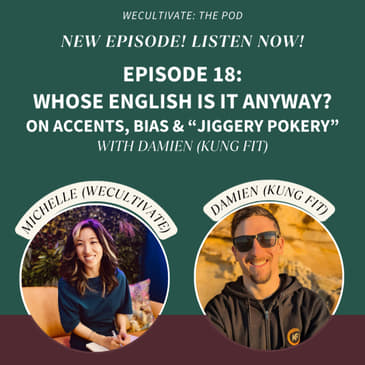



In this episode, Michelle is joined by Damien, a former archaeologist turned pain coach and kung fu teacher, for a rich conversation on the tangled web of English, identity, and global accents.
They explore why sounding “native” is a flawed metric, how accents shape perception and privilege, and why so many learners are pushed toward textbook ideals that ignore linguistic diversity. From RP to Aussie slang to the mystery of “jiggery pokery,” this episode breaks apart the myth of one correct English — and makes space for your own.
“Even if you are both native speakers speaking the same language, you can still say something and be completely misunderstood.”
“Obviously I'm from Britain, I have a British accent, but actually I would say I'm an oddity in the way that I speak, not because the way I speak in itself is very weird, but I've got quite what we'd call an RP or received pronunciation accent. And neither myself nor my family have any idea how I ended up speaking like this.”
“It wasn't until a couple of other people said, oh yeah, that's definitely a word. She was like, okay, well, I have never heard this in all of my years. And so who's right at that point? What is real English? You probably wouldn't find that in the dictionary, but it's still a valid way of communicating within the English language.”
“Be nice. Don't judge people for their accents, whether in a positive or a negative light. I think it's fair to say that there is no one right way of doing things and just accept everyone for what they are and don't feel like you aren't speaking English well enough because most British people cannot speak your language at all.”
Main Topics Covered:
Accent and Identity: Damien reflects on growing up with an unexpected RP accent, the assumptions people made about him, and how accent influences perception across the UK and beyond.
Language and Bias: Michelle and Damien unpack how certain Englishes are positioned as more “correct” or prestigious, and the subtle biases that show up in global communication.
Regional and Global English: From Dorset to Sydney to Shanghai, the episode explores how English changes across borders—and why no single version can claim authority.
Professional Journey: Damien shares his shift from archaeology to pain coaching, and how language continues to play a role in his life, teaching, and everyday interactions.
Cultural Expectations and Belonging: The conversation dives into how people define themselves nationally and linguistically, and how those labels can feel both useful and limiting.
Actionable Advice:
Stop apologizing for your accent.
Your voice is shaped by your history. Clear communication matters more than sounding “native.”Expose yourself to different varieties of English.
Listen to podcasts, watch media, or follow creators from different English-speaking countries (and regions) to expand your ear and reduce accent bias.Ask for clarification without shame—and offer it without judgment.
Misunderstandings happen, even between native speakers. Normalize asking: “Can you rephrase that?”Reflect on your own language assumptions.
What accents do you associate with being smart, funny, or trustworthy? Question where those ideas came from.Resist rigid language goals.
Instead of chasing one idealized accent or vocabulary set, focus on how you want to be understood and who you want to connect with.
Related Resources
Below, you'll find a few links tied to the topics we discuss in this episode. WeCultivate does not unequivocally endorse the material or its creators beyond a cursory review of the material presented. They have been shared here to encourage further exploration and independent learning. This is a dynamic list and subject to updates as time goes on. If any of the links become broken, or if you have a suggestion for the list, please let us know. Thanks!
On "Native" English Accents
Exploring 12 Unique English Accents Around the World (By Stefani Drumeva / SPEAK)
“How many English accents do you think exist? The answer might surprise you. With over 1.5 billion English speakers worldwide, the diversity of accents within this language is astonishing. English has over 160 recognised accents worldwide, ranging from the various tones of the United Kingdom to the complex rhythms of Africa, Asia, North America, and beyond. Therefore, when you hear English, you are not just hearing words; you are hearing a mix of sound and style that tell a story about where it is spoken. In this article, we’ll explore 12 distinct English accents that show this incredible linguistic diversity.”
https://blog.speak.social/exploring-12-unique-english-accents-around-the-world/International Dialects of English Archive (IDEA: Official Site)
Listen to recordings from 135 countries and territories from native speakers all around the world.
https://www.dialectsarchive.com/The English Language in 65 Accents (The New Travel / YouTube)
“A collection of English accents that I filmed in interviews, between 2019 - 2024.”
https://www.youtube.com/watch?v=UZuHE9m3a8Y
On "Native Speaker" Misconceptions
“Native speaker” is not a qualification (By Anna Aleksenko / LinkedIn)
"And yet… if I got paid every time I see “native teacher” mentioned like it’s an ultimate badge of quality, I’d probably be a millionaire by now. I know in my bubble it feels crystal clear — but outside of it, the myth is still alive and well.”
https://www.linkedin.com/posts/annaaleksenko_native-speaker-is-not-a-qualification-activity-7322888627238199296-L17Q“🗣️ Let's set the record straight about the CEFR (By Frank C. / LinkedIn)
“The Common European Framework of Reference for Languages (CEFR) was designed to assess language proficiency objectively. Yet, it's often misused in job listings, equating C2 level with "native-level" proficiency. This conflation is not only inaccurate but also perpetuates exclusionary hiring practices.”
https://www.linkedin.com/posts/frankcarrizozirit_languageeducation-cefr-inclusion-activity-7330982120833617921-U9oHWhat if non-native speaker meant... (By Meri Maroutian / LinkedIn)
“Here is a poem I wrote and revisited just now... “
https://www.linkedin.com/pulse/what-non-native-speaker-meant-meri-maroutian-otjofAddressing objections to my recent blog posts (By Meri Maroutian / LinkedIn)
https://www.linkedin.com/pulse/addressing-objections-my-recent-blog-posts-meri-maroutian-jmx2f
“Since when are all Native Speakers considered to have advanced fluency? I have taught native speakers of English about their own language on various occasions. Advanced speakers do not make up a majority anywhere. We all have to work our way to achieved advanced level in anything. Can we all agree on this? We are constantly pretending that native speaker teachers are the same as any native speaker. They are not.”
Other links recommended by Damien / Mentioned in the Episode
The RP (Received Pronunciation) Accent (Wikipedia)
“Received Pronunciation (RP) is the accent of British English regarded as the standard one, carrying the highest social prestige, since as late as the beginning of the 20th century. It is also commonly referred to as the Queen's English or King's English. The study of RP is concerned only with matters of pronunciation, while other features of standard British English, such as vocabulary, grammar, and style, are not considered.”
https://en.wikipedia.org/wiki/Received_PronunciationHudson's 1960 study: Pictorial Depth Perception in Sub-Cultural Groups in Africa
https://www.tandfonline.com/doi/abs/10.1080/00224545.1960.9922077Pictures used in Hudson's study, freely accessible
https://www.researchgate.net/figure/Drawing-1-top-and-7-bottom-of-the-Hudson-Pictorial-Depth-Perception-Test-Hudson_fig1_325420616The Weather in Accents (By Katia Kvinge / YouTube)
"A humorous and parodied look at the different ways one might describe weather across different regions and cities of the United Kingdom."
https://youtu.be/0AiAaybzd0Y?si=Hw90WS_QGoWN0O9UJimmy's Guide To Accents (By Jimmy Carr / YouTube)
"To get better at being a comedian, Jimmy thought it would be a good idea to improve his regional accents."
https://youtu.be/Q92-tiNtw8A?si=e4VOKfF2FNs3_74H