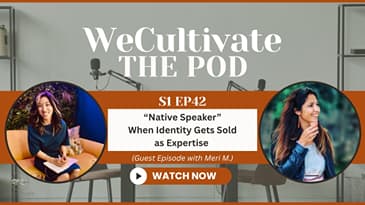
When did being a “native speaker” become a qualification?
In language education, the label has long carried assumptions about fluency, credibility, pronunciation, cultural knowledge, and even teaching ability. But what happens when an identity category gets treated as evidence of expertise?
In this episode of WeCultivate: The Pod, Michelle speaks with English language teacher and educator Meri Maroutian about native speakerism, accent bias, multilingualism, and the hierarchies that shape whose language is considered legitimate.
Drawing from Meri’s multilingual upbringing and professional experience in English language teaching, they examine how the native/non-native binary shows up in hiring, proficiency testing, teacher qualifications, classroom practices, and perceptions of credibility.
They also question what we actually mean by “native speaker” in the first place. Who gets perceived as native? Which accents and varieties are treated as the standard? Why can highly trained multilingual educators continue to be positioned beneath someone whose primary qualification is simply being identified as a native speaker?
In this conversation we break down:
• Native speakerism and the language-teaching industry
• Accent bias, race, nationality, and perceived credibility
• Language proficiency vs. teaching expertise
• CEFR levels, testing, and standardized ideas of “correct” language
• Intelligibility and our shared responsibility for understanding
• Multilingualism and linguistic identity
• Colonialism, power, and the global dominance of English
• How language hierarchies get passed to the next generation
• What educators and speakers can do differently
This conversation isn't about whether native speakers have valuable knowledge or experiences. It's about questioning what the label itself is being used to prove.
🎙️ “Native Speaker”: When Identity Gets Sold as Expertise
(with Guest Meri M.)
Subscribe to WeCultivate: The Pod for conversations about language, culture, identity, communication, and the assumptions we rarely stop to question.
Show notes and more at wecultivate.world/podcast