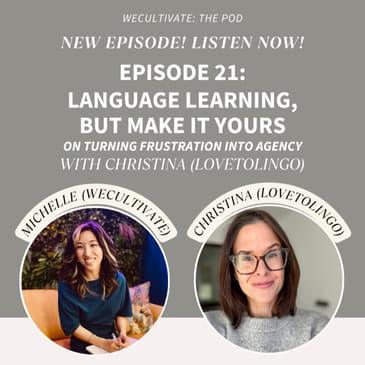



What does it really mean to learn a language—with agency?
In this episode, Michelle is joined by Christina from LoveToLingo, a long-time English teacher and language learner who’s spent over two decades navigating language, culture, and classroom systems. From her early years studying French to building a new life in Spain, Christina shares what she’s learned about language learning beyond the textbook—and why one-size-fits-all approaches rarely work.
Together, they unpack the hidden challenges of global English, how fluency often gets mistaken for intelligence, and the real reasons many learners feel stuck (hint: it’s not about grammar). They also dig into writing as a cognitive tool, the limits of traditional education, and how learner agency (NOT perfection) is what leads to long-term success.
If you’ve ever questioned the rules you’ve been handed or wondered whether there’s a better way to grow, this episode will give you the clarity and perhaps, the permission, to make language learning yours.
“The problem wasn’t the preposition, of course. It was the fact that she had these limiting beliefs—and she just assumed that everybody thought she was an idiot because she made a mistake in English.”
“Your English level is often seen as a proxy for your status or education level. It’s not just language—it’s perception.”
“Once you understand the concept of it, then you just apply it. But if you’ve never had to learn it as a concept, it’s a totally different process.”
“We don’t have cultural hegemony anymore—everyone’s working with different values, and that makes teaching a lot more complex.”
Main Topics Covered:
Why Language Learning Isn’t Linear
We talk about what it means to feel “stuck,” how fluency evolves over time, and why traditional education often misses the real work of learning.Cultural Friction vs. Cultural Fit
France and Spain offered very different integration experiences—Christina explains about how culture impacts connection, confidence, and communication.Writing as a Learning Tool, Not a Test
Whether you're journaling or drafting practice emails, writing gives you the space to clarify thoughts, build range, and notice patterns you miss while speaking.Language as Agency, Not Just Achievement
We unpack the myth of the “right” method and talk about how your goals, environment, and choices shape your language journey.
Actionable Advice:
Clarify Why You’re Learning
What’s your actual goal—social ease? career growth? cultural connection? Define your “why” so your strategies stay aligned.Use Writing to Strengthen Thinking
Don’t wait until you “need” to write something. Use writing to reflect, experiment, and stretch your range regularly.Watch the Narratives You Inherit
Just because you didn’t learn a language “the right way” doesn’t mean you failed. Ditch the shame. Rewrite the story.Build Your Own Framework
Borrow ideas, not identities. Someone else’s strategy might inspire you—but your brain needs its own blueprint.Practice Where the Stakes Are Low
Fluency builds in safe spaces. Make room to try, to mess up, to test things out. That’s real growth.
Related Resources
Below, you'll find a few links tied to the topics we discuss in this episode. WeCultivate does not unequivocally endorse the material or its creators beyond a cursory review of the material presented. They have been shared here to encourage further exploration and independent learning. This is a dynamic list and subject to updates as time goes on. If any of the links become broken, or if you have a suggestion for the list, please let us know. Thanks!
On English Language/Education in Spain
English in Spain: Education, attitudes and native-speakerism (Llurda & Mocanu, 2024 / World Englishes: Volume 43, Issue 2, Special Issue: ENGLISH IN EUROPE, Pages 315-331)
"Spain has traditionally featured rather low in the rankings measuring the knowledge of English by European citizens, and yet English has been constantly entering different areas of Spanish life and in all levels of education. This article delves into the efforts made at different levels of education to enable school graduates to communicate in English without difficulty. It focuses on how young people conceptualise English: their attitudes towards the language and to what extent they associate it with Inner Circle countries, or whether instead they see it as a tool for international communication."The Status of English in Spain (Juan-Pedro Rica-Peromingo, 2012 / International Corpus of Learner English, Version 2. (pp.168-174))
“Apart from these native languages, Spanish schools promote foreign language learning at all educational levels. While in the past, French was the most widely taught foreign language, today English as a foreign language (EFL) has undoubtedly gained the first position, as an obligatory subject from the third grade in primary school all the way through secondary school. The use of English is also common in professional circles. The awareness of the fact that English is an international language is at the root of this shift. It is also the reason why English is included in the national curriculum.”Identity and standards for English as a European Union lingua franca (By Marko Modiano / World Englishes: Volume 43, Issue 2, Special Issue: ENGLISH IN EUROPE, Pages 210-227)
“This article addresses, from an applied linguistics perspective, the position English maintains among the myriad of languages spoken in the European Union (EU). The linguistic make-up of EU society, as well as the language policy of the Union, is scrutinised. The role English is playing in European unification is also important for the discussion, as is the call for a re-evaluation of the norms deployed in English language teaching.”
On Cultivating Learner Agency
How to Cultivate Learner Agency (By Katie Novak / Novak Education)
“As educators, we play a pivotal role in cultivating learner agency. We are no longer simply dispensers of knowledge but guides and facilitators who create conditions that empower students to become active learners. As we look to make real change and empower and engage our learners, below are four ways to build learner agency in the classroom”Teacher Moves That Cultivate Learner Agency (By Paul Emerich France / Edutopia)
“Helping students become independent, questioning thinkers begins with stepping back and guiding them to take the lead in their learning.”What is Learner Agency? (By Michigan Assessment Consortium / ALN)
"Learner agency is a term that captures the important goal of students being active learners who can make choices and take actions to fully participate in their learning communities. Learners need opportunities to realize that they can make good things happen while they are in school; they need not wait until after graduation."